
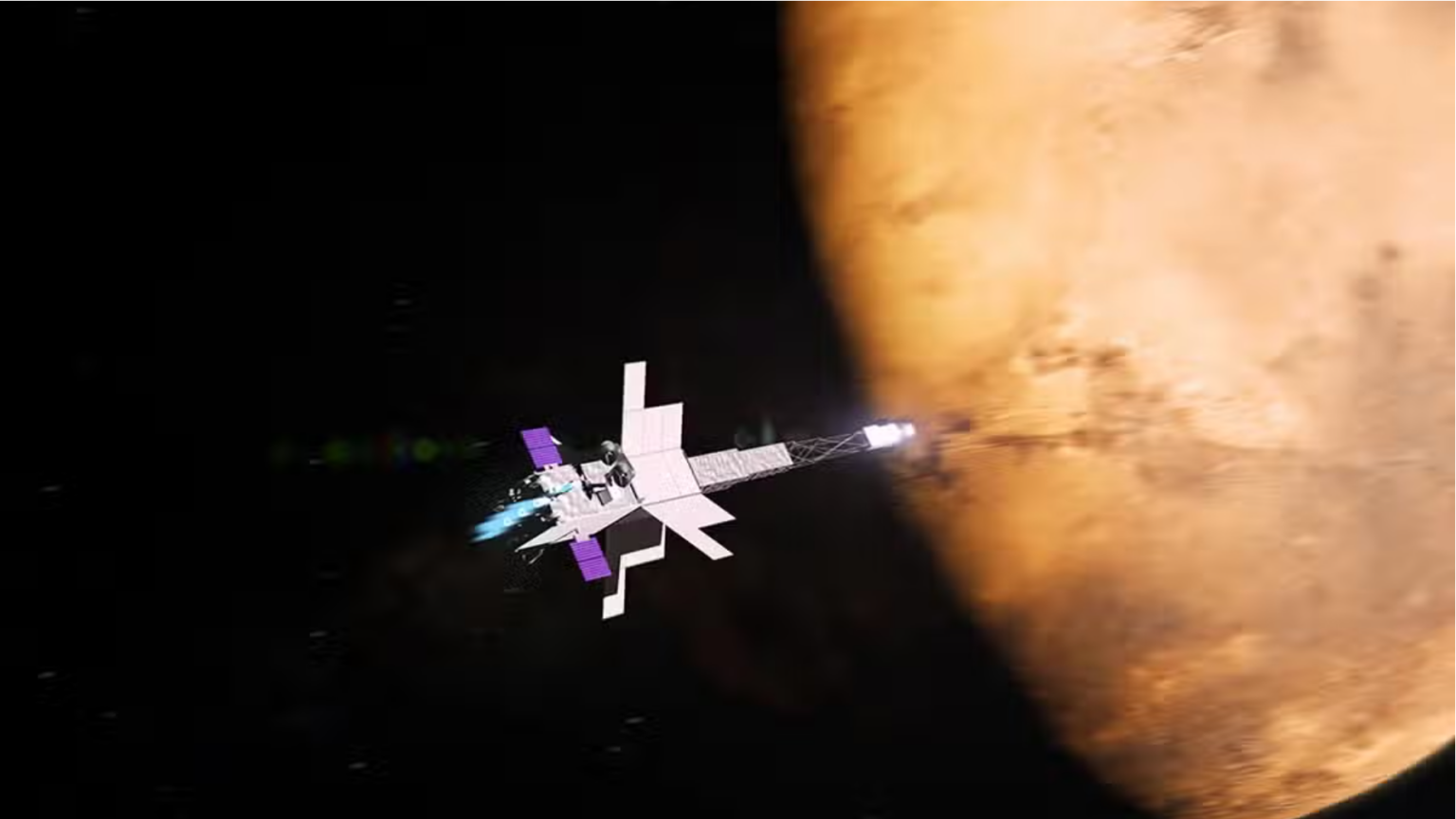
For years, nuclear propulsion sat in the same category as so many ambitious space ideas, impressive on paper, always a few steps away from reality.
Now NASA says that changes in 2028.
The agency plans to launch Space Reactor-1 Freedom, or SR-1 Freedom, before the end of that year on a mission to Mars called Skyfall. NASA describes it as the first nuclear-powered interplanetary spacecraft. The mission will carry three small helicopters meant to explore a possible human landing site on the Martian surface. Yet the most important payload may be the machine pushing the spacecraft there.
At the center of the mission is a fission reactor tied to a propulsion system called nuclear electric propulsion, or NEP. Instead of relying on sunlight, the reactor generates heat, that heat becomes electricity, and the electricity powers highly efficient electric thrusters. In practical terms, that gives a spacecraft a steady way to move through deep space without depending on large solar arrays.
Space Reactor-1 Freedom key systems at a glance (notional concept). (CREDIT: NASA)
That matters because Mars is only part of the story.
More than another Mars mission
NASA presented the Skyfall announcement during an event called Ignition, where the agency also laid out a broader shift in exploration plans. The reactor mission stood out because it was not framed as a one-off experiment. NASA cast it as a turning point, both for propulsion and for the way future missions may be built.
The agency said SR-1 Freedom will “establish flight-heritage nuclear hardware, set regulatory and launch precedent, and activate the industrial base for future fission power systems across propulsion, surface and long-duration missions.”
That statement carries a lot of weight. NASA is not just sending a spacecraft to Mars. It is trying to prove that nuclear systems can move from study documents and engineering proposals into regular use.
The distinction between this system and older nuclear power sources in space is important. Probes such as Voyager used radioisotope thermoelectric generators, which turn heat from radioactive decay into electricity for onboard instruments. Those systems provide power, but they do not propel a spacecraft. Nuclear electric propulsion does. It is an active drive system, and unlike solar panels, it can keep working no matter how far a mission travels from the sun.
That makes it especially appealing for the outer solar system, where sunlight grows weak and the power demands of serious exploration rise fast.
Three helicopters, one landing site
Skyfall is not only about propulsion. Once SR-1 Freedom reaches Mars, it will release a trio of helicopters modeled on Ingenuity, the small aircraft that arrived with the Perseverance rover in February 2021.
An updated render of the Dragonfly spacecraft. (CREDIT: NASA/Johns Hopkins APL/Steve Gribben)
Ingenuity was built to prove powered flight could work on another planet. It ended up flying 72 times before operations concluded in January 2024. The new helicopters will head to Mars with a narrower task.
They are meant to scout a possible landing site for future astronauts.
Using cameras and ground-penetrating radar, the aircraft will map the terrain, look for hazards, and examine subsurface water ice. That last goal could prove especially valuable. If humans are ever going to work for long periods on the Martian surface, water ice is not just a scientific target. It is a survival issue, tied to drinking water, fuel production, and day-to-day operations.
“They will also map and characterize the subsurface water ice to find out where the water ice deposits are, along with the size, depth and other important characteristics,” said Steve Sinacore, program executive for NASA’s Space Reactors Office.
If the current schedule holds, the spacecraft will launch in December 2028 and arrive at Mars about a year later. After releasing the helicopters, NASA says the vehicle may continue farther into the solar system, although that part of the plan has not yet been finalized.
Even that uncertainty says something useful. NASA appears to be treating SR-1 Freedom as a platform with room to grow, not simply a delivery system for Mars hardware.
NASA is reshuffling its priorities
The Skyfall reveal came alongside a much larger reset inside the agency.
Mars Helicopter Ingenuity on Mars. (CREDIT: NASA)
Among the biggest changes, NASA said it is pausing development of Gateway, the planned moon-orbiting station, and shifting attention toward building a permanent base on the lunar surface. Some Gateway hardware will be reused for that effort.
The moon base plan has three phases. It starts with early infrastructure and small habitats, then expands into semi-permanent facilities with help from international partners including Japan, Italy, and Canada, and eventually aims for continuous human presence on the lunar surface.
NASA Administrator Jared Isaacman described the urgency in blunt terms: “The clock is running in this great-power competition, and success or failure will be measured in months, not years.”
That line helps explain the mood around the announcement. NASA is not presenting these plans as distant aspirations. It is talking about speed, competition, and visible progress.
The agency also said it is exploring a new path for life after the International Space Station. Rather than risking a gap in U.S. human presence in low Earth orbit, NASA is studying a plan that would attach a government-owned core module to the station and then add commercial modules over time. Those commercial pieces could later separate and operate on their own. An industry request for information opened March 25.
A busy slate beyond Skyfall
Skyfall was not the only science mission highlighted.
NASA said Dragonfly, a nuclear-powered octocopter bound for Titan, remains on track for launch in 2028 and arrival in 2034. Its destination, Saturn’s moon Titan, is known for an environment rich in organic material, making it one of the more intriguing places in the solar system for this kind of exploration.
Artist’s concept of Phase 3 of NASA’s Moon Base. SR-1 Freedom will activate the industrial base for future fission power systems across propulsion, surface and long-duration missions. (CREDIT: NASA)
The agency also confirmed that it will deliver the European Space Agency’s Rosalind Franklin Rover to Mars in 2028. That rover will carry a mass spectrometer meant to search for organic matter.
Closer to home, the Nancy Grace Roman Space Telescope could launch as early as this fall. Its mission centers on dark energy. NASA also pointed to a new Earth science mission scheduled for next year that will measure the internal dynamics of convective storms in real time. The goal is to improve extreme weather prediction by up to six hours before an event.
Then there is the moon. NASA said it plans to expand its Commercial Lunar Payload Services program, aiming for up to 30 robotic lunar landings starting in 2027. The payloads will be open to industry, academic groups, and international partners.
Taken together, the list paints a picture of an agency trying to push several fronts at once, Mars, the moon, low Earth orbit, planetary science, and Earth science, while also reworking the tools needed to support those efforts.
Why the reactor may matter most
The practical importance of SR-1 Freedom sits well beyond the helicopters it will carry.
Nuclear electric propulsion could make deep-space cargo transport far more efficient than current options. For missions headed toward Jupiter or farther, NASA says it becomes the only workable choice for high-power spacecraft because solar arrays cannot provide enough energy at those distances.
That gives the reactor mission a different status from a normal science flight. It is not just trying to answer questions about Mars. It is trying to solve a transportation problem that has held back more ambitious missions for years.
A spacecraft that can generate its own propulsion power independent of sunlight changes design choices across the board. It opens room for heavier payloads, supports missions with larger power demands, and helps create the rules and supply chains needed to make future nuclear systems less exceptional and more routine.
NASA’s own description makes that clear. The mission is meant to build launch precedent, regulatory precedent, and industrial capacity, not only gather data.
In other words, SR-1 Freedom is being asked to do more than reach Mars. It is supposed to make later nuclear missions easier to approve, easier to build, and easier to fly.
That is a much bigger job than dropping off three helicopters.
Practical implications of the research
If NASA pulls this off, the effect could spread across much of its long-range planning.
A successful NEP mission would give future Mars efforts a stronger way to move large cargo. It could support robotic expeditions deeper into the solar system, where solar power loses its usefulness. It could also help sustain high-power systems on long missions and support surface operations that need steady energy over long periods.
The helicopters in Skyfall will search for a safe place to land and study the water ice buried below the ground. The reactor behind them could answer a different question, one that reaches far past a single mission: whether deep-space travel can finally move beyond the limits that have kept nuclear propulsion on the drawing board for so long.
Related Stories