
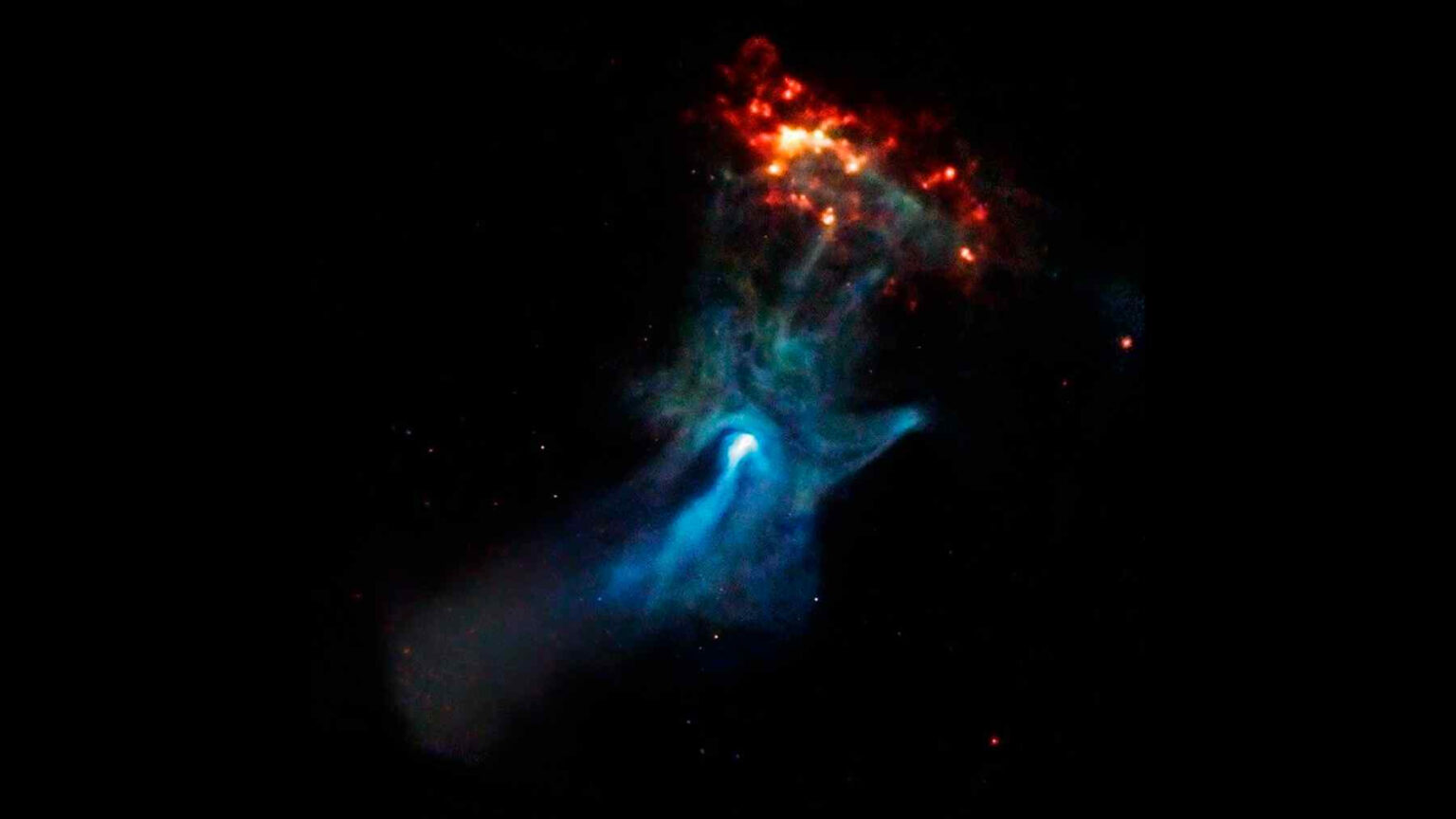
It looks almost intentional.
A giant hand, stretching across space. Fingers extended. A glowing palm at its center.
At first glance, it feels like an illusion—something your brain is trying to make sense of in the chaos of the cosmos.
But this shape is real.
And when NASA looked closer, they realized something inside it was moving with extreme force.
Spinning. Constantly. Powering everything around it.
So what exactly is this “hand” in deep space?
How NASA first detected the strange shape
The object was first captured by NASA’s Chandra X-ray Observatory.
From 17,000 light-years away, it appeared as a glowing cloud of energy, spread across nearly 150 light-years of space.
Different wavelengths revealed different colors—blue, green, red—forming a structure that looked unmistakably like a human hand.
A palm at the center.
Fingers stretching outward.
It wasn’t just visually striking.
It was active.
Energy was radiating from within it, suggesting something powerful at its core.
And that’s where scientists focused their attention.
A massive structure powered by something incredibly small
At the center of this enormous “hand” is something almost impossible to reconcile with its size.
An object only about 12 miles wide.
That’s smaller than many cities on Earth.
Yet it’s controlling a structure that spans light-years.
That contradiction raised the biggest question.
How can something so small shape something so vast?
The answer came from how it moves.
Because this object isn’t still.
It’s spinning.
The force behind the spinning core
The central object is a neutron star—what remains after a massive star explodes in a supernova.
More specifically, it’s a pulsar.
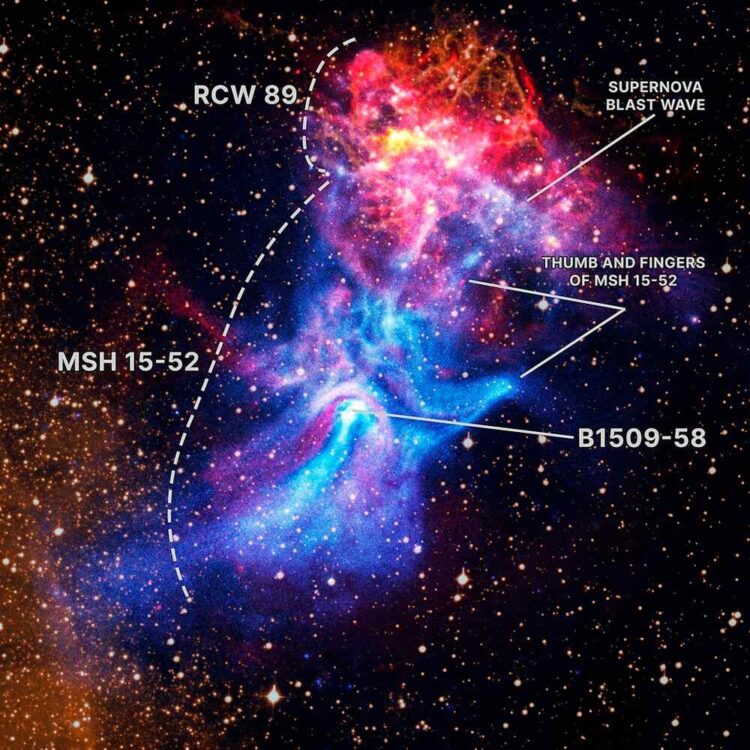 X-Ray and radio image of the pulsar PSR B1509-58 – X-ray: NASA/CXC/Univ. of Hong Kong/S. Zhang et al.; Radio: ATNF/CSIRO/ATCA; H-alpha: UK STFC/Royal Observatory Edinburgh; Image Processing: NASA/CXC/SAO/N. Wolk
Known as PSR B1509-58, it spins around seven times every second.
That speed alone is extreme, says Harvard University.
But what matters even more is what that spinning creates.
According to NASA Science, the pulsar generates an incredibly powerful magnetic field—trillions of times stronger than Earth’s.
As it rotates, it releases streams of charged particles into space.
A constant outflow.
A wind of force and energy.
What the “hand” actually is
The hand-shaped structure is not a solid object.
It’s a pulsar wind nebula.
The streams of charged particles emitted by the spinning neutron star collide with surrounding gas and dust, shaping it over time.
That interaction creates the glowing cloud we see.
The “fingers” are regions where cosmic energy and particles are being pushed outward.
The “palm” is the brightest, most intense area near the pulsar itself.
In other words, the hand is not reaching out.
It’s being sculpted.
Continuously reshaped by an invisible force.
Why scientists are still studying it
Even with this explanation, not everything is clear.
The exact reason the structure takes on such a defined, hand-like shape is still being studied.
There are models. Theories about magnetic fields, particle flows, and surrounding material.
But no single answer explains every detail.
That’s why NASA keeps returning to it.
Because objects like this are not just visually unusual.
They reveal how extreme physics works in environments we cannot replicate.
A glimpse into forces we barely understand
This “hand” is more than a cosmic coincidence.
It’s evidence of how powerful neutron stars can be.
Tiny remnants of dead stars, acting like engines that shape entire regions of space.
It challenges how we think about size, power, and influence in the universe.
Because here, something the size of a city is controlling a structure larger than anything we can truly imagine.
And it’s doing so through motion, magnetism, and energy we’re still trying to fully understand.
Which is why, even now, that glowing hand remains more than just a shape in space.
It’s a question—still reaching for an answer.