
MITCHELL — Before she was teaching NASA astronauts how to capture the moon during a high-speed flyby, Katrina Willoughby’s photography journey began in a garden in Mitchell, armed with a cheap, plastic 110 film camera.
Back then, she was a kid snapping pictures for 4-H projects, documenting the world around her one frame at a time.
Now, her “students” are orbiting Earth at 17,400 miles per hour, and she is teaching them how to bend the rules of photography to document humanity’s return to deep space.
A 2000 graduate of Mitchell High School, Willoughby now serves as a flight operations intravehicular activity imagery expert, working as a contractor with NASA through KBR in Houston, Texas. Her role centers on preparing astronauts for the challenges of space photography — work that proved critical for the Artemis II mission, which sent a crew around the moon this year for the first time in more than 50 years.
From navigating extreme, multidirectional lighting to operating complex camera systems in confined spacecraft, Willoughby ensures astronauts can capture both scientific data and historic imagery in an unforgiving environment.
Growing up in Mitchell, Willoughby spent much of her time outdoors with her family, gardening and exploring. That environment naturally led her to photography. Starting with basic film cameras, she documented everyday moments and 4-H projects, gradually building an interest that would shape her future.
Local educators helped turn that interest into a skillset. As a fifth grader, she was introduced to early photography concepts, including darkroom techniques. At Mitchell High School, she pursued an independent study when formal classes weren’t available, learning how to load film and develop black-and-white images.
That hands-on experience led her to the Rochester Institute of Technology (RIT) in New York, where she earned a Bachelor of Science in Imaging and Photographic Technology, focusing on the science behind photography as much as the art.

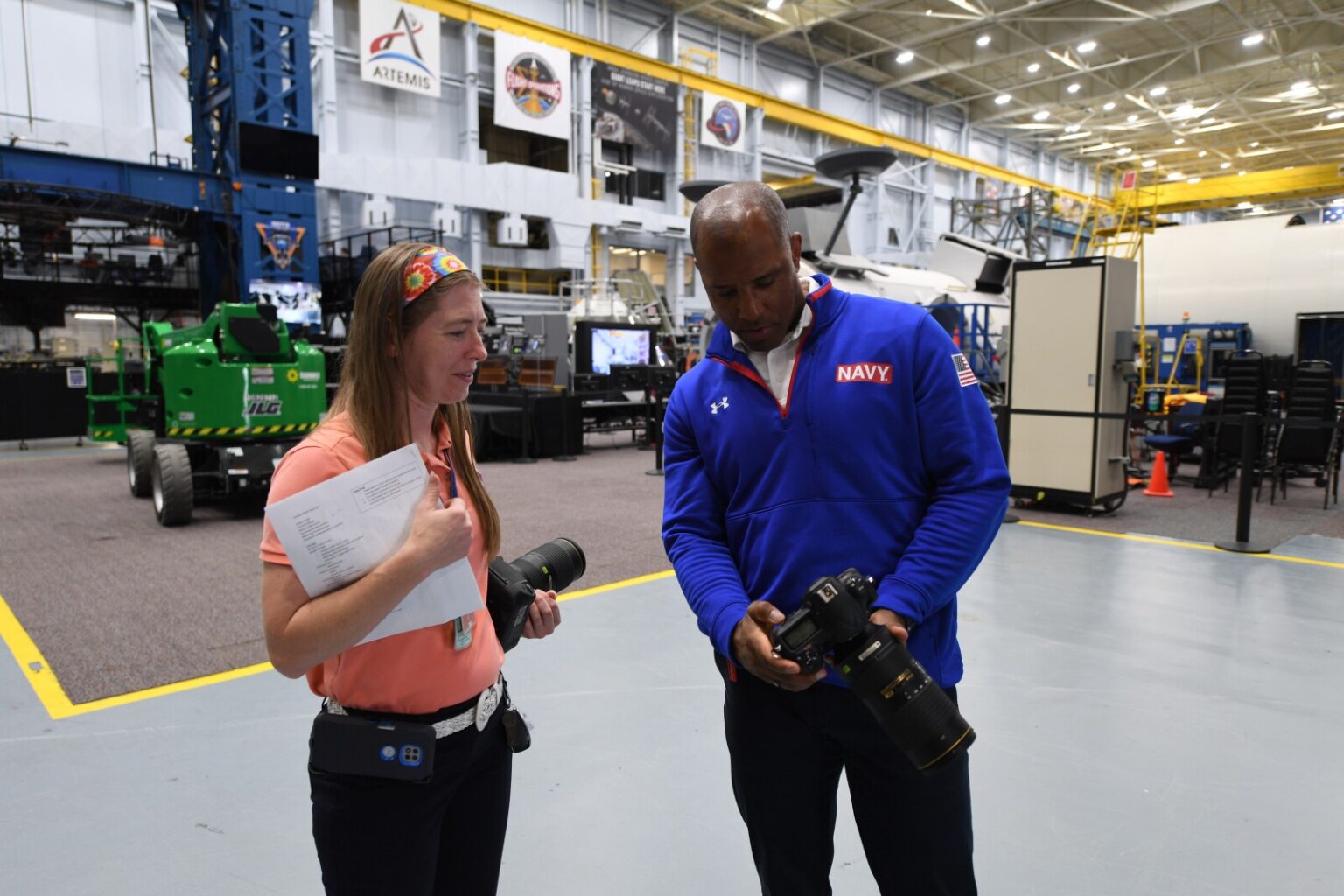
Katrina Willoughby, back center, stands with the Artemis II crew after completing imagery training.
Photo courtesy of NASA
At first, her goal was to become a National Geographic photographer. But as the industry shifted, she adjusted her expectations and cast a wide net after graduation.
“I put in 100 applications and I got one job offer,” Willoughby said. “But that was the one that mattered.”
That offer came through an RIT alumnus who shared a NASA-related job opening. Willoughby applied, landed the interview and moved to Houston, beginning what has become a career spanning more than two decades. She has worked exclusively with NASA since 2004.
Her early years supporting the International Space Station required her to master complex camera systems while learning to teach astronauts with widely varying levels of photography experience. That blend of technical knowledge and instruction now defines her role with the Artemis program.
Training astronauts for deep-space missions is far from a typical photography class. Astronauts learn everything from the basics — shutter speed, aperture and ISO — to advanced techniques tailored for space.
“One of the biggest challenges is lighting,” Willoughby said. “Here, we’re used to light coming from above. In space, it can come from any direction, and that changes everything.”
To prepare for those conditions, Willoughby and her colleagues design multi-year training programs that combine classroom instruction with hands-on simulations inside spacecraft mock-ups that replicate real missions. Astronauts practice working in tight quarters, managing reflections, coordinating with crewmates and using techniques like “focus, frame, fire” to rely on their surroundings as much as the camera itself.
“You have to think about everything happening around you, not just the camera,” Willoughby said.
The Artemis II crew trained for roughly two years on photography, completing about 20 hours of mission-specific instruction. They learned how to operate multiple camera systems, manage files and adapt to the extreme contrast between bright sunlight and deep shadow.

The shadow of Katrina Willoughby shows her handing off a camera during a nighttime training run simulating a spacewalk.
Photo courtesy of NASA
Camera selection for the mission reflected those challenges. Rather than choosing the newest technology, NASA prioritized reliability and performance. The crew relied heavily on Nikon D5 cameras, valued for their durability and strong low-light capabilities, along with lenses suited for both interior shots and long-distance views of Earth and the moon.
Even with the right equipment, another challenge shaped the mission: bandwidth.
Unlike the International Space Station, where astronauts can quickly send large volumes of images to Earth, deep-space missions like Artemis II operate with limited data capacity, requiring astronauts to actively manage files and select only the most important images to transmit while leaving others onboard. Video is typically recorded in high definition to reduce file size, and even then, transmitting a single image can take several minutes.
That preparation paid off during the nine-day mission, when astronauts documented their journey around the moon. Willoughby remained on the ground as part of the support team, helping troubleshoot equipment issues, answer questions and ensure critical photos were captured.
“We don’t get any telemetry from the camera unless they send us the image,” she said. “So they have to be able to explain what they’re seeing and work through problems.”
Even with those constraints, the imagery from Artemis II exceeded expectations.
From mission control in Houston, Willoughby watched as photos came in, including a striking and unexpected image of the moon. During the flyby, astronauts captured the dark lunar surface encircled by a ring of sunlight — a rare visual that wasn’t fully anticipated.
“Nobody really expected that,” she said. “Seeing that light wrapping all the way around the moon was incredible.”
Moments like that underscore the importance of her work. In space missions, there are rarely second chances to capture an image. The photos not only support scientific research but also shape how the public experiences space exploration.
For Willoughby, that is what makes the job meaningful. It is, she said, the privilege of a lifetime to know she played a role in capturing some of the most significant images of the decade.
Back home, her family has followed that journey with pride. Her mother, Lori Willoughby, said her daughter has always been matter-of-fact about her work, even as its impact has grown.
“Sometimes it’s hard to see her excitement, but it’s starting to show through,” she said. “We’re just in awe of what she does.”
Even as Artemis II marks a major milestone, Katrina Willoughby is already looking ahead. Future missions, including Artemis IV and beyond, will introduce new challenges. Unlike the lunar flyby of Artemis II, upcoming missions are expected to involve longer operations around the moon and spacewalks. Astronauts will need to take photos both inside and outside the spacecraft, often while wearing bulky spacesuits.
That shift is forcing her team to rethink everything from camera design to training methods. They are developing new systems, including the Human Universal Lunar Camera, designed to withstand the harsh conditions of spacewalks and the lunar surface, while training evolves to include more complex lighting scenarios and hands-on practice with equipment built for extreme environments.
Back in Mitchell, her story continues to resonate.
“There are so many options out there,” Willoughby said. “You don’t know how much you don’t know, and that’s okay. You’re going to stumble through it and learn as you go.”
Even while working on one of NASA’s biggest programs, her advice back home is simple.
“I just encourage everybody to find what makes them happy in life,” she said.