
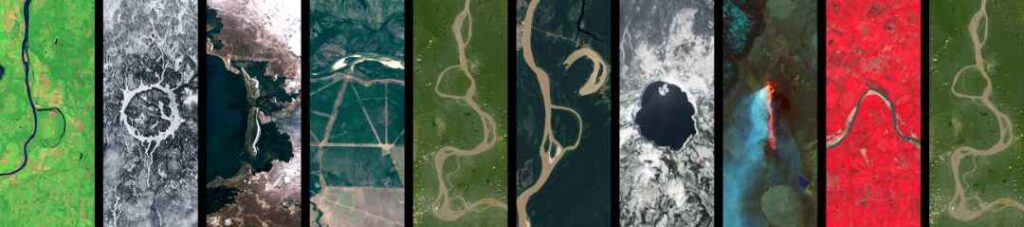
Landsat, a joint program between NASA and the United States Geological Survey (USGS), has been continuously collecting satellite images of the Earth since 1972. NASA’s “Your Name in Landsat” site lets users spell out their names using images from among the millions collected since the program’s inception.
Repeated letters use different images, but the same images are always used, so there is only one possible combination of images for each set of letters. The resulting image can be saved or shared via a link or QR code. Hovering over or clicking on an individual image reveals the name and GPS coordinates of the location featured in the image.
Of the eight Landsat satellites successfully launched, one failed to reach orbit, and two are still active. The satellites capture data across multiple spectral bands, including visible, near-infrared, shortwave-infrared, and thermal-infrared. The decades of images allow researchers to track changes over time, such as the disappearance of the Aral Sea and volcanic activity beneath Yellowstone National Park. Images are freely available on the USGS’s “EarthExplorer” site.
Previously:
• Satellites trace the appearance of crop circles in Saudi Arabia
• Watch a river change its path over the years
• Here’s what that huge fire in Alaska looks like from a NASA satellite