
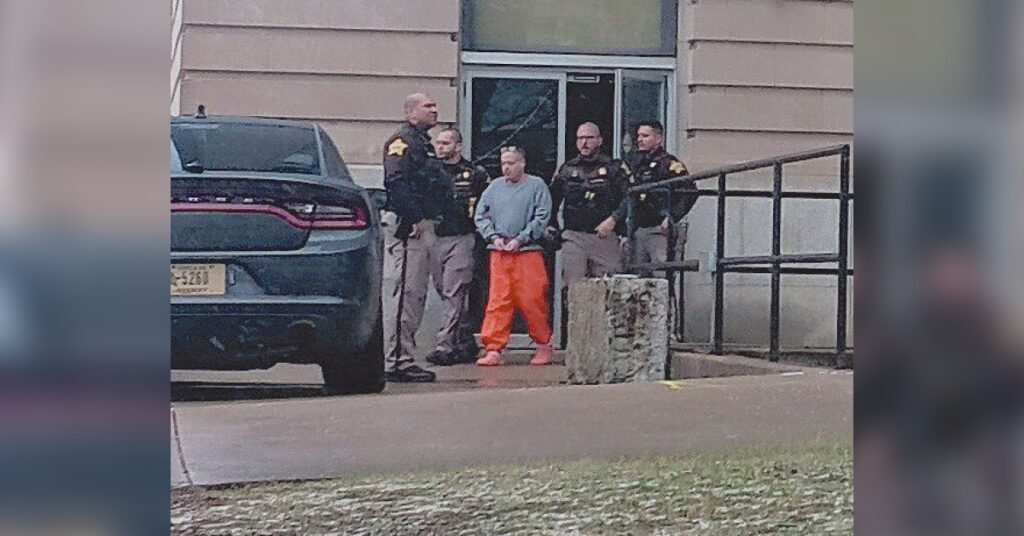
Richard Allen is led from the Carroll County Courthouse by sheriff’s deputies following his Dec. 20, 2024, sentencing hearing. Comet file photo
Richard Allen’s attorneys say his murder conviction should be reversed, arguing in a reply brief the trial court
made multiple errors involving search evidence, confessions and the defense’s ability to present its case.
The filing, submitted Monday to the Indiana Court of Appeals, responds to the state’s arguments and urges the
court to overturn Allen’s conviction or send the case back for further proceedings.
Allen’s attorneys also filed a motion Monday requesting oral argument in the case, citing its complexity and
constitutional significance. Attorneys Stacy Uliana and Mark Leeman said the case includes 22 volumes of
transcripts, 15 volumes of electronic exhibits and multiple volumes of conventional exhibits, making in-person
argument important for clarifying the issues.
The attorneys also argue the appeal raises an issue of first impression — whether statements made during a
psychotic episode allegedly caused by prolonged solitary confinement were voluntary and admissible.
The motion further states the case involves significant constitutional questions, including the right to present a
defense. The appellate court has not yet ruled on the request.
Allen was convicted in November 2024 in Carroll Circuit Court in the murders of Delphi teens Abigail Williams
and Liberty German and was sentenced the following month to 130 years in prison. His appeal challenges several
trial rulings, including the admission of evidence and statements.
In the reply, Uliana and Leeman argue the trial court “committed reversible error” in several key rulings they say
undermined the fairness of the trial.
Search warrant challenge
A central claim in the appeal focuses on the search warrant used in the investigation. The defense argues the
warrant affidavit contained false statements and omitted information that could have weakened probable cause.
Specifically, attorneys contend investigators misrepresented witness statements and excluded descriptions that did
not match Allen while emphasizing those that did. Without those alleged inaccuracies and omissions, the defense
argues, probable cause “evaporates.”
They also argue the trial court erred by denying a hearing under Franks v. Delaware, which allows defendants to
challenge the validity of a search warrant when false or misleading information is alleged.
Confessions and confinement
The reply brief also challenges the admission of Allen’s confessions, arguing they were involuntary and the result
of prolonged solitary confinement.
According to the filing, Allen was held in maximum-security conditions for more than a year and experienced
mental deterioration. The defense argues the state failed to prove the statements were voluntary and instead
“benefited from confessions obtained under these conditions.”
Attorneys argue coercion can occur outside traditional police interrogation and say the circumstances of Allen’s
confinement, combined with his mental health, rendered his statements unreliable.
Right to present a defense
The defense further argues Allen was denied his constitutional right to present a complete defense.
The brief cites several categories of excluded evidence, including a composite sketch of a suspect, expert
testimony and evidence related to alternative suspects.
“The jury never saw the sketch of Bridge Guy that clearly was not Allen,” attorneys wrote in the reply.
The attorneys argue those exclusions prevented the jury from hearing information that could have supported
Allen’s claim of innocence.
The filing also criticizes the state’s investigation, arguing it had “tunnel vision” on Allen and overlooked or failed
to pursue other leads.
Harmless error disputed
In their appellee brief, prosecutors argued the evidence against Allen was overwhelming and that any errors at trial
were harmless.
In the reply brief, Allen’s attorneys dispute that, pointing to the prosecution’s reliance on Allen’s statements at trial
and arguing those statements played a significant role in the conviction.
Attorneys argue the jury “never got to hear” evidence they say would have undermined the reliability of those
statements, including what they describe as Allen’s “tangential, pressured and delusional speech.”
They also contend the jury was misled by testimony about the timeline of events. According to the filing, the state
was able to present a cohesive timeline only because the defense was limited in challenging key pieces of evidence,
including witness accounts, phone data and forensic findings. “If even one of these is wrong, the State’s entire timeline unravels,” attorneys wrote, arguing the jury was presented with a one-sided version of the case.
The defense argues the case presented to the jury was incomplete, describing a “one-sided story” in which
evidence that could have challenged the state’s theory, including questions about forensic evidence and Allen’s
mental state, was excluded.
“The only way our justice system works is if the jury hears the full truth,” the brief states. “Because the jury only
heard half of the story, Allen was denied a fair trial.” Citing Chapman v. California, the attorneys argue the state has not shown beyond a reasonable doubt that the
alleged errors did not contribute to the verdict.