
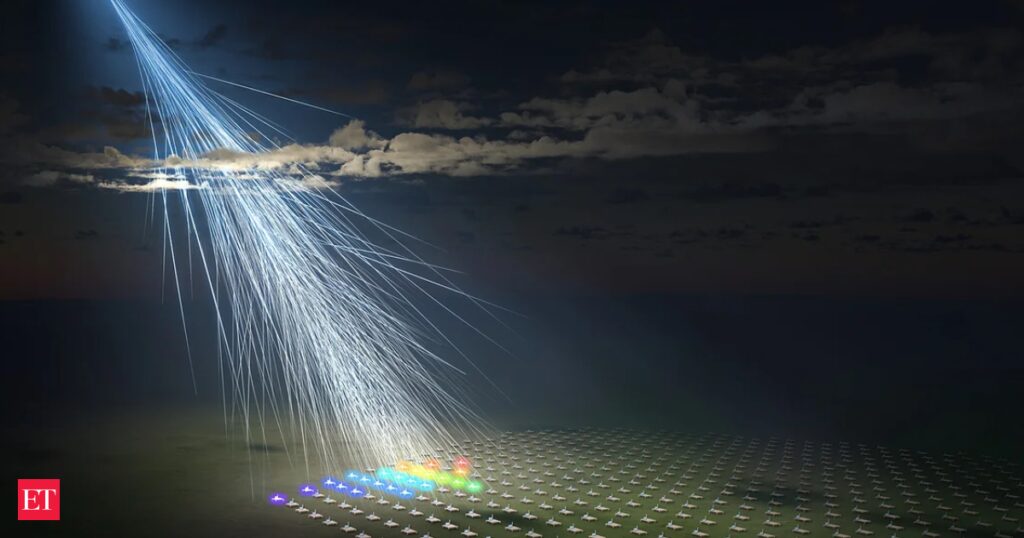
Researchers in 2021 spotted one of the strongest particles to ever hit Earth this event instantly caught all the attention of the world science community. It was named”the “Amaterasu particle” following its Japanese sun goddess awe-inspiring particle had a power level that was far greater than any produced by technology developed by humans, such as that of the Large Hadron Collider. The Amaterasu particle was approximately 40 million times the power than the particles that were accelerated in this massive instrument.
Amaterasu is part of a group of physics that are known as cosmic rays they are charged, highly energetic particles that travel through space at speeds close to that of light. While cosmic rays may not be unique in themselves, the particles that have such extreme energies are extremely uncommon. One event is more remarkable in history, and that is the famed “Oh-My-God” particle that was discovered in the year 1991. These remarkable discoveries are not only scientific curiosity; they offer clues to some of the most destructive and intense processes that occur that exist in the universe.
The Puzzle of the Local Void
The thing that can make the Amaterasu particle so fascinating is its apparent location. The initial observations indicated that it came from the region dubbed the Local Void the Large Void, which is an enormous area of space that has little galaxies, and virtually none of the harsh environments normally involved in the production of high-energy particles. It was a major mystery since scientists think that ultra-high-energy cosmic rays usually originate in extreme cosmic environments like supernova explosions, or nearby supermassive black hole formations at the center of galaxies.
If Amaterasu really came from an inaccessible space, it would be a challenge to the theories that exist about the way and how these particles get their energy. In reality, the Local Void simply lacks the type of energy activity needed to propel particles towards such massive energy levels.
 Live Events
A New Study Offers Fresh InsightThe most recent research study, titled “Tracing the Origins Ultra-High Energy Cosmic Rays using Data-Driven Methods” done by the Max Planck Institute for Physics and Astrophysics, provides an intriguing fresh viewpoint. The researchers Francesca Capel and Nadine Bourriche utilized a unique statistical technique to examine the possibility of the causes that could be the source of Amaterasu particle.
The research suggests that the particle might not originate from the Local Void after all. It could have come from a much more active close cosmic area. One of the most likely candidates identified by their research is the galaxy that forms stars Messier 82, also known as M82. This galaxy is famous for its powerful stars and its energy-intensive processes. This makes it an ideal candidate for an extremely strong particle.
Following the Particle’s Path
In order to arrive at their conclusion, the scientists employed a sophisticated algorithm for statistical computation that is known as Approximate Bayesian Computation. This method was able to imagine how a powerful particle such as Amaterasu will travel through space, while in the path of field magnetics in the universe. The magnetic fields are able to affect the motions of charged particles. This makes it challenging to determine the origins of these particles directly.
Through comparing the realistic simulations to real observations The team created probability maps that show areas of the most probable source. The maps emphasized the emptyness that is the Local Void and toward more energetic cosmic regions where high energy processes have been observed to take place.
Why It Matters
Finding out the source of ultra-high-energy cosmic rays such as Amaterasu involves much more than resolving a single puzzle. These particles function as natural probes for the extremes of our universe. They offer insights into the ways in which matter may be rapidly accelerated, reaching energies that go far beyond the capabilities of human laboratory experiments.
The results of this research will also aid in improving our knowledge of the cosmic accelerator. In determining the likely source, like active galaxies that form stars Scientists can focus their research and create more precise models of cosmic astrophysical phenomena with high energy.
A Step Closer to Cosmic Truths
The quest to discover the origins of Amaterasu particle reflects the wider desire to better understand the universe on its most basic scale. Although the puzzle isn’t entirely solved, the work carried out by scientists at the Max Planck Institute for Physics is a major step in the right direction. The research demonstrates how cutting-edge methodological approaches based on data are able to illuminate problems that previously seemed out of the reach of.
While scientists continue to study the universe, particles like Amaterasu are bound to remain important messengers carrying information about the most significant events that occur that occur in the universe. Each new discovery helps us get closer to knowing not only what the source of these particles is and what they represent, but also the amazing force that shapes our universe.