
Less than a year after astronomers spotted a mysterious object streaking through the sky, scientists have uncovered new clues about its origins, and they suggest a birthplace far colder than our own solar system.
The object, known as 3I/ATLAS, is only the third known visitor from beyond our solar system ever detected. While its exact origin remains unknown, a new study led by the University of Michigan has revealed that the comet formed in an environment dramatically different from the one that created Earth and its planetary neighbours.
The findings, published in Nature Astronomy, are based on a detailed analysis of the comet’s chemical composition, specifically, its unusually high levels of “heavy water.”
Water molecules typically consist of two hydrogen atoms and one oxygen atom. However, in some cases, hydrogen is replaced by deuterium, a heavier form of hydrogen that contains an additional neutron. This creates what scientists call deuterated or “heavy” water.
Researchers found that 3I/ATLAS contains an extraordinarily high ratio of deuterium compared to ordinary hydrogen, about 30 times higher than any comet observed within our solar system, and nearly 40 times greater than the ratio found in Earth’s oceans.
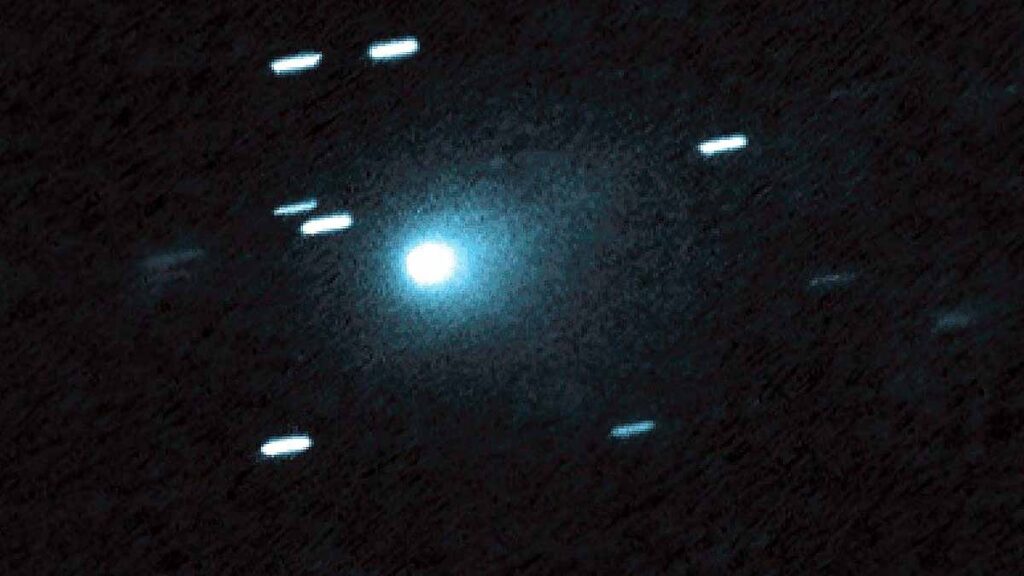
Interstellar comet 3I/Atlas as captured in space. (Photo: Nasa)
“This is unlike anything we’ve seen before,” said lead researcher Luis Salazar Manzano, a doctoral student in astronomy. “It tells us that the conditions where this comet formed were very different from those in our own solar system.”
Scientists use these ratios as cosmic fingerprints, helping them reconstruct the environment in which celestial objects were born. In this case, the high deuterium levels indicate that 3I/ATLAS likely formed in a much colder region of space with lower radiation levels.
“This is proof that the conditions that shaped our solar system are not universal,” said co-author Teresa Paneque-Carreo. “Planetary systems can form in very different environments across the galaxy.”
The breakthrough was made possible by a combination of early detection and advanced telescopes. Initial observations were conducted at the MDM Observatory in Arizona, followed by more detailed analysis using the powerful Atacama Large Millimeter/submillimeter Array (ALMA) in Chile.
ALMA’s sensitivity allowed scientists to distinguish between normal and deuterated water molecules, a first for an interstellar object.
The study marks a significant milestone in astronomy, demonstrating that scientists can now probe the chemistry of objects formed around other stars.
As more interstellar visitors are discovered, researchers hope to build a clearer picture of how planetary systems evolve across the galaxy.
– Ends
Published By:
Sibu Kumar Tripathi
Published On:
Apr 29, 2026 15:18 IST