
We had the distinct pleasure of speaking with legendary science fiction author Alan Dean Foster about his novelisation of Alien: Covenant. Foster is no stranger to the franchise—or to cinematic novelizations in general. Having written the adaptations for Alien, Aliens, and Alien 3, as well as the original Star Wars novelization and Splinter of the Mind’s Eye, Foster’s return to the Alien universe after a 25-year hiatus was highly anticipated.
In this interview, Foster discusses his triumphant return to the series and his candid thoughts on Prometheus. He delves into the challenges of adapting Ridley Scott’s ambitious concepts into scientifically grounded prose, specifically noting how he fixed notable plot holes (such as Walter checking the planet’s atmosphere). The conversation also covers the characters’ fleshed-out motivations, the biological influences of the Xenomorph, and his original prequel novel, Alien: Covenant – Origins.
You can listen to the interview below and read on for a transcription. Please note that the accompanying transcript has been edited for clarity and brevity.
https://www.avpgalaxy.net/files/podcasts/avpg_pc_episode51.mp3
Return to the Franchise & Grounding the Science of Covenant
Alien: Covenant Novelisation by Alan Dean Foster
Aaron Percival: Could you give us a brief rundown of who you are and what your association with the Alien series is?
Alan Dean Foster: My name is Alan Dean Foster. I did the novelisations of the first three films, and was asked to do the novelisation of the fourth, Alien Resurrection, but because of some charming experiences I had on Alien 3, I declined to do so. I was asked to do the novelisation of Alien: Covenant, which I have done, and also an intermediary novel set chronologically between Alien: Covenant and Prometheus. That book is completed and at the publisher.
Aaron Percival: The last time you worked on ntan Alien novel was in the early nineties on the Alien 3 novelisation. You had such a bad experience on it that, like you said, you turned down working on Alien Resurrection. It has been nearly 25 years and your name is back on the cover of an Alien novel. How did you end up getting involved with Alien: Covenant?
Alan Dean Foster: The editor at Titan Books, Steve Saffel, who I had actually worked with many years earlier on other original science fiction of mine at Del Rey Books, has now been with Titan for quite a while. Because of my connection with Alien from a long time ago and our personal connection, as well as Titan apparently thinking that I was the right person to do this, I was asked if I would be interested in doing Alien: Covenant. Being a big Ridley Scott fan, as well as a big Alien fan, I said sure.
Aaron Percival: Did you have any trepidations going into it because of the last time with Alien 3?
Alan Dean Foster: Yes, but those were discussed before I came on board. In other words, before I agreed to do it. Steve was familiar with my hesitation because of what had happened on Alien 3, which had nothing to do with him. Basically, it was going to be myself, Titan, and Fox. None of the people who had been involved with Alien 3 specifically, certainly not with the book end of it, were going to be involved with Alien: Covenant or with the intermediary novel. On that basis, I said I would be delighted to come on board and do the books.
Aaron Percival: Alien: Covenant served as a sequel to Prometheus. Prometheus is a bit of a polarising film for Alien fans. You are quite a big Alien fan yourself, are you not? What did you think of Prometheus and did that have any bearing on how you approached the Alien: Covenant novel?
Alan Dean Foster: Certain filmmakers who are very good at what they do can get very ambitious. There is this constant tug of war when you want to make an ambitious film, say something like 2001: A Space Odyssey, and yet you have to cover the cost of production and hopefully make money for the studio. In the course of developing the project and also actually shooting the film, the director and the writer are constantly torn between wanting to do something of interest and significance, and trying to do something commercial.
I think that is the biggest problem that affected Prometheus. On the one hand, you have the creative people trying to tell an interesting human origin and evolution story that is also part of the Alien universe. Then, on the other hand, you have them wanting to make a commercial film that people who are not the least bit interested in evolution or the history of human development will go and see. There is this constant tug of war going on between the aspirational and the commercial. Making a film that accomplishes both things is extremely difficult to do, and sometimes it results in certain creative decisions that are at odds with each other, shall we say. I think that was the biggest problem with Prometheus.
Aaron Percival: Did any of your opinions on how Prometheus turned out influence you while you were working on Alien: Covenant?
Alan Dean Foster: No, that is not my job. My job is to make a readable, enjoyable novel out of the screenplay that I am given. It is not to go back and try to retcon things or bring things forward from previous projects into the novelisation that I am working on at the time. As a fan, I would love to do that, but as a professional doing a work for hire, that is extremely difficult to do and not really my position.
Aaron Percival: When I saw that you would be writing the novel for Alien: Covenant, I was personally quite excited, and I know a lot of other fans were, because we knew you would be approaching it not just as a job, but as a fan yourself. We knew you would have the same concerns that we would. It is quite comforting because you said that your job was not to fix the other stuff, but you are in a position where you do get to, in some manner or other.
Alan Dean Foster: Well, in the book I am working on, in this case Alien: Covenant, yes. What you do is you go through and you try to fix things that you see as possibly being, not necessarily a mistake, but that can be better. You hope that the powers that be who are responsible for the final decision, the final cut if you will, will leave those things in. All of that material of that nature on Alien 3 was taken out, which is the main reason I was so disappointed with Alien 3 and did not do Alien Resurrection. However, a great deal of what I did when I wrote Alien: Covenant was left in, and I am very pleased with the result.
Aaron Percival: Coming at it from that angle, as the man responsible for taking that script and turning it into a novel, and also as a fan of the property, what were your initial thoughts when you finally got the Alien: Covenant script on your desk and read it for the first time?
Alan Dean Foster: I thought it was quite good. It is not what I would have written, but there are probably at least two million fans out there who would have written something different, and probably already have, because that is what fans do. All these changes and suggestions are done out of love. Although there may be hateful comments on the web, the changes that fans like to see are done because they love the property and they love the franchise. As you say, I am in a position to do some of those things. However, I thought the script was good. I would have changed some things here and there, but there probably is not anybody listening right now who would not have done the same thing.
Aaron Percival: The next thing I was wondering was how involved with the writing process of Alien: Covenant were Fox and Titan? Was it a much freer experience than your last outing?
Alan Dean Foster: Oh yes, infinitely better. I could not make a stipulation to that effect at the beginning when I started the project, but it was pretty much understood that whatever I was going to write, the publisher and Fox were not going to jump all over me like what happened with certain people on Alien 3. It would be deja vu all over again. That is pretty much what happened. As far as their involvement, I actually had more involvement from Fox than I had on any of the previous three films. You can attribute that to the internet and the fact that this is now a long-running franchise and the studio takes more interest in it.
I was able to get, for example, pictures, which I did not really have from the first three films. I asked, “Can I get some pictures of people in uniform so that I could describe the uniforms? Can I get pictures of devices and weapons and sets so that I can describe those reasonably accurately?” This way, somebody who picks up the book and reads the book does not, for example, read a description of the bridge as being decorated in pink and puce polka dots when it is not. That is important to me as a fan. As a writer, I can make all of that stuff up. That is easy to invent if I have to, but I have a much greater sense of satisfaction describing something that is in the film in the book as it actually is in the film. Fox was extremely helpful in that way.
Aaron Percival: So you actually knew what the Neomorph looked like this time? For the first Alien, you never knew what the creature looked like, did you? You had never seen it before writing the book.
Alan Dean Foster: If you read Alien, the novelisation of the first film, there is no description of the alien in it. That was tough.
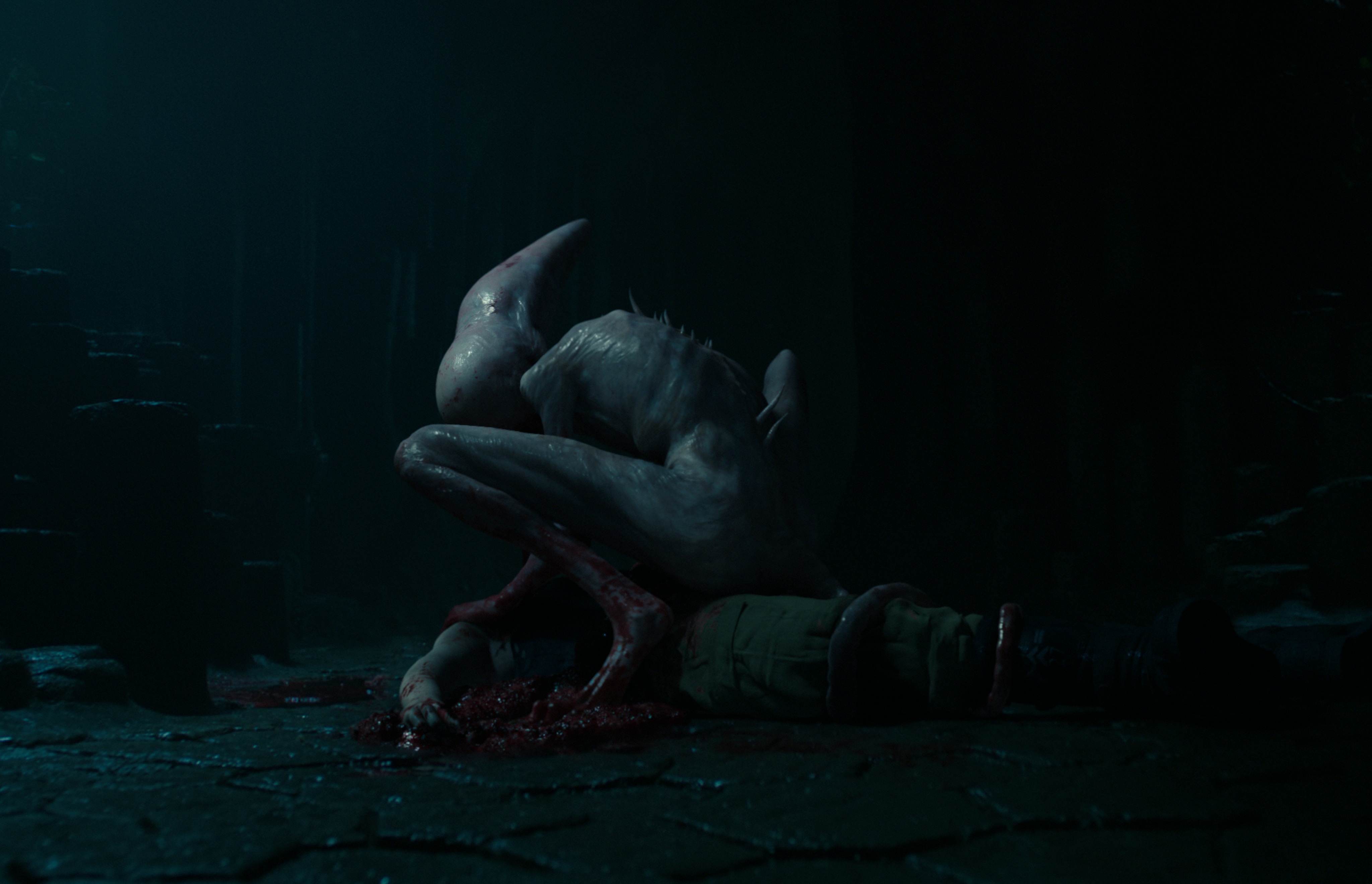
Neomorph
Aaron Percival: If I remember rightly, did you not also have your Facehugger having an eye, like some of the older Giger concept art?
Alan Dean Foster: Yes, that is true too. But things change not just in the script, but in the course of production. You might get a script that is up to date within twelve hours, and three days later on the set, the director and the lead actors decide to change everything in a certain scene. There obviously is nothing I can do about that in the course of writing the novelisation. Fox was more involved, and the people from Fox were very helpful and cooperative. It just makes my job that much easier and makes the book that much more accurate as far as relating to the film. However, there will always be changes made in the course of production that do not show up in the book.
Aaron Percival: I think that was really the case with this one, was it not? I suppose you obviously have not seen the film so you do not know, but your novel is fairly authentic to what ended up on the screen. There were a few differences, which I was hoping to ask about now just to see whether they came from you or from the script. There were several “big” issues that myself and other fans had with the film, which I personally felt were rectified in the novel. So, let us see if it was you or the script. The first thing is the crew when they venture out onto the surface.
Alan Dean Foster: That was me. I knew that question was coming because it relates to Prometheus too. As soon as I read the script and they walked out of the ship in the script, kind of like they walked out of the ship in Prometheus and nobody checked anything, I immediately thought this needs to be fixed and it should be a simple fix. Fortunately, we have the presence of a non-infectable, at least as far as we know, android on board. It was a simple matter, instead of having the crew fiddle with instruments for 24 hours, just having Walter take a stroll outside and check everything and say, “Yes, it is okay.” So that was me, yes. I will take credit for that.

Lander
Aaron Percival: That also served to bolster some of the confidence of the crew later on in their decisions and how they handle things like the motes and stuff like that. So, that was a very nice addition.
Alan Dean Foster: It is great when you fix one thing and it inadvertently fixes other things down the line. That is nice when it works out that way.
Aaron Percival: The biggest issue I personally had with the finished film was that David was responsible for the creation of the aliens. Your novel had the aliens as being an existing thing that was left behind by the Engineers that David tinkers with. Was that you or the script?
Alan Dean Foster: A little of both in that case. The script was actually fairly ambivalent about that. So I was left to make my own determination on that basis. My feeling, and I have no idea where the next film is going to go with this, but I just got the feeling that David was working with material that had been left behind by the Engineers and he had been playing around with it. You actually have both possibilities open, as I see it, for future development.

David
It is possible that the Engineers developed the Xenomorph, or it is possible that David developed a more advanced version of the Xenomorph, which you could use to explain how the Xenomorph and the Neomorph, for that matter, develop so quickly in this film as opposed to the earlier films. In other words, the life cycle is greatly sped up. Now, who is responsible for that? Is that something the Engineers left behind? Is that something David came up with on his own? The ambiguity of it all, I think, is still there. So, fans can continue to debate that. I will continue to debate that myself, actually, and we will see what happens with the next storyline.
Aaron Percival: Because in the novel, you have David specifically mention in the narrative that he had tinkered and the Chestburster had an increased growth rate. For clarity’s sake, did you mean the whole alien life cycle had been increased in terms of that iteration of the alien, rather than just the Chestburster?
Alan Dean Foster: Yes, it had to be. The whole alien life cycle has to be accelerated, or what you see in the film would not be possible. So, the storyline and the explanation had to follow what you see in the film. If we had a 24-episode miniseries, you might be able to do a slower alien life cycle. For that matter, I thought that the alien life cycle growth in the very first film was outrageously fast. So, extrapolating from that to what we see in Alien: Covenant, I do not think is that big a jump.
Aaron Percival: Was that also your own doing as well, then? Just your own explanation?
Alan Dean Foster: David’s line about it being a more advanced model, so you get the accelerated growth, yes, that was me. I had to put something in there because obviously the rate of growth is faster in Alien: Covenant than it is in the first three Alien films, and you have to say something. I am very scientifically oriented, even though I have no formal training in science, but I take pride in making my science, even if it is a film, as believable as I possibly can when I do a novelisation. I felt that that line was necessary, and for what it is worth, Fox left it in there. So, nobody there objected to it. There were things they objected to that we took out, but they did not object to that, so fans can make of that whatever they will.
Aaron Percival: Brilliant. Well, that was another one of the little things in there that improved the experience for me. It was exactly stuff like that, which is why I was excited when I heard you were writing this book.
Alan Dean Foster: Thanks. The key thing to me, one of the very key things about science fiction, whether it is filmed science fiction or written science fiction, is maintaining the internal logic. In other words, if you are going to have a genie push your spaceship, then you have to have genies pushing spaceships throughout the entire film. Then it is not science fiction anymore, it is fantasy, but at least the logic is the same. You cannot have a genie pushing a spaceship in the first half hour and then go to a faster-than-light drive in the last half hour, because that breaks the internal logic.
So, if you are going to have an accelerated rate of growth for your alien, which is shown in the first three films, and you are going to speed that up for Alien: Covenant and any subsequent films, you have to at least explain it, even if it is a one-line explanation, so that you maintain the internal logic. In other words, things do not just happen. There has to be some kind of an explanation. It may be an outrageous explanation, it may be a seemingly stupid explanation, but you have to have an explanation.
Aaron Percival: Well, this is the last you-or-the-script question. We are aware that there was a sequence that was cut from Alien: Covenant where the alien and the Neomorph were attacking the crew simultaneously, but the novel has a scene where it is slightly different, in which the alien and the Neomorph go for each other. Was that you or the script?
Alan Dean Foster: That was in the script. That sequence in the book is expanded directly from something that was in the script. I think it is a very good way of expanding the Alien universe. One thing that is not addressed in the screenplay, and is therefore not addressed in the novel, is that you land on a world which is completely devoid of animal life. My thought on that is, if you are going to have the black goo, shall we say, produce infections that result in Xenomorph and Neomorph and other morph-type creatures, and they eventually eliminate themselves through internecine fighting, then you are going to see more skeletons and more bodies of creatures other than just the Engineers. You do not really have time to talk about this in a two-hour film, so it was not shown in the film.
I think that line of thought and development is one that could be profitably expanded upon in future Alien stories. You start thinking about well, people can get infected, Engineers can get infected, and obviously everything else on this world gets infected. It is a choice Boschian vision of hell that results, and maybe we will see something like that, and maybe not.
Aaron Percival: What do you think of the whole concept of the black goo, of the accelerant? It was fairly ambiguous in Prometheus, but they seem to have settled on a more straightforward path for Alien: Covenant with it.
Alan Dean Foster: It is just there, and I worked with it on that basis. I had enough other things that were in the film more overtly that I had to develop. I just really did not have time to, if you will excuse the expression, get into the black goo. So, I am just leaving that alone. I do not want to talk about something that the filmmakers have not had a chance to talk about, because they very well may in the next instalment.
Aaron Percival: Now, you mentioned earlier that there was stuff that you had to take out of the novel. I was wondering if you could elaborate a little more on anything that you were unable to do in Alien: Covenant, anything that had to be taken out.
Alan Dean Foster: No, I cannot do that. There is a prohibition in place. I will become infected, shall we say. I cannot do that, but I can say it was not a great deal. There were not chapters that had to be excised whole. There were just little things here and there. Mostly things that I went off in a certain direction with that did not accord with the direction the film was taking. When you have a good working relationship with a studio, that is usually what happens. It is, “Okay, you invented this, or you explained this, but it fits within the canon that we are developing, so we are going to leave it in.” But then you go off and do something and say, “Well, we actually find out that Walter got married before he left Earth to a female android.” You cannot do stuff like that because it contradicts the canon and the storyline. I wish I could tell you, but I can say that it was not major stuff.
Aaron Percival: What do you consider was the most rewarding part of working on this novel? What did you have the most fun with?
Alan Dean Foster: Exploring the characters and getting to know the characters better. That is true of every novelisation, really. Characters are at the heart of any successful novel or any successful film, and in a two-hour film you just do not have time to really get into characters’ heads and show their motivations, unless you have two characters. Something like Luc Besson’s Angel-A, for example, which is essentially two characters, or My Dinner with Andre.
You just do not have time to get into the characters’ minds and show their motivations. The scene, for example, in the shuttle with Ledward and the two ladies. That goes by pretty quick in the film because it has to. It is an action sequence, and you do not linger on it. But I get to show, as the writer of the novelisation, because I have unlimited time, what is going on in those people’s heads while all this is happening. While that is not a particularly enjoyable sequence to write, it is enjoyable in the sense that you can actually show what is going through people’s minds. It can be depressing for a writer. Most writers reflect what their characters are feeling as the writer is writing, and if most of your characters are being killed, it can be kind of depressing sometimes, especially if you get to like the characters.
Aaron Percival: On the flip side of that, then, what was the most challenging aspect of taking on this particular job? Anything that gave you grief?
Alan Dean Foster: Two things really. What I just said, which was developing all of these really interesting, nice, likeable people and then seeing them destroyed one by one. That was one thing. The other thing was it was difficult to fix some of the scientific stuff. The most disappointing thing for me is when I cannot fix it, because it is such a large part of the story that to fix it would change the story. I know I cannot do that for reasons I just enumerated. Do they still have the gigantic energy sails at the beginning of the film?
Aaron Percival: They do, yes. The ship. Yes. Your explanation of that was different, actually. Well, in terms of the accident?
Alan Dean Foster: Yes, it had to be.
Aaron Percival: Were you annoyed by the neutrino thing?
Alan Dean Foster: It just goes back to the whole science thing. It reminded me somewhat of Disney’s Treasure Planet. You just do not have… it just does not work scientifically. It works beautifully visually. It works fine in a film, and I have talked to a number of directors who have done things like this. Shots or sequences that are obviously impossible from a scientific standpoint, but that work extremely well in the film, and so they leave it in for that reason. I understand that. As somebody who really takes pride in their science, those are the things that I like to fix, and when I cannot fix them the way I would like to fix them, then it is disappointing. You just have to do the best you can, which is what I did with that sequence, and move on.
Aaron Percival: So, are you talking in terms of the accident itself or the solar sail concept?
Alan Dean Foster: The solar sail concept, basically. You are in deep space, and you are just not going to get enough energy, no matter how big your sails are, to move at any kind of reasonable speed to take you between solar systems. It is just not possible. You cannot fix that unless you completely redesign your spaceship, which I could not do obviously, because it was in the film. But it was very pretty. So, from a cinematic standpoint, that might have been a better way to go than something that would have been entirely scientific.

Covenant Solar Sales
Aaron Percival: If I remember rightly, didn’t you expand on it a little bit in terms of it not being so much a solar sail as just a general sort of energy collector type situation?
Alan Dean Foster: Yes, thank goodness for dark energy. Nobody has seen it, but we know it is there. It is a great deus ex machina for a situation like that. Well, it collects dark energy and it is powered that way. That sort of thing works better for me than something like solar energy. But it is a minor point, really, unless you are particularly into the science. You cannot obsess over things like that as a filmmaker, or you will never get your film made. There are other things that bother me too, but I understand why they are done. For example, we are several hundred years in the future, and people are still using projectile weapons, still shooting bullets. One would think that far in the future, the technology of armaments would have advanced to the point to where… well, you see where I am going with all this.