
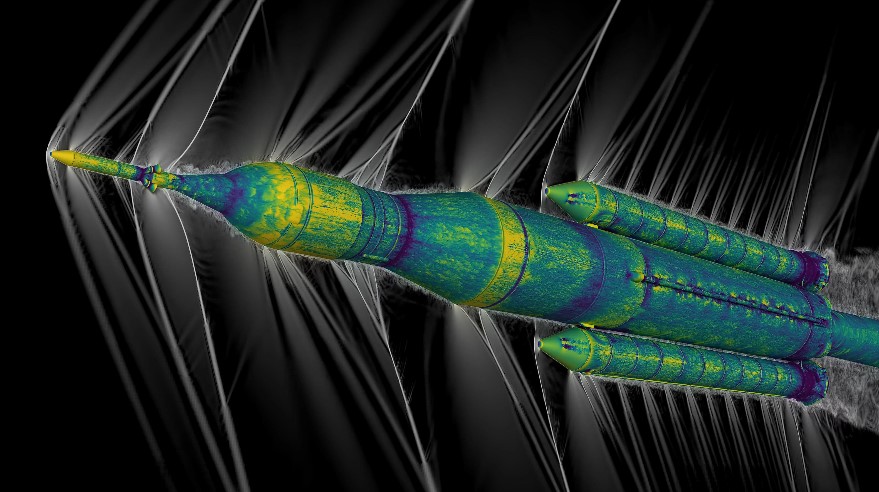
NASA has announced the release of a powerful software tool to the U.S. aerospace community. The program is called the Launch, Ascent, and Vehicle Aerodynamics (LAVA) framework. Its purpose is to help engineers analyze how air flows around rockets, aircraft, and spacecraft, especially during challenging phases like launch, ascent, and re-entry. More to the point, LAVA aims to support mission success by offering higher-fidelity simulations that inform design and testing decisions.
Releasing LAVA
LAVA is a computational fluid dynamics package created by NASA. It brings together the agency’s expertise to predict air movement with a high level of accuracy. The software is capable of modeling environments that are difficult to reproduce on Earth, yet essential for understanding real-world performance. By providing NASA-grade analysis to external users, the tool enables broader access to advanced simulation methods.
The release opens access to university researchers, science teams, and private companies across the United States. Practically, this means more organizations can test ideas, optimize designs, and evaluate safety considerations using the same foundational technology NASA uses for its missions. The expansion of access is framed as a way to speed up innovation by broadening the pool of practitioners who can run complex simulations.
“This isn’t only about releasing software; it’s about accelerating innovation,” said Jared Duensing, LAVA team lead at NASA’s Ames Research Center in California’s Silicon Valley. “When university researchers can run more complex simulations and when small companies can optimize designs with NASA-grade precision, we’re not only sharing tools, we’re unleashing potential.” The statement highlights both the technical benefits and the broader opportunities that come with wider use of LAVA.
NASA has already used LAVA in several high-profile ways. It has helped guide Moon and Mars launch and landing concepts, and it supports ongoing work to improve next-generation aircraft. For instance, engineers examined supersonic parachute deployment for Mars missions, a scenario not easily tested in Earth’s atmosphere, with LAVA providing critical insights. The software has also supported analyses of ice formation effects on aircraft performance, addressing issues relevant to flight safety.
With the software now broadly accessible, the Artemis program and other NASA initiatives may see industry partners applying LAVA’s capabilities to a wide range of vehicles, from large high-speed airliners to smaller delivery drones and air taxis. The release is described as enabling new applications across the aerospace sector, guided by the same precision that underpins NASA’s mission work.
 Published by James Hydzik
James Hydzik is a technology geek focused on the junction of engineering, writing, and coffee. He joined Orbital Today in 2020 to help make sense of the Johnson government’s decision to buy OneWeb. Since then, he has taken on interviewing and editor-in-chief roles. James learned the ropes of editing and writing with Financial Times magazines, The World Bank, PwC, and Ericsson. Thus far, interviewing New Space movers has put the biggest smile on his workaday face. The son of an Electrical Engineer, James understands the value of putting complex topics into clear language for those with a lay person’s understanding of the subject. James is a European transplant from the United States, and as ex-KA3LLL, he now holds European amateur radio licenses. His next radio project is a portable 10GHz EME (moonbounce) station, as it combines his childhood interests in antennas and space.