
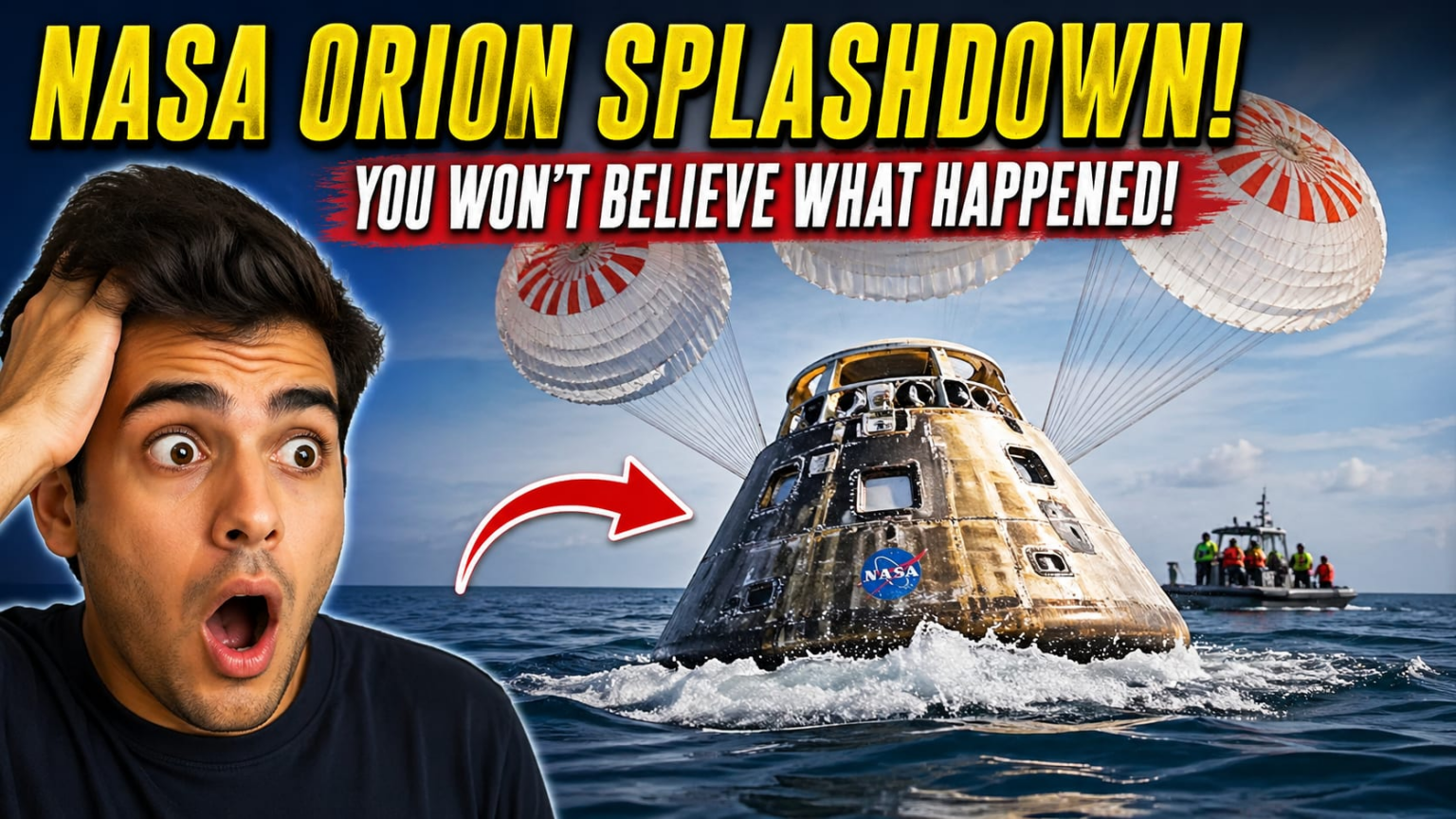
NASA Orion Splashdown Photos: A Stunning Return from Deep Space That Signals a New Era
Writer: King Pokhtoon
When the first images of the Orion spacecraft floating in the ocean began circulating online, people around the world stopped scrolling. These were not just ordinary space photos. They captured a moment that felt both futuristic and strangely familiar—a spacecraft returning home, gently touching the surface of Earth after traveling far beyond it.
The splashdown marked the successful end of a major mission under NASA’s ambitious Artemis program. But what made these images so powerful wasn’t just the technology. It was what they represented: humanity stepping back into deep space after decades of hesitation.
The Orion capsule had spent weeks traveling thousands of kilometers beyond the Moon, reaching distances no human-rated spacecraft had achieved before. Even though there were no astronauts onboard during this test flight, everything about the mission was designed with humans in mind. Every system—from life support to heat shielding—was tested as if people were inside.
One of the most talked-about aspects of the splashdown photos is the intense heat Orion endured before returning. As it re-entered Earth’s atmosphere, temperatures around the capsule reached nearly 2,800 degrees Celsius. That’s hot enough to melt steel. Yet, thanks to its advanced heat shield, Orion survived this fiery descent. In fact, engineers later revealed that this was one of the most extreme heat tests ever experienced by a spacecraft designed for human travel.
Another fascinating detail hidden behind these trending images is the precision of the landing. Space is vast, and returning from it is not as simple as aiming for Earth. Orion had to enter the atmosphere at exactly the right angle. Too steep, and it could burn up. Too shallow, and it could bounce off the atmosphere and drift back into space. The margin for error was incredibly small, yet the capsule landed almost exactly where scientists predicted.
The splashdown itself was equally dramatic. As Orion approached Earth, a series of parachutes deployed in perfect sequence. First came the small drogue parachutes to stabilize the capsule, followed by three massive main parachutes that slowed it down enough for a safe landing in the ocean. The moment it touched the water was both gentle and powerful—a reminder of how far engineering has come.
But perhaps the most surprising element of the mission lies in its connection to the past. Many viewers noticed how similar the splashdown looked to the returns of the Apollo missions in the 1960s and 70s. This was not a coincidence. NASA intentionally chose ocean landings for Orion, partly because they are safer for human crews and partly because they build on decades of proven experience. In a way, these modern photos echoed history while pointing firmly toward the future.
The mission, known as Artemis I, was only the beginning. Future missions will carry astronauts around the Moon, and eventually, NASA plans to land humans on the lunar surface again—something that hasn’t happened since 1972. Even more exciting, the Artemis program includes plans to send the first woman and the first person of color to the Moon, making it a historic step not just technologically, but socially as well.
There’s also a deeper reason why these photos are trending: they remind people that space exploration is still alive and evolving. For years, many believed that humanity’s greatest space achievements were behind us. But Orion’s successful journey tells a different story. It shows that we are not done exploring. In fact, we may just be getting started again.
Experts also point out that missions like this are not only about reaching the Moon. They are preparing us for something even bigger—Mars. The data collected from Orion’s journey will help scientists understand how spacecraft perform during long-duration missions, how to protect astronauts from radiation, and how to safely bring them back home.
In the end, the splashdown photos are more than just beautiful images. They are a snapshot of progress, risk, and ambition. They capture the exact moment when a machine built by humans completed a journey through deep space and returned safely to Earth. And for many people watching from their phones or computers, that moment felt like a glimpse into the future.
It’s not every day that a spacecraft travels beyond the Moon and comes back successfully. That’s why these images are everywhere right now. They tell a story without needing many words—a story of fire, distance, precision, and finally, a calm landing in the vast blue ocean.
And perhaps the most exciting part is this: next time, there will be humans inside.