
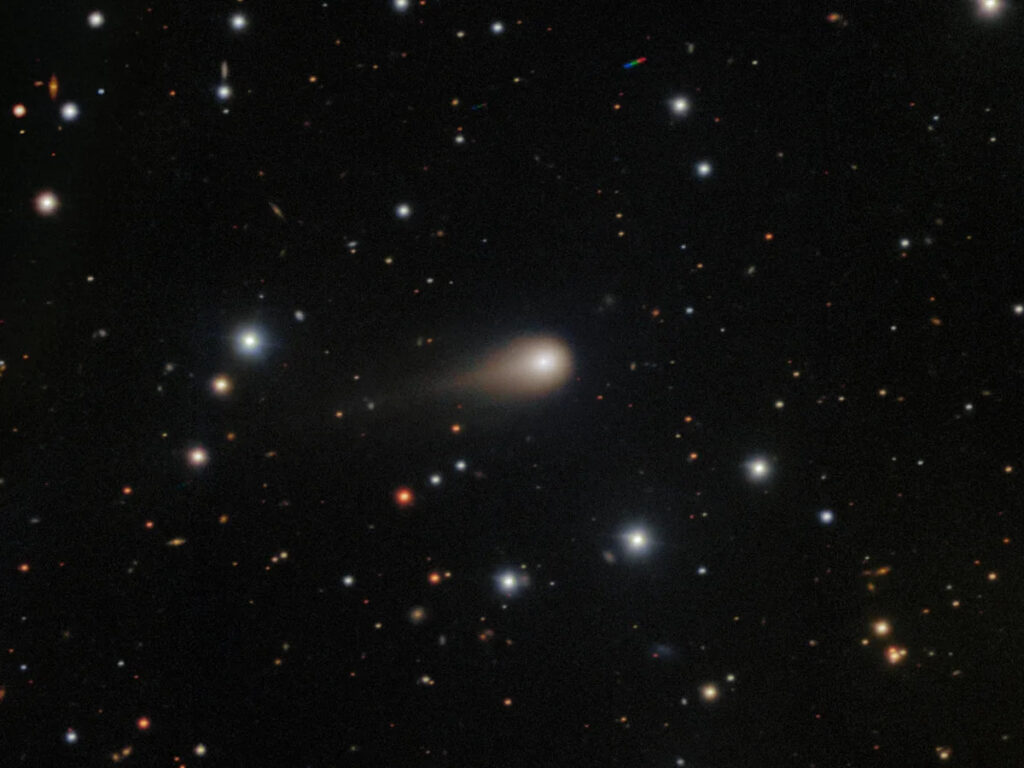
Comet 3I/ATLAS, an object from another star that was found speeding through our solar system last summer, is now fading from telescopic view as it retreats back to interstellar space. But it continues to offer lessons about its faraway origins—and, consequently, to demonstrate how special our solar system may be.
Astronomers caught a glimpse of 3I/ATLAS just days after the icy comet made its closest approach to the sun in late October 2025. With the telescopes of the Atacama Large Millimeter/submillimeter Array (ALMA) in Chile, they used radio waves of light to study the starlight-warmed material the comet was venting into space. The spectroscopic results showed way more exotic, “heavy” water than would be expected for a comet from our own solar system, according to research published yesterday in Nature Astronomy.
Like ordinary water, heavy water pairs two hydrogen atoms with one oxygen atom to make each molecule of moisture. But for the weightier version, at least one of those hydrogen atoms is a heavier isotope such as deuterium—which, unlike a typical hydrogen atom, has one neutron.
Whether water in a rocky body contains deuterium depends on the chemical processes that formed it. Specifically, cold temperatures greatly favor reactions that pump up the amount of heavy water relative to everyday water. So that ratio is a sensitive probe of a watery reservoir’s thermal history.
The ratio “acts as a ‘thermometer’ for the formation environment of planetary systems,” says Luis Salazar Manzano, a doctoral student at the University of Michigan and lead author of the Nature Astronomy study. That is why he and his co-authors were so shocked when ALMA’s data revealed 3I/ATLAS had a heavy water fraction that was about 30 times greater than that of typical solar system comets.
The finding lands atop a stack of related results that reach an inescapable consensus: wherever this interstellar interloper hails from, its origins must’ve been much colder and more alien than that of anything found around our familiar sun. Previous studies have suggested the comet is at least seven billion years old and perhaps even older than 10 billion years; either estimate greatly exceeds the age of the solar system, which formed about 4.5 billion years ago.
More than a month after Manzano and his colleagues used ALMA to monitor 3I/ATLAS in radio waves, teasing apart the subtle signatures of heavy water in its cloudlike “coma” of gas, a different team turned the infrared gaze of NASA’s James Webb Space Telescope (JWST) to the comet. That team also found signs of deuterium. Those JWST results have yet to be peer-reviewed, but they were publicized in multiple preprints posted online.
“Our observations were the first evidence of such an enhancement, and the JWST data came to reconfirm what we had discovered with ALMA,” says Manzano’s co-author Teresa Paneque-Carreño, an assistant professor at the University of Michigan, who lobbied for precious observing time on ALMA.
These spectroscopic studies of comets are a recent breakthrough in astronomy. “That is a very, very difficult measurement to make,” says Darryl Seligman, an astronomer at Michigan State University, who wasn’t directly involved in either the ALMA or the JWST work. “It’s almost unprecedented for solar system comets, and now they’ve done it for an interstellar comet,” Seligman says. “The fact they were able to do it is just remarkable.”
There are two broad and potentially overlapping explanations for 3I/ATLAS’s extraordinary deuterium enrichment, Manzano says. The comet could have inherited its abundant deuterium from a “primordial prestellar environment”—the cloud of gas from which its star formed—that was much colder than the one that produced our sun. But in principle, 3I/ATLAS’s deuterium level could’ve also been enhanced later because of complex thermal processes it experienced while forming and drifting through its host system’s protoplanetary disk. Those processes in a disk, however, can also warm up comets enough to reduce their deuterium levels. “That’s why our interpretation is not only that the host system of 3I/ATLAS was extremely cold but also that the material in 3I/ATLAS likely experienced relatively limited thermal processing.”
Either way, Manzano says, the comet’s overabundance “still points to a remarkable difference between the 3I/ATLAS host system and our own solar system.” Perhaps the difference was in the system’s birth environment, which may have been more isolated and quiescent than that of our sun; perhaps the anomalous deuterium resulted from how 3I/ATLAS formed and migrated through the system’s disk, whose size and shape may have kept the comet farther from stellar radiance; perhaps it was a mix of both.
Comet 3I/ATLAS is just the latest interstellar oddball: 1I/ʻOumuamua, the first-ever object from another star to be seen streaking by our sun, was also deeply weird. It behaved so strangely when astronomers found it in 2017 that Seligman and others postulated it might be a frozen nitrogen iceberg from very frigid environs rather than a run-of-the-mill comet. The second such visitor, 2I/Borisov, was found in 2019. And although it showed chill-associated oddities, it appeared more similar to solar comets than its predecessor.
What’s most exciting, Paneque-Carreño says, is the potential for future discoveries with ALMA and other cutting-edge telescopes. Thanks to new facilities such as the Vera C. Rubin Observatory in Chile, she adds, “detection and analysis of interstellar objects will be more common, leading to direct comparison between the chemical conditions of our solar system and others.”
“Either the solar system is weird and unique or planet formation in other stars is not quite understood,” Seligman says. “Those are really two different ways of saying the same thing.”