
American and German physicists have updated a 30-year-old concept of the laser. This discovery could revolutionize the way humanity measures time.
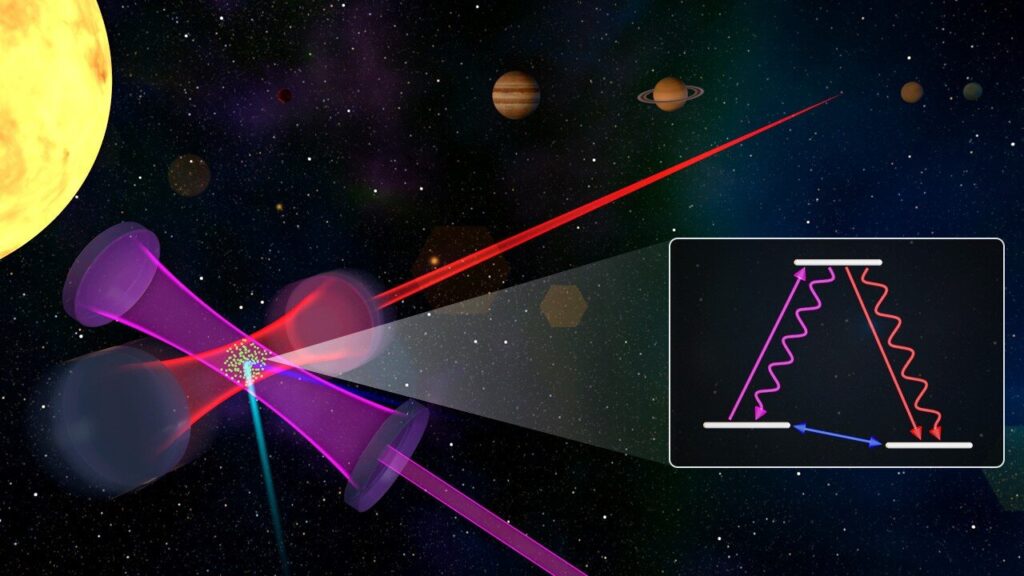
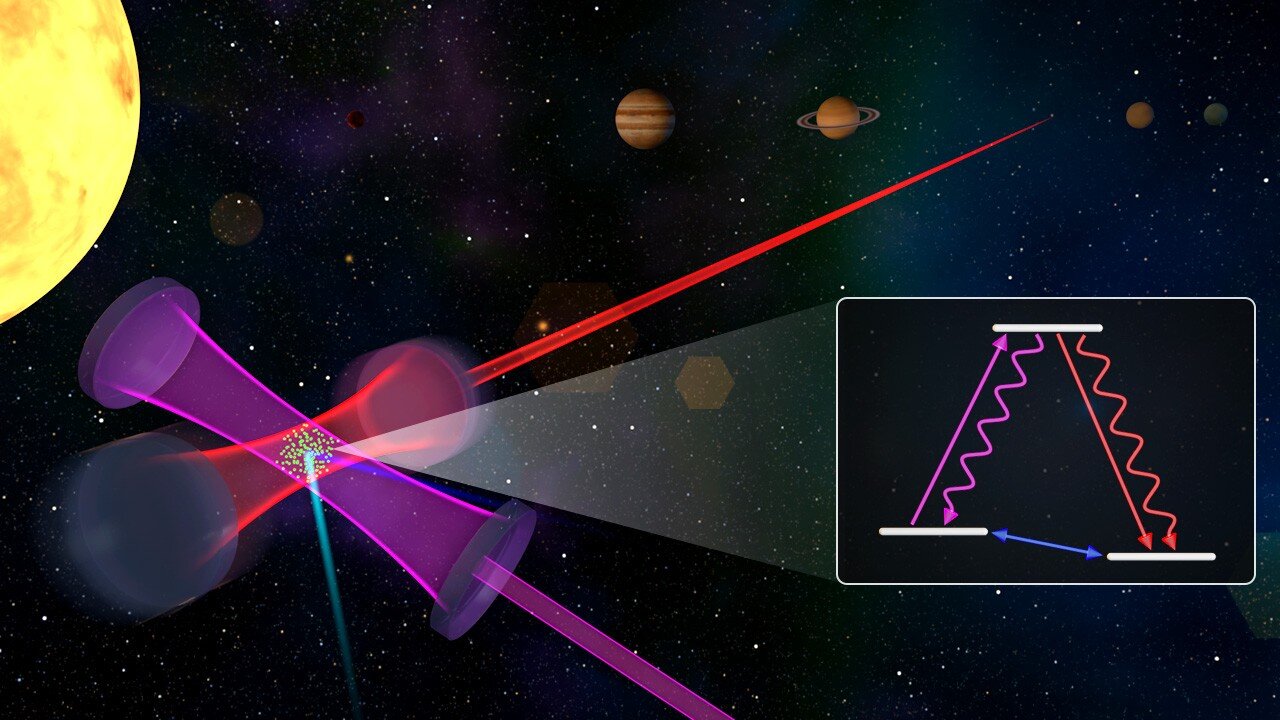 Light generated by a superradiant laser is capable of maintaining coherence (phase stability) throughout its entire journey from Earth to Uranus. Source: Jarrod Reilly / University of Colorado / Phys.org
Lasers come in two types: conventional and superradiative—and they operate on fundamentally different principles. A conventional laser generates a beam of light using a resonator cavity, which “oscillates” photons between atoms. In a superradiant system, the particles synchronize their oscillations and act as a single, coherent source.
As a result, the radiation frequency is maintained within the atoms themselves rather than in the resonator—and is thus much less susceptible to external influences such as vibrations, temperature fluctuations, and mechanical noise. The idea was first proposed back in the 1990s and was tested in practice in 2012, but physicists have never managed to achieve a fully continuous operating mode.
Overheating problem and its solution
For a laser to run like clockwork, it must emit photons continuously—and to do this, the atoms must be constantly “fed” energy. If each particle is excited individually, this creates chaotic fluctuations that heat up the system and disrupt synchronization.
Jarrod Reilly and his colleagues proposed adding a third energy level to the classic two-level model. This allows the injection and emission processes to be distributed across different transitions: collective synchronization is maintained, while heating is significantly reduced.
The narrowest line in optics
Theoretical calculations for barium atoms have shown that such a device can achieve a linewidth—that is, the precision with which the frequency is determined—of about 100 microhertz. This is a record figure for the field of optics.
The coherence length of the beam in question—the distance over which the light remains in phase—extends from the Sun to the orbit of Uranus, or about 2.7 billion kilometers. In addition, the researchers found that the unwanted influence of the resonator on the laser’s output frequency can be adjusted and, in theory, reduced to zero.
Uses other than watches
If this concept can be successfully implemented, such a tool would also be useful for optical interferometry—a method of ultra-precise measurement. The authors suggest that it could increase the sensitivity of gravitational wave detectors: if the device’s frequency does not respond to the external environment, any detected shift would indicate solely a distortion of spacetime.
Scientists also point to the possibility of creating an active nuclear clock that measures time based on transitions within the atom’s nucleus rather than in its electron shell. This could pave the way for the most accurate time measurements in history.
According to phys.org