
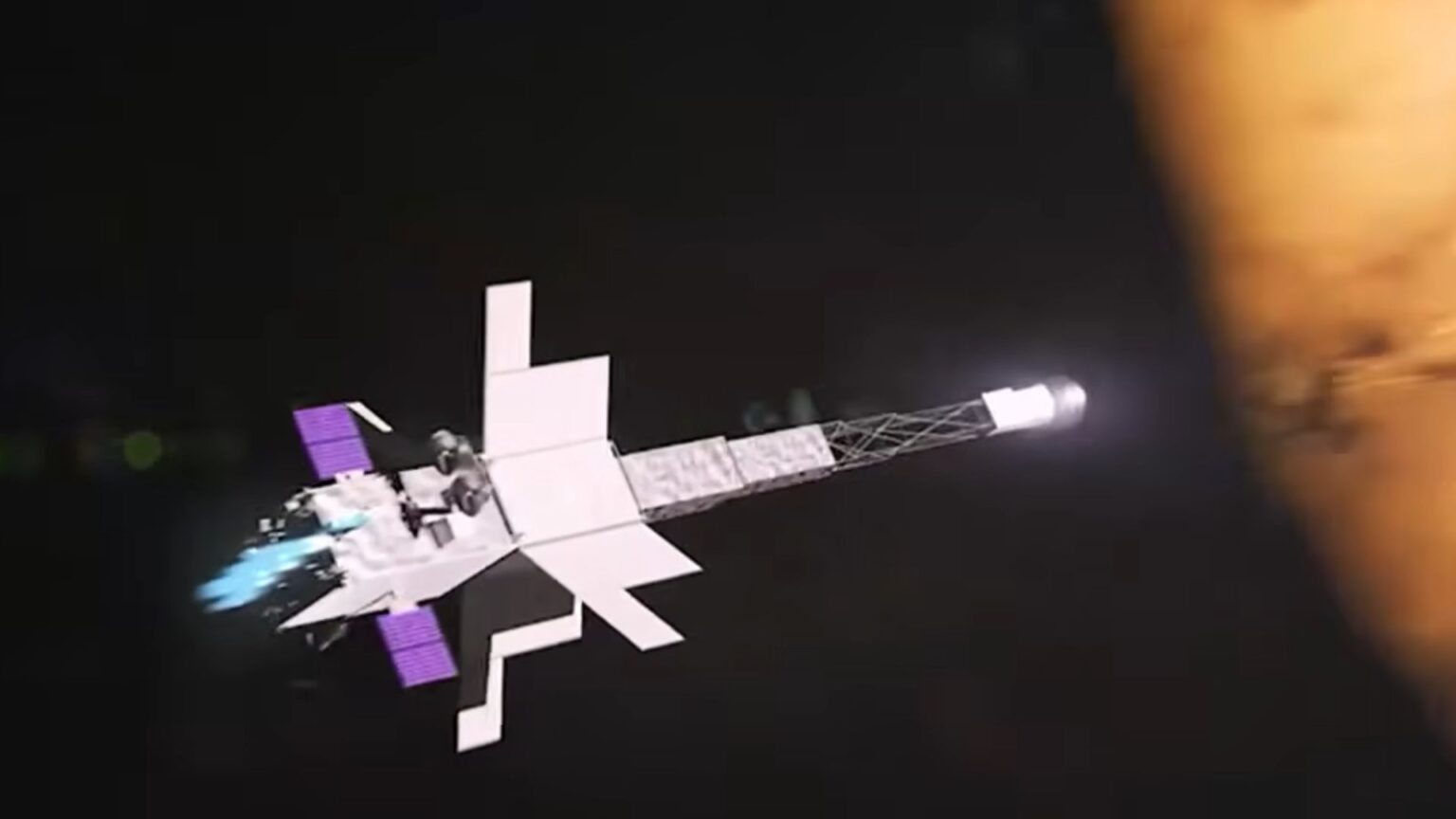
Following a December 2025 executive order prioritizing “American space superiority,” NASA is advancing nuclear propulsion under the leadership of Administrator Jared Isaacman.
The centerpiece of this new era is Space Reactor-1 (SR-1) Freedom. Slated for a December 2028 launch, it will be the first interplanetary spacecraft powered by a nuclear fission reactor.
It aims to finally realize the long-held goal of nuclear-powered space travel by launching a nuclear electric propulsion rocket to Mars.
If successful, it would clear the path to the establishment of a permanent, nuclear-driven base at the Moon’s south pole.
Advancing nuclear goal
Nuclear thermal propulsion has remained in a cycle of development, never reaching operational deployment.
SR-1 Freedom aims to break that cycle by utilizing existing technology to meet a strict 2028 deadline.
Despite 60 years of research and $20 billion spent on various failed or aborted programs, this mission seeks to succeed where its predecessors — such as the short-lived SNAP-10A — failed.
To ensure it hits the 2028 launch window, NASA is intentionally limiting the spacecraft’s scope, pairing a single new nuclear reactor system with proven, existing technologies rather than attempting a total design overhaul.
Isaacman characterizes the SR-1 Freedom as a “70 percent solution,” designed primarily to demonstrate the viability of nuclear propulsion rather than serve as a final, perfect model.
The spacecraft will use a 20-kWe reactor fueled by HALEU (High-Assay Low-Enriched Uranium) to power advanced electric thrusters.
It is expected to be activated within 48 hours of launch, beginning its year-long journey to Mars.
The system will use a closed Brayton cycle to convert heat into electricity, supported by heat pipes and a boron carbide radiation shield.
To manage thermal loads and propulsion, the craft will employ lightweight composite-titanium radiators and an advanced 48-kW electric propulsion system, which also doubles as the primary spacecraft bus for communications and power distribution.
Skyfall mission
Its primary mission? To act as a mother ship for Skyfall, a triad of “Ingenuity-style” helicopters.
Equipped with ground-penetrating radar, the drone swarm will survey potential landing sites and identify ice deposits, providing the critical data needed to verify the terrain for upcoming crewed missions.
NASA has yet to determine the fate of SR-1 Freedom following the Skyfall mission.
Officials are currently weighing whether the reactor-driven craft will perform a simple flyby or attempt to enter Mars orbit once its primary cargo has been delivered.
“The team is still looking at exploring the opportunities. Once we drop off Skyfall what do we do with SR-1 Freedom?” said Steve Sinacore, NASA’s fission surface power program executive.
NASA aims to move from hardware development in June 2026 to a December 2028 launch for SR-1 Freedom.
This mission serves as a stepping stone for Lunar Reactor-1 in 2030, part of a broader shift toward mass-producing megawatt-class reactors for human Mars missions and commercial use.
To sharpen this focus, the agency is pausing the orbital Gateway Program, redirecting all resources toward establishing a permanent surface base at the lunar south pole.
Prioritizing nuclear energy over solar, NASA aims to provide the consistent heat and power needed for survival and exploration in the permanently shadowed regions of the Shackleton crater.
NASA’s $30 billion, three-phase roadmap begins with a 2026 commercial cargo and crewed lunar return, scaling up to establish a nuclear-powered infrastructure by 2032.
By 2036, the agency aims to sustain a continuous human presence through habitable outposts capable of supporting four-person crews for month-long stays.