
Astronomers using the James Webb Space Telescope (JWST) have uncovered water-ice clouds in the atmosphere of a distant exo-Jupiter, Epsilon Indi Ab, challenging previously held assumptions about exoplanet atmospheres. This significant finding, published in The Astrophysical Journal Letters, marks a pivotal moment in exoplanet research, revealing new complexities in planetary atmospheres and offering a glimpse into the future of extraterrestrial life detection.
A New Era of Exoplanet Research
The James Webb Space Telescope has officially entered its next phase of exoplanet exploration. With its high-resolution capabilities, JWST has begun to unravel the mysteries of distant planets in ways never before possible. One of the most intriguing discoveries to date involves Epsilon Indi Ab, a gas giant that, although much more massive than Jupiter, shares a similar size. This planet, orbiting the star Epsilon Indi A, located 11.8 light-years from Earth, provides scientists with a rare opportunity to study a solar-system analog.
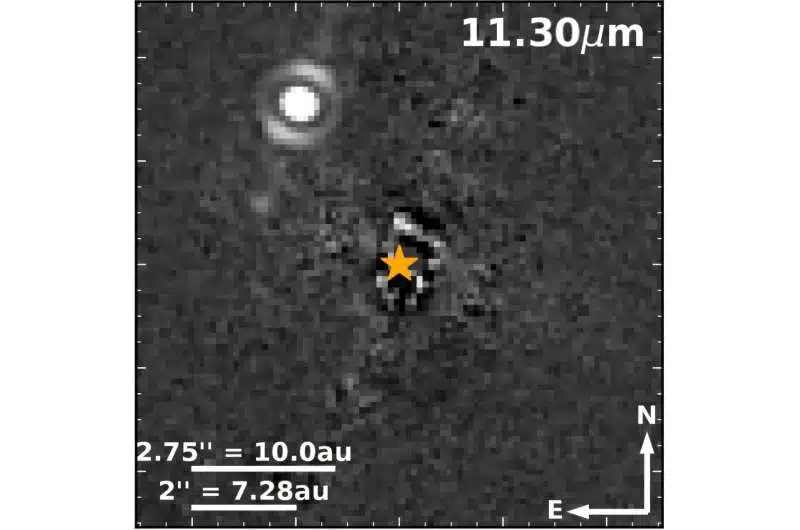
Until now, studying such exoplanets in detail has been difficult due to their extreme distances and high temperatures. Most gas giants studied thus far are far hotter than Jupiter, complicating efforts to obtain clear data on their atmospheres. However, this new study, led by Elisabeth Matthews and her colleagues at the Max Planck Institute for Astronomy, has changed that. They used JWST’s mid-infrared instrument to capture detailed images of Epsilon Indi Ab, uncovering surprising evidence for clouds, including water-ice clouds, an unexpected finding that deepens our understanding of exoplanetary atmospheres.
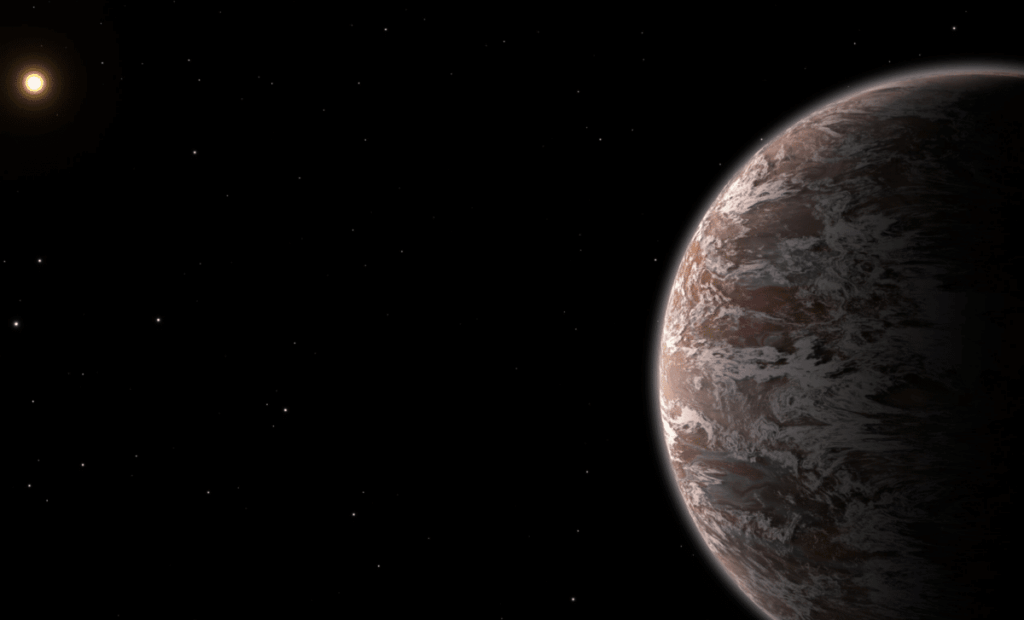
 Artist’s impression of the planet Epsilon Indi Ab, with water clouds atop its ammonia-dominated atmosphere.
Credit: E. C. Matthews, MPIA / T. Müller, HdA
Unexpected Discovery: Water-Ice Clouds on a Distant Planet
Initially, astronomers expected that Epsilon Indi Ab would share characteristics similar to Jupiter, with ammonia-rich clouds forming in its upper atmosphere. But what Matthews and her team found was something entirely different. Instead of the anticipated ammonia clouds, the planet displayed signs of thick, patchy water-ice clouds, something never before detected on such a distant world. This discovery has significant implications for how astronomers model exoplanet atmospheres.
Most models used to simulate these atmospheres have, until now, ignored the presence of clouds, as their inclusion complicates the computational models.
“It’s a great problem to have,” says James Mang, a co-author of the study from the University of Texas at Austin. “It speaks to the immense progress we’re making thanks to JWST. What once seemed impossible to detect is now within reach, allowing us to probe the structure of these atmospheres, including the presence of clouds. This reveals new layers of complexity that our models are now beginning to capture.”
The findings, published in The Astrophysical Journal Letters, are an essential step forward, offering insights into the types of clouds that may be present on other gas giants and laying the groundwork for future observations of potentially Earth-like planets.
A Step Toward Understanding Exo-Jupiters
Epsilon Indi Ab is not just another exoplanet; it is a key piece of the puzzle in understanding exo-Jupiters, gas giants that share similarities with our Solar System’s largest planet. Despite its greater mass (7.6 times that of Jupiter), Epsilon Indi Ab’s diameter is similar to that of Jupiter. The planet’s surface temperature ranges from -70°C to +20°C, which makes it a unique candidate for study compared to the scorching hot gas giants typically observed by astronomers.
By using JWST’s coronagraph, which blocks out the light of the planet’s star, the research team was able to focus on the planet’s faint emissions. They found that the amount of ammonia in Epsilon Indi Ab’s atmosphere was lower than expected, further suggesting the presence of water-ice clouds. “JWST is finally allowing us to study solar-system analog planets in detail,” says lead author Elisabeth Matthews. “If we were aliens, several light years away, and looking back at the sun, JWST is the first telescope that would allow us to study Jupiter in detail.”
The discovery adds another layer of complexity to our understanding of exoplanets and pushes the boundaries of what we thought was possible with current technology.
The Path to Earth-Like Planets
While JWST is capable of providing in-depth data on gas giants like Epsilon Indi Ab, the ultimate goal of exoplanet research is to find Earth-like planets where life may exist. The discovery of water-ice clouds on Epsilon Indi Ab represents a significant leap in this pursuit. As astronomers continue to refine their techniques and models, future space telescopes like the Nancy Grace Roman Space Telescope, slated for launch in the next couple of years, will help them delve even deeper into the atmospheric composition of distant worlds.
As Matthews points out, “For studying Earth in detail, we would need much more advanced telescopes.” However, the groundwork laid by JWST is a crucial first step in making the search for life on other planets a reality.