
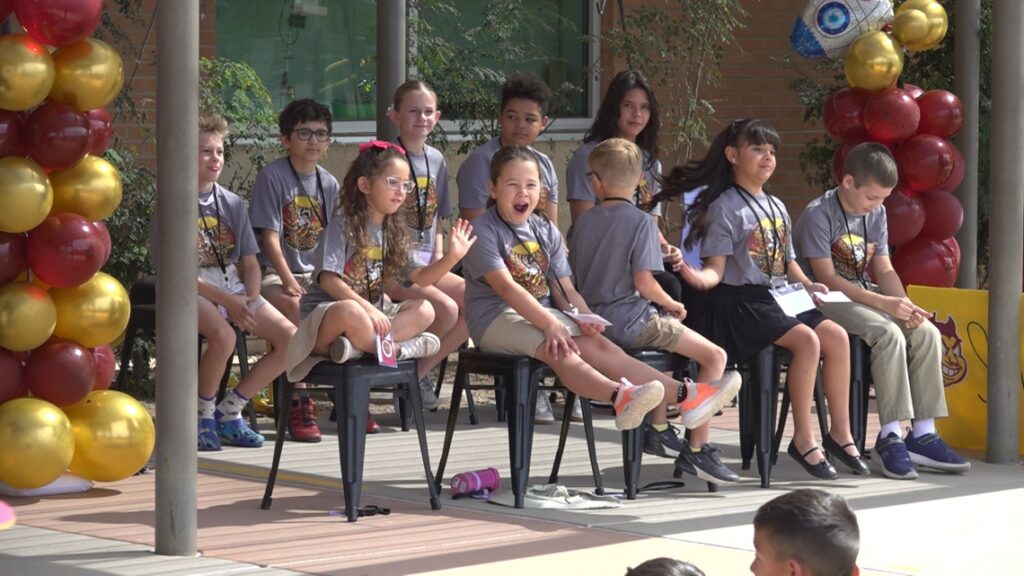
Students at ASU Prep connected with astronaut Chris Wilson on the ISS during a live radio call.
PHOENIX — Somewhere, 250 miles above the Earth, NASA astronaut Chris Wilson is floating.
The International Space Station is flying at more than 12,000 mph and is about to start flying over the Southwest. He has an appointment to keep and a radio headset to put on.
250 miles down, a radio antenna on the roof of ASU Prep in Mesa is aiming at where the ISS is scheduled to be at 9:52 a.m. There’s no room for error in time, no error in location.
The HAM radio operators from the Superstition Amateur Radio Club try calling.
“November Alpha One Sierra Sierra, this is Whiskey Bravo Seven Tango Juliet Delta for a scheduled radio contact,” one of the group’s members says into a microphone.
In the audience, hundreds of kids from Kindergarten through sixth grade sit in the sun, listening to the speakers hiss.
They try again. And again. No response.
One more time, and then —
“This is the International Space Station, we copy loud and clear and are looking forward to some wonderful questions,” Wilson’s voice comes through from space.
The classes cheer and a small group of kids grabs their laminated note cards. One by one, they’re called to a microphone where they’ll get to ask Wilson, floating in zero gravity, questions the entire school has worked on for months.
“Hi. My name is Jude. How do you sleep without a bed? And how does sleeping in space affect your body? Over.”
Jude asks his question and steps back, waiting for an answer from space.
“It’s kind of nice,” Wilson says, “We sleep in a sleeping bag almost standing up. But because there’s no gravity, it feels really comfortable.”
One by one, the kids get up and ask questions. Some step back to their teachers to listen to the answers, grinning, fidgeting, and excited.
Third grader Noah steps up to the mic.
“Hi. My name is Noah,” he says. “What special techniques help plants grow in space and why is varying the support for future missions? Over.”
“That’s a great question,” Wilson says. “Actually, right next to me on the space station, now we have a little experiment where we’re growing alfalfa plants.”
The entire school has been studying space all year. Planets, the solar system, what life is like in space, and how to get there. They even have their own call-and-response: a teacher shouts, “Mission Control!” and the kids yell back “Over!”
It’s all been leading up to today.
“The entire school brainstormed those questions, worked on them, edited, and then made changes and continued until it was just right,” ASU Prep STEM teacher Danielle Houseman said.
“I was so proud,” she said. “It was a moment that none of us will ever forget.”