
First-ever measurement of deuterated water in an interstellar object shows its home system formed under extreme conditions
New observations from the Atacama Large Millimeter/submillimeter Array (ALMA) have yielded the first-ever measurement of deuterated water — also known as semi-heavy water — in an interstellar object. The discovery reveals that the interstellar comet 3I/ATLAS contains at least 30 times the proportion of semi-heavy water found in comets from our own Solar System, providing a direct chemical window into the frigid conditions under which its home star system formed.
The research was led by PhD student Luis E. Salazar Manzano at the University of Michigan, working with assistant professor Teresa Paneque-Carreño, who served as Principal Investigator of the ALMA Director’s Discretionary Time program that made these observations possible. The data were obtained with ALMA’s Atacama Compact Array (ACA) just six days after 3I/ATLAS reached its closest point to the Sun — a narrow observing window made possible by ALMA’s unique ability to point toward the solar direction, unlike most optical telescopes.
“Our new observations show that the conditions that led to the formation of our Solar System are much different from how planetary systems evolved in different parts of our Galaxy,” said Salazar Manzano.
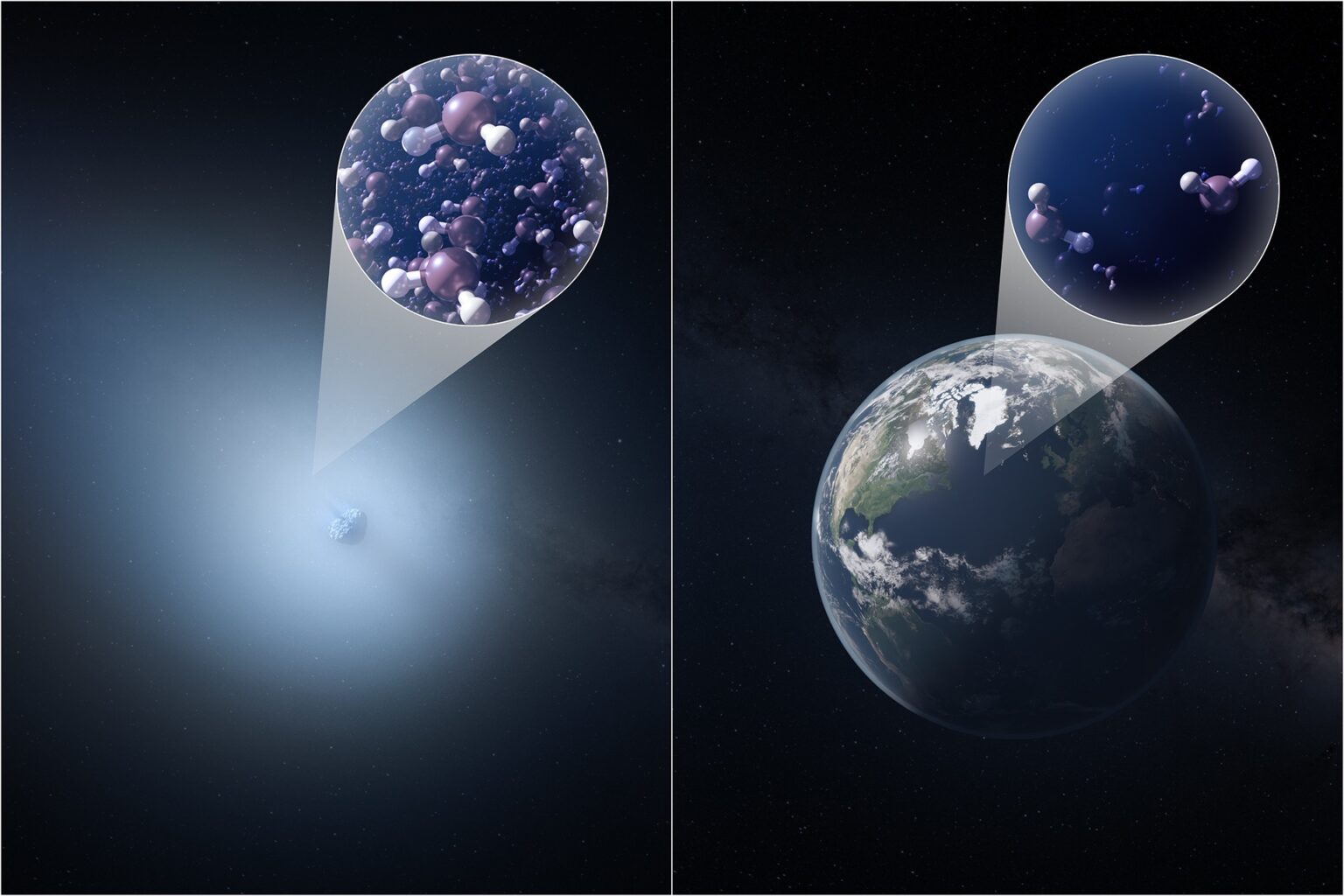
Comets are often nicknamed dirty snowballs, in part because of their high water content — water that carries frozen chemical records of the environment in which they formed. Alongside ordinary water (H₂O), comets contain a molecular variant called deuterated water (HDO), in which one hydrogen atom is replaced by deuterium, a hydrogen atom with an extra neutron. In Solar System comets, roughly one molecule of semi-heavy water exists for every ten thousand molecules of ordinary water. In 3I/ATLAS, that ratio is at least 30 times higher — and over 40 times the proportion found in Earth’s oceans.
Notably, ordinary water (H₂O) itself fell below ALMA’s detection threshold during these observations. The team constrained the D/H ratio indirectly, by detecting HDO directly and inferring the water production rate through the excitation of methanol lines — a sophisticated modeling approach that showcases ALMA’s unique analytical capabilities.
This elevated ratio points to an origin in an exceptionally cold and chemically distinct environment. “The chemical processes that lead to the enhancement of deuterated water are really sensitive to temperature and usually require environments colder than about 30 Kelvin, or about minus 406 degrees Fahrenheit,” explained Salazar Manzano. The ratio was set as the comet’s home system formed and has been preserved intact throughout its interstellar journey.
ALMA’s instrumental role in this discovery was essential. Paneque-Carreño noted: “Most instruments can’t point toward the Sun, but radio telescopes like ALMA can. We were able to observe the comet within days after perihelion, just as it peeked out from its transit behind the Sun. This gave us a constraint on these molecules that’s not possible using other instruments.”
Beyond being a chemical fingerprint of a distant planetary system, the HDO/H₂O ratio carries a special cosmological significance: the abundances of deuterium and hydrogen were set during the Big Bang itself, making this measurement a uniquely fundamental probe of the conditions under which other worlds are born. “Each interstellar comet brings a little bit of its history, its fossils, from elsewhere. We don’t know exactly where, but with instruments like ALMA we can begin to understand the conditions of that place and compare them to our own,” said Paneque-Carreño.
Additional Information
This research is published in Nature Astronomy on April 24, 2026, under the title “A Direct View of the Chemical Properties of Water from Another Planetary System: Water D/H in 3I/ATLAS” by Salazar Manzano, Paneque-Carreño et al.
The original press release was issued by the National Radio Astronomy Observatory (NRAO), an ALMA partner on behalf of North America.
The Atacama Large Millimeter/submillimeter Array (ALMA), an international astronomy facility, is a partnership of the European Southern Observatory (ESO), the U.S. National Science Foundation (NSF), and the National Institutes of Natural Sciences (NINS) of Japan in cooperation with the Republic of Chile. ALMA is funded by ESO on behalf of its Member States, by NSF in cooperation with the National Research Council of Canada (NRC) and the National Science and Technology Council (NSTC) in Taiwan, and by NINS in cooperation with the Academia Sinica (AS) in Taiwan and the Korea Astronomy and Space Science Institute (KASI).
ALMA construction and operations are led by ESO on behalf of its Member States; by the National Radio Astronomy Observatory (NRAO), managed by Associated Universities, Inc. (AUI), on behalf of North America; and by the National Astronomical Observatory of Japan (NAOJ) on behalf of East Asia. The Joint ALMA Observatory (JAO) provides the unified leadership and management of ALMA’s construction, commissioning, and operation.
Image
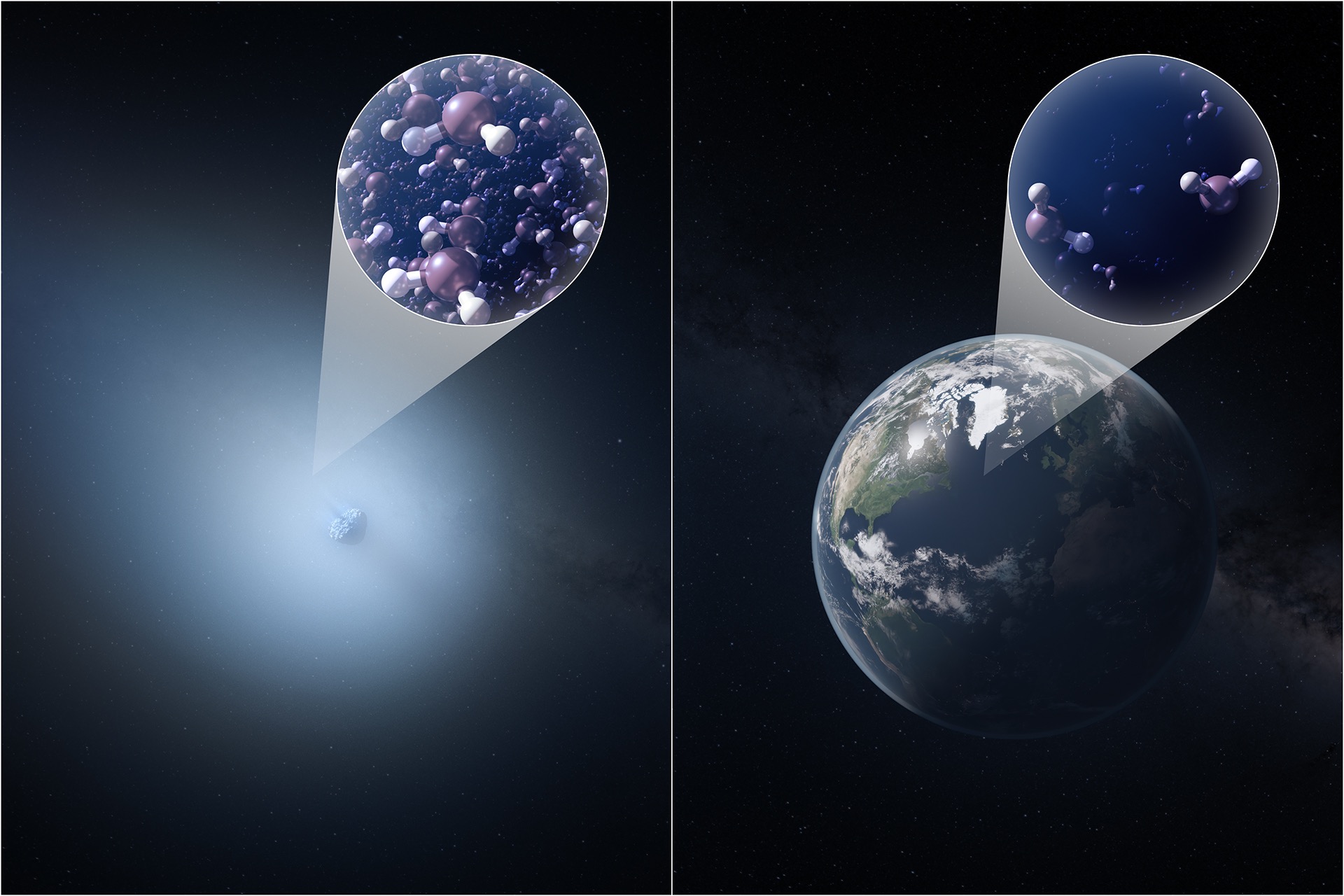 This artist’s impression compares the semi-heavy water content of the interstellar comet 3I/ATLAS (left) and Earth (right). Insets illustrate the relative abundance of deuterated water (HDO) molecules, showing that 3I/ATLAS contains over 30 times more HDO than is found in Earth’s oceans. This elevated ratio suggests the comet formed in an extremely cold environment, very different from the conditions that shaped our Solar System. Credit: NSF/AUI/NSF NRAO/M.Weiss