
Dark matter is estimated to make up about 27% of the universe, yet not a single molecule of it has ever been directly detected. Its existence is inferred solely through the gravitational pull it exerts on visible matter, until, perhaps, now. A new study suggests that an unexplained excess of far-ultraviolet light permeating the Milky Way could be the electromagnetic signature of dark matter annihilation events, offering what might be the first indirect glimpse of one of science’s most elusive quantities.
The research, recently published in the Journal of Cosmology and Astroparticle Physics, was led by Michael Sekatchev, an astrophysicist at the University of California, Berkeley. It centers on a specific and still-hypothetical class of dark matter candidate: axion quark nuggets, or AQNs. These are described as ultra-dense objects, smaller than a micrometer yet heavier than a few grams, composed of quarks and linked to axions, themselves still-theoretical ultralight particles. What makes AQNs particularly intriguing is that, unlike most dark matter candidates, they could leave detectable traces through electromagnetic radiation when they interact with ordinary matter.
A Glow Without a Source
The mystery at the heart of this research stretches back roughly a decade. According to Popular Mechanics, NASA’s Galaxy Evolution Explorer, known as GALEX, used its far-ultraviolet instrument to map the diffuse FUV background across the sky: the faint ultraviolet light not traceable to individual, easily identified sources. In the Milky Way, most of that glow is attributed to starlight scattered by interstellar dust. But even after accounting for the light produced by the galaxy’s hundreds of billions of stars, astronomers were left with a residual excess of FUV radiation that no known source could explain.
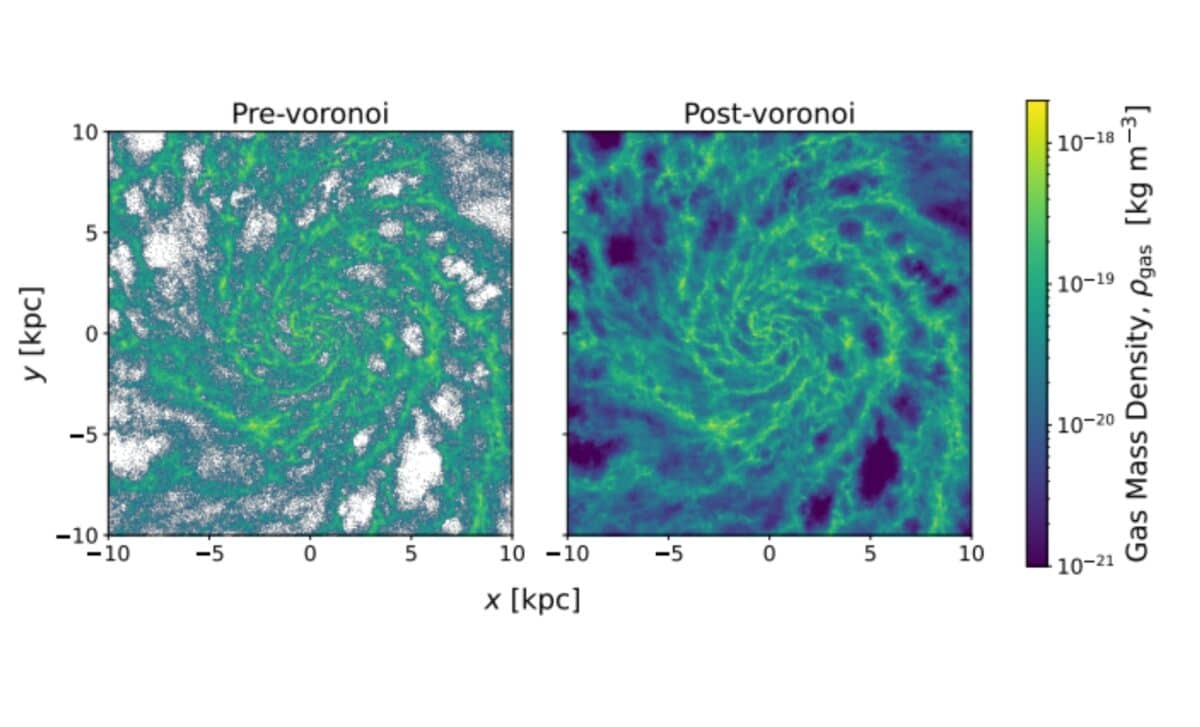 Gas distribution in a 20x20x4 kpc3 cube around the centre of the m12i galaxy simulation – © Journal of Cosmology and Astroparticle Physics
What made the puzzle harder to dismiss was its spatial character. The excess did not align with the galactic longitudes of the Milky Way’s brightest UV-emitting stars, ruling out the possibility that it was simply unresolved starlight. Its distribution was unusually smooth and even, quite unlike the light emitted by stars, which tends to be far less uniform. Crucially, the brightness of the GALEX observations matched earlier data collected by NASA’s Dynamics Explorer spacecraft, which operated from a much greater distance from Earth, confirming that the signal could not be attributed to terrestrial sources or anything within the Solar System.
New Horizons and the Half That Remains Unexplained
Further confirmation came from an unexpected source. Observations made by the Alice UV spectrograph aboard the New Horizons spacecraft, best known for its Pluto flyby, reinforced what GALEX had suggested. According to the study, while roughly half of the far-ultraviolet intensity measured could be traced back to known UV-emitting sources, the other half remained entirely unaccounted for. That persistent, structureless residual was what drew Sekatchev toward the hypothesis of dark matter annihilation.
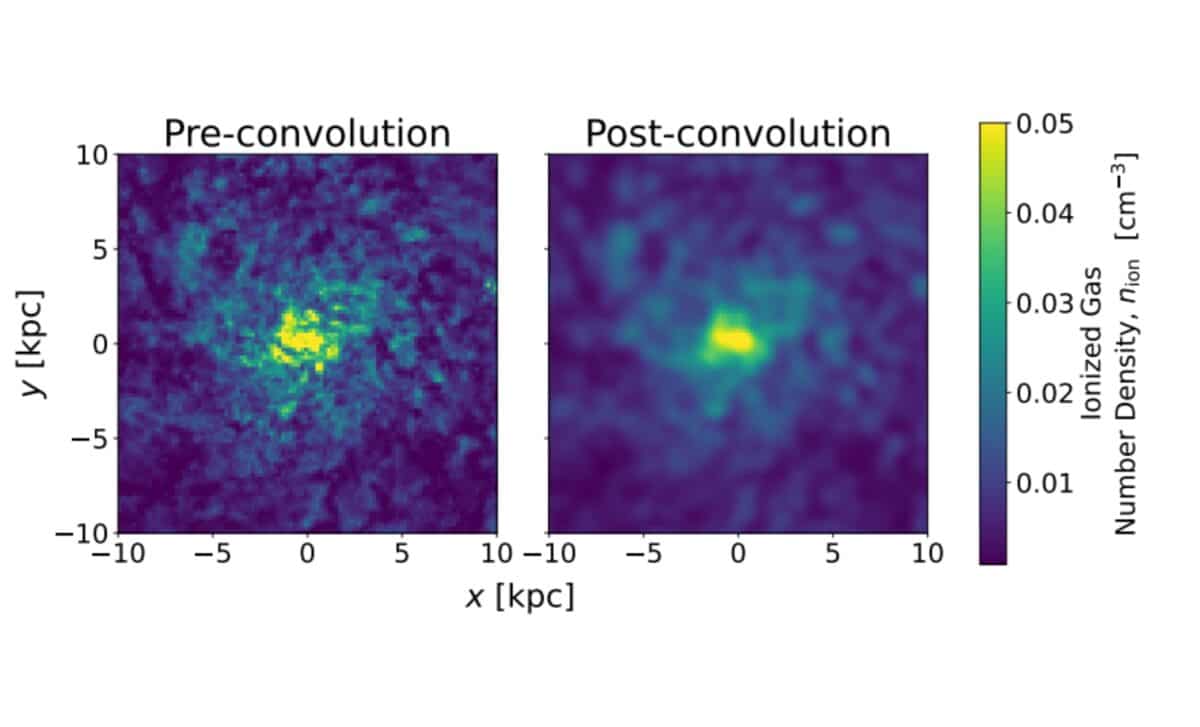 Pre-convolution and post-convolution ionized gas density distributions, using a spherical
averaging kernel with R = 0.6 kpc – © Journal of Cosmology and Astroparticle Physics
After finding that several existing theoretical models failed to match the GALEX data, Sekatchev turned to an earlier speculative study describing a composite, electrically neutral dark antimatter object, one whose charged internal constituents could still interact with ordinary matter. If some AQNs are made of antimatter, encounters with visible matter would not merely produce radiation; they would trigger annihilation events, converting mass directly into bursts of light. It is precisely this mechanism that Sekatchev and his team proposed as the source of the unaccounted FUV glow.
Simulations, Matches, and a Broader Implication
To test their hypothesis, the research team turned to computer simulations. They calculated how much far-ultraviolet light would be emitted by AQNs distributed according to the dark matter profile already established for specific regions of the Milky Way, including the area surrounding the Solar System. The results aligned with both the GALEX observations and the New Horizons findings. As the researchers wrote in their paper, the goal was to calculate “the FUV electromagnetic signature in a region surrounding the Solar System, resulting from interaction between AQNs and baryons.”
The implications, if the model holds, extend beyond ultraviolet light. The team found that ionizing photons produced during these matter-antimatter annihilation events could also speak to other unresolved astrophysical questions.
According to Sekatchev, recent observations from the James Webb Space Telescope have shown that early, faint galaxies appear to be surprisingly prolific producers of ionizing photons, a finding that existing models have struggled to explain. “Whether this can be sufficient to explain the JWST result without a significant change remains to be demonstrated,” he noted, stopping short of any firm claim.
The theory would also carry cosmological significance beyond the FUV puzzle alone. According to the study’s authors, AQNs could help explain the matter-antimatter asymmetry of the universe and shed light on why the visible and dark components of the universe are present in such similar quantities, two of the most stubborn open questions in modern physics.