
 Credit: The Exploration Company
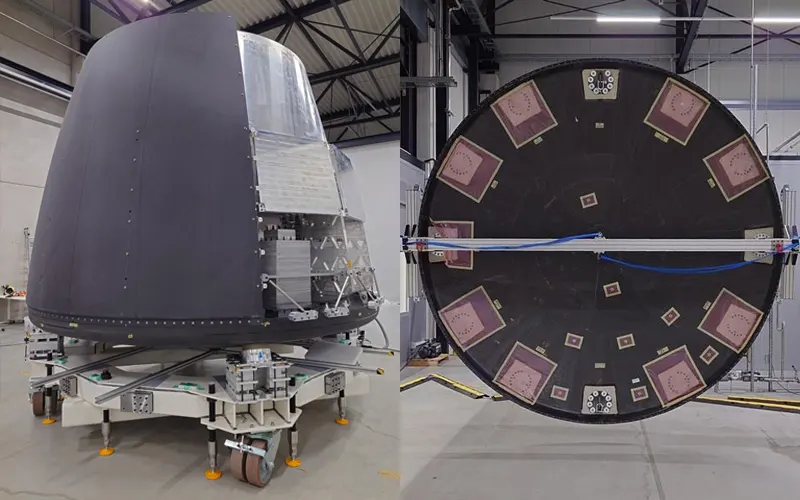
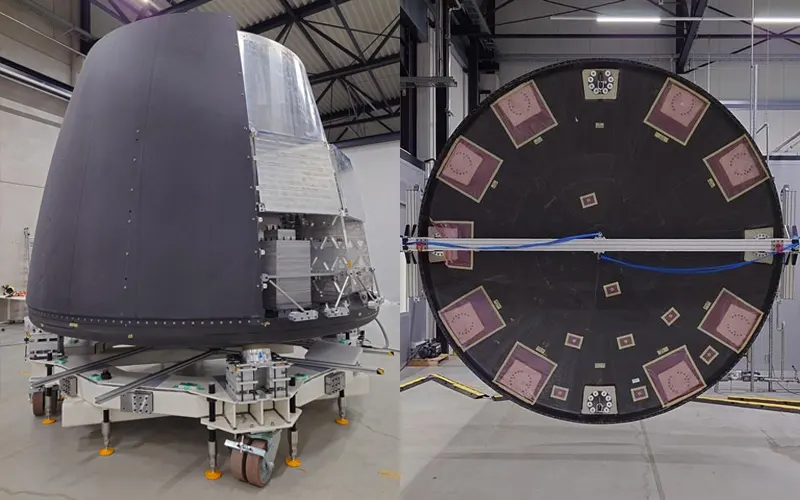
European in-space logistics startup The Exploration Company has signed a memorandum of understanding with Spain’s OCCAM Space to develop a customised variant of its KISS-XL clampband. The clampband will handle the separation of The Exploration Company’s Nyx capsule from its launch vehicle once in orbit.
The Exploration Company began developing its multi-use Nyx capsule in 2021 to initially transport cargo to and from low Earth orbit. The development of this initial variant of the vehicle is being funded, in part, by the European Space Agency through its LEO Cargo Return Services initiative. The inaugural demonstration flight of Nyx is expected in 2028 and will transport cargo to the International Space Station.
On 13 April, the company signed an agreement with OCCAM for the development of a four-metre variant of its KISS-XL clampband, which it claims was successfully used for the first time in late 2025 in a configuration exceeding four metres. In response to questions about the details of this initial use, OCCAM told European Spaceflight that, “due to confidentiality agreements,” they are unable to disclose details about the customer, mission, or launch date.
According to a representative from The Exploration Company, the initial agreement for the clampband’s development is non-binding, and the company was working closely with OCCAM to “mature the technical and programmatic aspects of the collaboration.” It will then assess the potential transition to a contractual phase “with the goal of staying on cost, on schedule, and on quality for our Nyx capsule.”
The Exploration Company recently completed pressure testing of the Structural Test Model (STM) of its Nyx capsule. The testing verified that the capsule could safely withstand internal cabin pressure and the stresses experienced during flight. The STM was then transported to the European Space Research and Technology Centre, where it is undergoing a dynamic vibration test campaign that began on 2 April.
In an announcement published yesterday, The Exploration Company shared that it had successfully completed a separate vibration test campaign on the capsule’s Nyx Power Conditioning Unit, which is designed to manage, regulate, and distribute electrical power to all onboard systems. This test campaign was conducted in-house at the company’s facilities in Germany.
As the company progresses through a number of technical milestones, it is also preparing to answer ESA’s call for the second round of its LEO Cargo Return Services initiative.
Launched in December 2023, the LEO Cargo Return Services initiative aims to foster the development of a sovereign European space cargo transportation service. The Exploration Company and Thales Alenia Space were awarded Phase 1 contracts for the initiative in May 2024. On 8 January 2026, the agency published the call for Phase 2 under the Autonomous LEO Accelerated Demo Docking to ISS Node (ALADDIN) initiative. The initiative will require awardees to complete a demonstration mission to the ISS during the second quarter of 2029, the last time there will be a docking port available to ESA before the station is decommissioned.
Keep European Spaceflight Independent
Your donation will help European Spaceflight to continue digging into the stories others miss. Every euro keeps our reporting alive.