
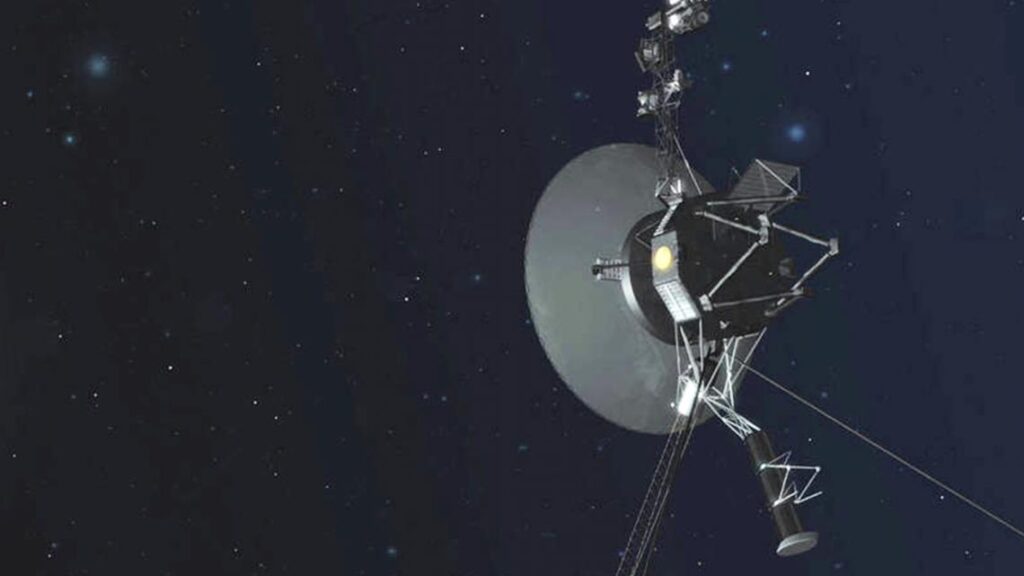
Voyager 1 has been slowly losing power since launching from Earth in 1977. Scientists have had to make difficult decisions to keep it running.
WASHINGTON — NASA engineers shut down another instrument on the Voyager 1 probe last week in an attempt to conserve more of the dwindling energy powering the farthest manmade object from Earth.
On April 17, engineers at NASA’s Jet Propulsion Laboratory in Southern California sent commands out to the nuclear-powered satellite to turn off a device known as the “Low-energy Charged Particles” experiment, or LECP.

This story continues below.
The LCEP has been operating almost continuously since Voyager 1 launched alongside its twin, Voyager 2, in 1977. It measures ions, electrons and other low-energy particles originating from our solar system and galaxy.
In a statement, NASA said the instrument “has provided critical data about the structure of the interstellar medium, detecting pressure fronts and regions of varying particle density in the space beyond our heliosphere.”
With its shutdown, humanity has lost one of its only windows into deep space.
“The twin Voyagers are the only spacecraft that are far enough from Earth to provide this information,” NASA said.
But there is still some hope for the LECP.
NASA said that one part of the device, a small motor that spins the sensor in a circle to scan in all directions, will remain on because it uses very little power. Keeping the motor running gives researchers the best chance of rebooting the LECP if they’re able to find a way to give it extra power.
Voyager 1 has slowly been losing power since launching from Earth more nearly 50 years ago, and scientists have had to make difficult decisions in the ensuing decades to keep it running for as long as possible.
The satellite has traveled over 24 billion kilometers from Earth in its 49-year journey, approximately one “light-day.” Because of the immense distance, it takes nearly 24 hours for signals from Earth to reach it, meaning that when engineers send a command, they don’t know if it was successfully carried out until they get a feedback response 48 hours later.
It’s not the first time instruments have been shut down to conserve power, and it won’t be the last.
In March of 2025, NASA said they powered down an instrument on Voyager 1 designed to study cosmic rays.
With the LCEP now down, only two of the 10 original scientific instruments are still transmitting data on the spacecraft.
The Magnetometer and Plasma Wave Subsystem remain operational for now, but it is only a matter of time before they go dark as well. There is a plan in the works to provide extra power to the satellite, but NASA isn’t sure if it will work.
The plan, designated “the Big Bang,” would swap out all of the devices currently running on the probe at the same time with a number of low-power alternatives that would keep Voyager 1 warm enough that its fuel lines don’t freeze. They will first attempt the maneuver on Voyager 2, because it has a bit more power in case things go wrong.
If the test slated for May is successful on Voyager 2, NASA said they will attempt the Big Bang on Voyager 1 as well later this year.
“There is even a chance that Voyager 1’s LECP could be switched back on,” the agency said.