
NASA said today that the Nancy Grace Roman Space Telescope will launch in September, eight months ahead of schedule and under cost. Originally called the Wide-Field Infrared Space Telescope or WFIRST, it will survey the universe broadly rather than in the greater detail of the James Webb Space Telescope launched in 2021. The two complement each other, with Roman identifying targets that JWST can examine in greater detail, for example.
The telescope is named after Nancy Grace Roman, NASA’s first Chief of Astronomy in the 1960s and 1970s and recognized as the “Mother of Hubble” — the beloved Hubble Space Telescope that just celebrated is 36th birthday.
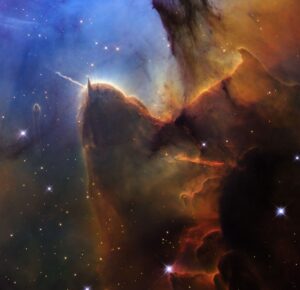
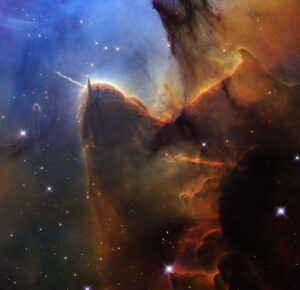 NASA celebrates Hubble’s 36th anniversary with a new image of the Trifid Nebula, a star-forming region it first captured in 1997. The telescope leveraged almost its full operational lifetime to show us changes in the nebula on human time scales with an improved camera. NASA, ESA, STScI; Image Processing: Joseph DePasquale (STScI)
Hubble primarily images the universe in the visible (optical) part of the spectrum plus some in the adjoining ultraviolet and infrared bands.
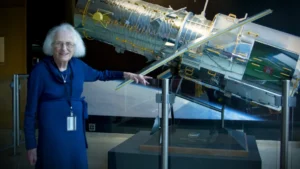 Nancy Grace Roman, who passed away in 2018 at the age of 93, stands next to a scale model of the Hubble Space Telescope outside the Hubble control center at NASA’s Goddard Space Flight Center in Greenbelt, Maryland in an undated photograph. NASA
Roman and JWST are infrared telescopes. JWST has a narrow, detailed, field of view while Roman can look more broadly. NASA says together they can “reveal extraordinary new information about our universe such as primordial galaxies, black holes, and planets beyond our solar system.”
Roman has its own work to do, too. At a briefing today, Julie McEnery, Roman’s Senior Project Scientist, said “current observations hint that the standard model of the universe is incorrect” and “Roman will be able to confirm these and set us on a path to understanding what’s right.” For example, scientists now see evidence that the Hubble constant that measures the rate of the expansion of the universe “as inferred from very early times is not consistent with the Hubble constant that we measure closer to now.” In addition, “recently we’ve seen evidence that the cosmological constant might, in fact, not be constant.”
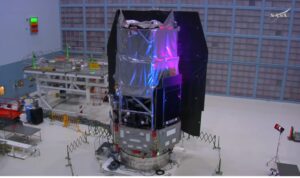 The Nancy Grace Roman Space Telescope at NASA’s Goddard Space Flight Center waiting to be transported to Cape Canaveral for launch in September 2026. Screenshot, April 21, 2026.
The Hubble constant (and the Hubble Space Telescope) refer to astronomer Edwin Hubble who discovered that the universe is expanding outwards. The cosmological constant explains dark energy — the unknown reason the universe’s expansion seems to be speeding up.
NASA Administrator Jared Isaacman said today Roman will launch in September. SpaceX’s Falcon Heavy rocket will send it to the Sun-Earth L-2 Lagrange point about 1 million miles (1.5 million kilometers) from Earth away from the Sun, the same region where JWST is located.
Isaacman and Science Mission Directorate head Nicky Fox praised Roman for being ahead of schedule and below cost. Asked how that came to be, Project Manager Jamie Dunn credited his team for designing it from the beginning with the understanding that success would be judged not only on scientific results, but staying within a cost cap. In return, they had funding stability from NASA Headquarters and Congress. “Year after year we did what we said we were going to do, and the resources, the support from them, was always there.”
Roman is the most recent in NASA’s series of flagship space telescopes referred to as “Great Observatories” that have been launched since 1990 including not only Hubble and JWST, but Compton (gamma ray), Spitzer (infrared) and Chandra (x-ray). Compton was deorbited in 2000. Spitzer was decommissioned in 2020.
Next up is the Habitable Worlds Observatory (HWO), in the planning stages now. An infrared/optical/ultraviolet telescope like Hubble, it will search for signs of life on planets elsewhere in the universe. The cost and timeline haven’t been determined yet. Fox said 2028 is a milestone when NASA will “step back and look and say is this mission possible.” If so, they will “sprint” to do it.
Last Updated: Apr 21, 2026 9:01 pm ET