
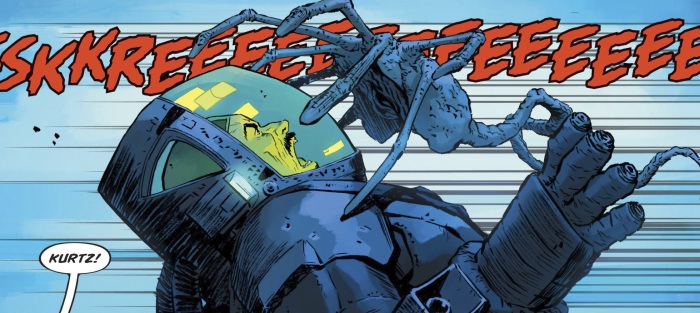
In 2018, Dark Horse Comics released an official comic book adaptation of cyberpunk pioneer William Gibson’s unproduced screenplay for Alien 3. The five-issue miniseries was written and drawn by Johnnie Christmas, known for his work on Image Comics’ Sheltered and Firebug, as well as Margaret Atwood’s Angel Catbird.
We sit down with Christmas to discuss his entry into the comic industry, his personal history with the Alien franchise, and the unique challenges of translating a fast-paced movie script into a serialised comic. Christmas also dives deep into the creative process, revealing his inspirations for the terrifying “New Beast,” the struggles of designing the UPP faction’s tech against studio mandates from 20th Century Fox, and his personal communications with William Gibson.
You can listen to the interview below and read on for a transcription. Please note that the accompanying transcript has been edited for clarity and brevity.
https://www.avpgalaxy.net/files/podcasts/avpg_pc_episode087.mp3
From Fan to Creator – Adapting a Sci-Fi Legend
Gibson’s Alien 3 – Issue 1
Aaron Percival: Could you tell us a little bit about yourself and how you became involved in the comics industry?
Johnnie Christmas: I started off doing covers here and there and maybe a one-shot here and there. My first series was Sheltered. It came out through Image Comics in 2013. It was me and Ed Brisson writing, and we did 15 issues. After that, the next notable thing I did was a book called Angel Catbird with Margaret Atwood. That is what put me in touch with my editoJohnnie Christmas Interviewr. The editor on Angel Catbird, Daniel Chabon, is the editor on Alien. So he brought me on to that. I also released a book last year called Firebug, a mythological volcano goddess adventure that I put out through Image Comics.
Aaron Percival: I did not realise he had done this one. I just assumed Randy Stradley did everything, Alien and Predator.
Johnnie Christmas: I do not know how it shook out, but Daniel contacted me about it, and he has been my guy on this one.
Aaron Percival: Do you remember the first time you became aware of Alien?
Johnnie Christmas: I think it was always in the background. It was always just part of the tapestry. But the first one that really stood out to me was Alien 3. Ripley was looking badass. She had a shaved head, and I was like, “What on earth is this?” So that was my first entry point. Then I went and saw the other ones. After that, it was game over.
Aaron Percival: You came in on Alien 3. That is an interesting one because that is not one that a lot of people normally come in on.
Johnnie Christmas: Because the other ones were before my time. I think as a child, they were maybe a bit artsy. Definitely, Alien would have been way too artsy with the pacing. So Alien 3 was my entry point. After that, Alien and Aliens far and away became some of my favourite movies of all time. So, Alien 3, I would say that was the first touchstone for me.
Aaron Percival: That is a cool little connection with you doing this alternative.
Johnnie Christmas: Yes, it was pretty cool getting to draw Ripley a little bit for this. Sigourney Weaver is so iconic in the series all around. But in part three, with the shaved head and just looking badass, it really stood out.
Aaron Percival: The later entries are probably the most striking appearances for her. As you say, with that bald head and then with that costume from Alien Resurrection, even if it is not the favourite film of the franchise, that costume is one of the ones that I think is more iconic of her.
Johnnie Christmas: Yes, and it was the first one where her physicality changed. She is kind of a superhero, but she also has the physical strength of a superhero. For whatever anyone might say about the movie itself, the Ripley in that one was personified outside as she was inside, which was really cool.

Sigourney Weaver as Ellen Ripley in Alien 3
Adam Zeller: Considering you worked on this alternate Alien 3, we would be remiss if we did not ask you specifically about your thoughts on the original film. How do you feel about it in general?
Johnnie Christmas: I try to honour everyone’s attempt. I think it was cool. It had some really cool visual elements. It had some cool ideas in it. It does not really feel like an Alien movie to me, really. It feels like a music video, and the performances were a bit big for me. That being said, I know they wanted to do something different, and I respect that they tried to do something different with it.
Aaron Percival: It is interesting that you use a music video to describe it, considering David Fincher came from music videos. He was quite notable for a Madonna video that he had done prior to working on Alien 3.
Johnnie Christmas: You could see it. He leaned into his strengths, which you cannot fault him for. The cool thing about the Alien franchise is that every film takes on the personality of the filmmaker, which is something I really like about them. That is why I am okay with some of them being better than others and not being super consistent because they are all David Fincher’s take. I have not done any franchise stuff or property stuff in my comic career, but one of the things that I thought would be cool about doing an Alien book is that the Alien franchise is so auteur-ish. You can come in and give your version of it. It still stands among the rest. Whether people like it or not, the Fincher one is an Alien movie, and that is his window into the world through his lens, which is kind of cool.
Aaron Percival: How do you feel about Alien Resurrection then? Is it the same sort of thoughts in terms of the differences in tone and everything?
Johnnie Christmas: Yes, the same way. It was very much like Delicatessen. It felt like a Jeunet. The camera was very close to everyone’s faces, very French cinema. It was cool to look at, very superhero-esque. You get to see the Xenomorph move around a lot, so that was cool. It is more of a visual situation than a character piece.
Aaron Percival: That is often described as being a bit of a comic book-style film. Would you agree with that sort of assessment in terms of the visuals?
Johnnie Christmas: Absolutely. It is very cartoony. Everything is very big. There is not a lot of slow building up to anything or big reveals. There is a reveal where Winona Ryder is a synth, but it did not pay off in some world-shattering kind of way. It was just like, “Oh yes, right, you are a synth. Cool.” But again, that is not a knock. It is what it is. I was super excited about it when watching it, thinking that there was going to be an Earth War after. But it did not come.
Adam Zeller: So, Alien has had quite the extensive expanded universe. Were you familiar with any of the previous series before starting work on this?
Johnnie Christmas: Just here and there. I would jump in when something had really cool art, like Mike Mignola’s Salvation, I believe it was. Things like that. Because I think of a lot of franchises as wherever it started is where the canon is. So anything outside of that is where I will pop in if it is notably cool. With Star Wars, I will follow it on screen, but not so much in any other media because… And then they will come out with a new movie that will completely obliterate ten years of novel continuity or something. So I will just stick with where it first appeared. With Alien, unless it is super awesome visually, I usually just skim the surface of the extended universe.
Aaron Percival: Not even any interest in the Earth Hive and Earth War stuff, considering it sounded like you liked where Alien Resurrection was going?
Johnnie Christmas: I remember Earth War and thinking it was cool. But that was again, like Salvation, it was just a few and far between. So much so that I do not remember a lot of the stories from them. I remember the visuals mostly. Which is not a knock to the storytellers; I am sure they did a fantastic job. But as a child, you just skimmed through comics. I did, anyway. I devoured a bunch of stuff, and a lot of the stories from then did not really stick in my brain.
Aaron Percival: How aware were you of William Gibson’s Alien 3 stuff prior to working on the series?
Johnnie Christmas: Not very. I knew there were a bunch of versions of it, but I did not deep dive into a lot of it. When I saw the Vulture piece, it was actually when I had a fuller understanding of exactly how many versions there were and the story of Gibson’s involvement.
Aaron Percival: Okay. So that knowledge all just came about when you were having to adapt this series, then.
Johnnie Christmas: Yes, about to approach adapting it. Daniel actually sent me the Vulture piece. I checked, and I am pretty sure I knew about it beforehand, because when he sent it to me, it was not a shock. It was like, “Oh yes, right.” But I think it was just peripheral, about as much as I know of the Vincent Ward stuff. It was just like, “Oh, cool,” but even now, I do not have a super deep understanding of the Vincent Ward script. It is just kind of like, “Oh, cool, there is another one.” I think that is how I knew about the Gibson one. It was just, “Oh, cool, that would have been interesting.”
Aaron Percival: What were those early conversations with Daniel like? Was it pretty much just, “We are thinking of doing adaptations of old scripts, do you want to get in on this?” Or was it more specific conversations about what would be happening?
Johnnie Christmas: It was very much about this one. I still do not know if they have plans to do more. I know he just thought it would be really cool. He said, “Hey, check out this article, and we have got the rights, we could probably get this made.” So it was like, “Oh yes, that would be really cool.” So I read both versions of it, and I got totally hooked reading the screenplays. I was pretty much in from that point on. The conversations were just enthusiasm. He was enthusiastic, I was enthusiastic, and it was just like, “Alright, let us try and make this thing.”
Aaron Percival: Do you remember when that was?
Johnnie Christmas: I would say around Autumn 2017. Then I started working on adapting the scripts and trying to figure out how to make it into a five-issue series while preserving as much of it as I possibly could because that was very important to me. Then I got rolling on art after making sure things were up to what Fox wanted in terms of the visuals and just plunked it out from there.
Adam Zeller: Did you face any notable difficulties adapting the script into comic format?
Johnnie Christmas: Script-wise, not so much. It was more your average storytelling challenges. As a movie script, you have got a midpoint high point, you have got breaking into Act Three, you have got those act breaks as high points. But if you want five cliffhangers, you have to create more. So I had to heighten a few places to create four satisfying cliffhangers to get you to the next issue. The challenge was trying to juice the drama in certain scenes. Just heighten it a bit, but not so much that it is a high point before we get to our full-on breakout in issues four and five, where things just go totally off the rails. It was actually just a really cool storytelling challenge to show where we have a chestburster scene that I did as a flashback to kick off issue two, just so we can have a nice visual punch. And on issue one with the reveal of Hicks, things like that, to bring our readers along and make them want to come back for more.
Aaron Percival: And there was not a lot actually removed from it either. I could think of one notable bit, which was when Halliday met Hicks; otherwise, I think it was mostly just odd bits of dialogue as well. So you did not really need to trim out a great deal.
Johnnie Christmas: Yes, it took a lot of time trying to make sure that I kept as much as I could, without being a purist about it. I wanted it to stay in because it was all very good, and it all made sense. The way William Gibson wrote the screenplay, as you guys might recall, it is all baked in very well. As a novelist, it is not Lego-ed in; it is all very much of a piece. A lot of foreshadowing and character bits were tucked in with the plot really nicely. So I wanted to preserve that flow. A lot of what I cut was Bishop’s journey through the tunnels.
A lot of that was really cool visually, but it did not advance the plot. Comics exist out of time. We are not music, film or a medium that has a tempo. Well, there is a visual tempo, but there is no actual time. I could see that on-screen Bishop’s journey through the tunnels would have been very cool because you could build up anticipation that way. But in a comic book, you could get rid of that because you can ratchet up tension using that, but the page count would be ridiculous. I do not think it would give the reader that much more. So that was an easy place to cut. For the most part, it was just here and there, trying to shave things off and sweeten things here or there as we went along.
Aaron Percival: Were you never tempted to try and fix any of the little bits at all? What stood out about that particular draft?
Johnnie Christmas: Only if I had done it in consultation with William Gibson. There were certain things that I thought I could smooth over. But I thought some of the things that were not super smooth made things feel very apt for the horror for me. It felt like sometimes, in a horror film, things do not seem like there is rhyme or reason to the universe, almost like a car accident on a street. Sometimes it is just like, “Oh my God, I cannot believe that thing happened, my world is on edge, there is no reason for it.” So I thought certain things in it that I could have smoothed over would have just added more reason and logic to the universe, where I think the horror of the universe is the thing that stands out for me more. I am fine with things having warts, so long as they are not ridiculous. Anything that was just a little bit out there, I was totally fine with it.
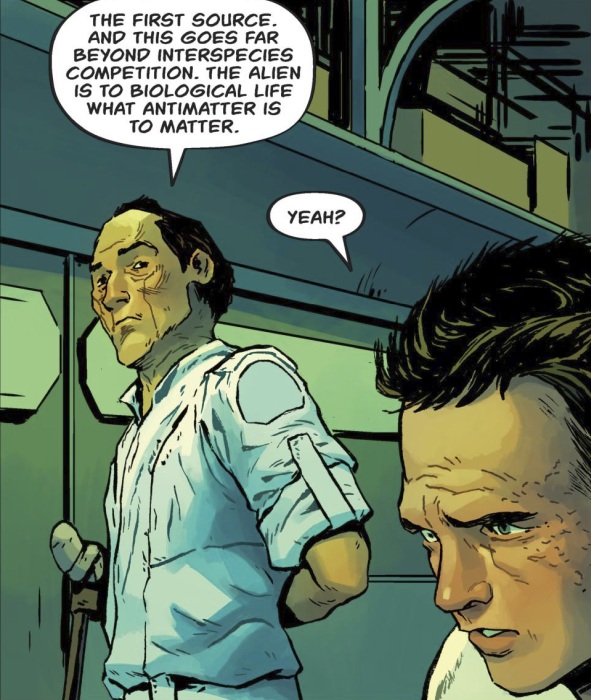
Hicks & Bishop in Gibson’s Alien 3
Adam Zeller: I do want to say, though, I thought you particularly nailed the look and personality of both Bishop and Hicks. I thought those characters were really well done in the comic.
Johnnie Christmas: Well, those two actors have some of the all-time great faces of film. So it was an absolute pleasure to draw them, I have to say.
Adam Zeller: You had mentioned this was a five-issue run. Dark Horse Comics’ Alien series usually runs for four issues. Were the five issues the length you determined it needed to be from the beginning?
Johnnie Christmas: I think my memory is a little hazy on this. I think they were hoping for four at first, but getting the five was pretty easy. It was not a big deal. There was a leaning towards four. Six might have been a bit much. Five just felt right. It was a really nice place where you could still have some characterisation and some builds, because I wanted the escalation, which is the heart of the tension, to be an important part of it, the arms race. You are with these characters as they are trying to do this thing on both sides, trying to build up this weapon. Then, when everything goes haywire, it is all over. It does not slowly slide back down the mountain; it just explodes. So I thought the build was very important to that.
Aaron Percival: It must have been nice because a lot of the older Alien comic adaptations have only been two or three issues. So these are the finished films that were getting such a small page count. To actually have five, I thought, was great because it did not feel like you were being rushed, and it felt like you were able to go at the proper pace, which I really liked.
Johnnie Christmas: Yes, because if you were to do that in two, you could, but then you would have to use a whole lot of narration, which would not feel like a movie. It would feel like a comic or a novel, which this is a comic, but I wanted the comic to feel like Gibson’s adaptation. With Neuromancer, some of that dialogue was so great that it had a literary bent with a noir-ish dialogue. To cut a bunch of that for narration would have been a great tragedy. It would be a second tragedy to the script. Five felt good because then you can keep a lot of it. I love that line about eyes like cufflinks. Just keeping stuff like that around, it is precious. Priceless.
Aaron Percival: I believe Fox actually specifically requested that you work off the second draft for this project. Was there anything from the first draft that you would have liked to have brought over into the series had you been able to intermingle a bit?
Johnnie Christmas: Well, the first has full-on action of maybe 50 Xenomorphs. So that would have been cool, just a full-on explosion extravaganza. That part would have been cool. I think there was a cafeteria scene or a shopping area scene. That would have been kind of cool. But I do think the second was the right choice, especially for a comic book series, because I do like the build better. I think if you had done the first one, it would have looked really cool and it would have been really fun, but it would not have been as memorable. The second one has more characterisation and has more stuff for you to hold onto a lot longer.