

Get insights on thousands of stocks from the global community of over 7 million individual investors at Simply Wall St.
Synopsys (NasdaqGS:SNPS) has been selected by NASA to help validate spacesuit compatibility with the lunar environment for upcoming Artemis missions.
The company is providing advanced simulation and test technologies to assess risks such as triboelectrification, electrical charging, and communication issues on the moon’s surface.
The collaboration involves NASA, Synopsys, and EMA working together to support astronaut safety and overall mission reliability.
For investors watching Synopsys beyond its core chip design tools, this NASA alliance highlights how its simulation technology is being applied to high stakes space programs. The shares most recently closed at $449.58, with a 14.6% gain over the past week and a 19.2% return over 3 years, while the year to date move of 6.4% shows that performance has not been one directional. Over 5 years, the stock is up 78.8%, indicating that longer term holders have seen meaningful appreciation.
This new role in validating spacesuit performance puts Synopsys in a visible position within critical aerospace and defense applications. Investors may watch how projects tied to Artemis and other space initiatives influence demand for the company’s simulation tools and whether similar collaborations emerge in adjacent mission critical fields.
Stay updated on the most important news stories for Synopsys by adding it to your watchlist or portfolio. Alternatively, explore our Community to discover new perspectives on Synopsys.
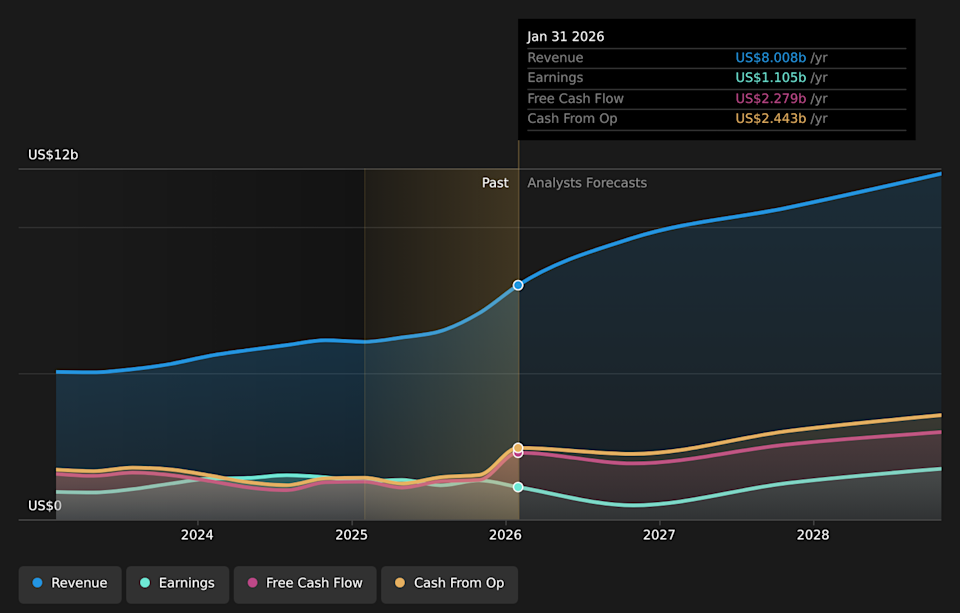 NasdaqGS:SNPS Earnings & Revenue Growth as at Apr 2026
📰 Beyond the headline: 3 risks and 2 things going right for Synopsys that every investor should see.
This NASA win shows how Synopsys is pushing its tools further into complex, safety critical systems like spacesuits and lunar communications, not just chip design. By working with EMA and Cesium on digital twins for charging, radio coverage, and antenna behavior, the company is tying its simulation stack to long duration Artemis missions where reliability is non negotiable. That can help deepen relationships with aerospace agencies and contractors, and may strengthen Synopsys’ position when buyers compare it with peers such as Cadence Design Systems and Siemens EDA for system level work.
This type of aerospace engagement aligns with the view that Synopsys is broadening from silicon into system wide engineering, using advanced simulation to address more complex products and use cases.
Success in highly specialized projects like lunar missions may pull resources and focus toward bespoke work. This could complicate the shift toward more scalable SaaS and high value IP that is often highlighted in discussions of the company.
The specific use of digital mission engineering for RF coverage on the Moon and triboelectrification analysis on spacesuits is not explicitly covered in the broader narrative, so investors may want to judge whether this kind of work can scale into a repeatable, material business line.
Knowing what a company is worth starts with understanding its story. Check out one of the top narratives in the Simply Wall St Community for Synopsys to help decide what it is worth to you.
⚠️ Complex, mission critical projects for agencies like NASA can be technically demanding and any setbacks could add to execution risk at a time when analysts already highlight integration and operational challenges.
⚠️ A growing mix of aerospace and space related work may increase dependence on a relatively small set of large customers and government programs, adding another layer of concentration risk to what analysts have already flagged.
🎁 Working on Artemis missions gives Synopsys a high profile reference for its simulation capabilities, which could help when competing with other EDA providers for aerospace, defense, and industrial contracts.
🎁 The integrated simulation and test workflow with EMA’s lab and NASA’s Glenn Research Center may support Synopsys’ efforts to be a system level partner from silicon all the way to mission execution, in line with its broader expansion goals.
From here, it is useful to watch whether this Artemis work leads to additional contracts, either with NASA or with commercial space and defense customers, and how often Synopsys tools are specified in future mission architectures. Competitive responses from Cadence or Siemens EDA in space and high reliability sectors will also matter, as will Synopsys’ ability to scale these workflows into reusable offerings rather than one off projects. Any commentary from management on how space related programs contribute to bookings, margins, or cross selling with the broader simulation and EDA suite could help investors judge how important this area becomes over time.
To stay informed on how the latest news affects the investment narrative for Synopsys, visit the community page for Synopsys to follow the top community narratives.
This article by Simply Wall St is general in nature. We provide commentary based on historical data and analyst forecasts only using an unbiased methodology and our articles are not intended to be financial advice. It does not constitute a recommendation to buy or sell any stock, and does not take account of your objectives, or your financial situation. We aim to bring you long-term focused analysis driven by fundamental data. Note that our analysis may not factor in the latest price-sensitive company announcements or qualitative material. Simply Wall St has no position in any stocks mentioned.
Companies discussed in this article include SNPS.
Have feedback on this article? Concerned about the content? Get in touch with us directly. Alternatively, email editorial-team@simplywallst.com