
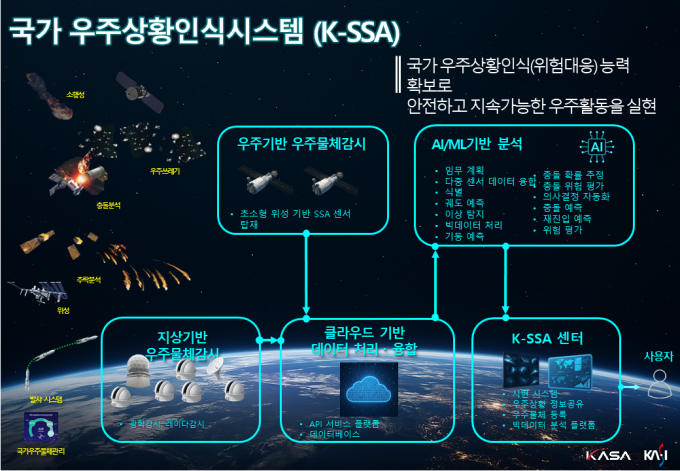
■ The Korea Aerospace Administration (KASA) announced on the 16th that it will hold a kickoff meeting on the 17th for the ‘Korea-Space Situational Awareness (K-SSA) System Development’ project. To protect public safety and national space assets from space risks such as falling or colliding space objects, the project will develop two SSA microsatellites, a private cloud-based integrated management system for space objects, and AI/ML-based space risk prediction technology. The satellites are targeted for orbital insertion in the second half of 2029, and the space surveillance information will be opened as public data to contribute to the vitalization of the private space industry ecosystem.
■ The Ministry of Science and ICT (MSIT) announced on the 16th that it is accepting nominations for the ‘2026 Engineer of the Year Day Government Awards.’ The awards, coinciding with the ‘1st Engineer of the Year Day’ on September 7, will recognize and reward researchers and research organizations that have led private-sector technological innovation. Eligible for nomination are individuals such as researchers, engineers, and CTOs from corporate research institutes who have created innovative products and services, as well as organizations that have contributed to technology commercialization. The nomination period is from April 16 to May 11, and details can be found on the websites of the MSIT and the Korea Industrial Technology Association.
■ The Ministry of Science and ICT (MSIT) and the Innopolis Foundation announced on the 16th that they are launching the 2026 projects for the 13 special R&D zones nationwide. This year, a total of 53.5 billion won will be invested to promote public technology-based startups and strengthen the establishment of research-institute-affiliated companies, with over 60% of startup support allocated to young entrepreneurs. The focus is on nurturing startups with technological competitiveness by combining proven public technologies from universities and government-funded research institutes with the ideas of young people.
■ KASA Administrator Oh Tae-seok signed a Memorandum of Understanding (MOU) with the Canadian Space Agency at the Space Symposium in the U.S. on the 14th (local time), it was announced on the 16th. They agreed to establish a working-level cooperation framework in areas such as Earth observation, space exploration, low-Earth orbit satellite communication, and Space Situational Awareness (SSA). As Canada pursues securing a low-Earth orbit satellite communication network as a national strategic project, Korea’s domestic satellite communication ground station ecosystem and advanced manufacturing capabilities are drawing attention as a key cooperation partner.
■ The National Research Council of Science & Technology (NST) announced on the 16th that it held a customized Small-scale, focused Research-team for Technology council (SRT) on healthcare research data from the Korea Food Research Institute. This marks the first time that non-patent R&D results, specifically research data, have been the subject of an SRT discussion. The council explored the commercialization potential of three data platforms: a cohort for cancer patients’ chemotherapy side effects, a dietary and clinical cohort for patients with chronic diseases, and an integrated Korean gut microbiome cohort. This is a pioneering attempt to expand the patent-centric technology commercialization ecosystem to include non-patent outcomes.
■ A team led by Professor Noh Chang-hyun of the University of Science and Technology (UST)-Korea Atomic Energy Research Institute (KAERI) School announced on the 16th that they published a review paper on next-generation radiation detection materials in the April issue of the international academic journal ‘Progress in Materials Science’. The paper comprehensively summarizes the principles and potential applications of advanced materials such as halide perovskites, quantum dots, metal-organic frameworks (MOFs), 2D materials, and metamaterials in revolutionizing radiation detection technology. It presents a range of applications from safety monitoring in nuclear facilities to wearable radiation sensors, and is expected to serve as foundational data for future research and commercialization.
■ The Gwacheon National Science Museum announced on the 16th that it will host the ’18th Happy Science Festival’ from the 18th to the 19th under the theme ‘Artificial Intelligence in Daily Life, a Future We Open Together.’ The festival will feature various programs including AI exhibitions, hands-on activities, career experiences, an escape room, and a magic show. Special lectures by Professor Sook-kyung Cho and former Go player Lee Se-dol are also scheduled. The detailed schedule can be found on the Gwacheon National Science Museum website (www.sciencecenter.go.kr).
Copyright ⓒ DongA Science. All rights reserved.