
The Dark Energy Spectroscopic Instrument (DESI) has completed the most comprehensive 3D map of the universe ever created, pushing the boundaries of our understanding of dark energy. Published across two papers in the prestigious Astronomy & Astrophysics journal, the results from DESI’s five-year mission promise to rewrite cosmology as we know it, shedding new light on the mysterious force that is accelerating the expansion of the universe.
The Desi Team’s Exceptional Achievement
For the past five years, a global team of scientists has worked tirelessly to harness the power of DESI, a massive instrument designed to study dark energy. Now, the effort has borne fruit: DESI has succeeded in mapping 47 million galaxies and quasars, vastly exceeding the original target of 34 million. The study published across two papers in the prestigious Astronomy & Astrophysics journal, comes as the instrument approaches the completion of its survey, ahead of schedule and under budget.
The scale and precision of this survey are remarkable. DESI’s 5,000 fiber optic “eyes” have provided unprecedented views of the cosmos, revealing galaxies and star systems in ways never before possible. Klaus Honscheid, the lead scientist of DESI’s instrument operations, expressed his pride in the accomplishment: “DESI has exceeded expectations. It is a big deal because the DESI team was able to complete a heavily ambitious survey program on schedule and on budget. It wasn’t at all clear that we would achieve this years ago when we first planned DESI and applied for support from the Department of Energy.”
Despite facing challenges, including unforeseen delays and natural disasters, Honscheid emphasizes the incredible effort of the team:
“Our ability to complete the survey in five years was challenged more than once. Everyone on the operations team worked incredibly hard to keep the survey progressing with high efficiency. And I think rightly so, we are all very proud that we actually achieved this goal.”
Understanding Dark Energy: A Mystery Finally Within Reach
At the heart of DESI’s mission is the quest to unlock the secrets of dark energy, a mysterious force that comprises approximately 70% of the universe’s energy and is believed to be responsible for its accelerated expansion. Discovered in the late 1990s, dark energy remains one of the greatest puzzles in modern science. Researchers have relied on various cosmological probes, such as baryon acoustic oscillations (BAO) and the cosmic microwave background, to study this enigma, but none have offered enough sensitivity to resolve its true nature.
Nathalie Palanque-Delabrouille, a DESI collaborator and scientist at Berkeley Lab, highlights how DESI’s data fills the gap left by previous probes:
“The mystery of dark energy arises from observations from the combination of several cosmological probes, including baryon acoustic oscillations (BAO), cosmic microwave background, and Type 1a supernovas. None of these probes yet has the sensitivity to resolve the mystery of dark energy on its own. The data DESI has already gathered will allow us to strengthen our findings and clarify what options remain possible.”
With DESI’s unprecedented dataset now in hand, researchers are diving deep into analyzing the results, expecting revelations that could change everything we thought we knew about the cosmos. Palanque-Delabrouille is optimistic: “The data DESI has already gathered will allow us to strengthen our findings and clarify what options remain possible.”
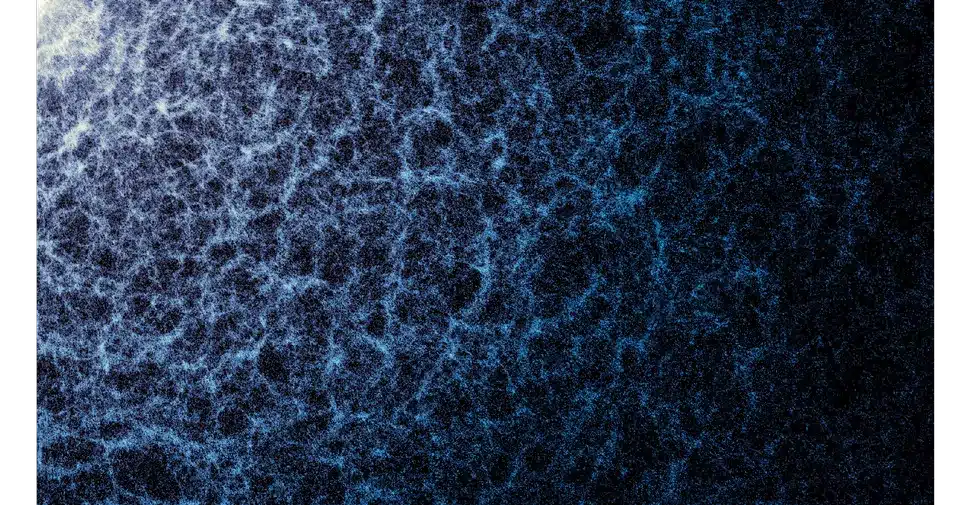
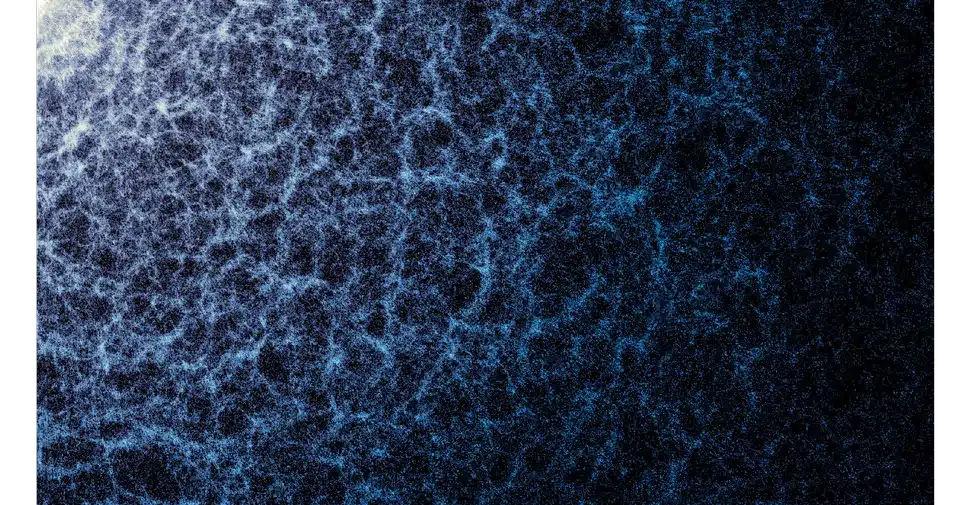 A small portion of DESI’s year-five map in which the large-scale structure of the Universe, created by gravity, is visible. Each dot represents a galaxy. The denser areas indicate regions where galaxies and galaxy clusters have clumped together to form the strands of the cosmic web. Also seen are large voids between the filaments. (Image credit: DESI Collaboration and DESI Member Institutions/DOE/KPNO/NOIRLab/NSF/AURA/R. Proctor; Image Processing: M. Zamani (NSF NOIRLab))
A Major Shift in the Standard Cosmological Model
One of the most tantalizing implications of DESI’s findings is a potential shift in how we understand the universe’s expansion. Traditional cosmological models, such as the Lambda Cold Dark Matter (LCDM) model, have operated under the assumption that dark energy is constant. However, early indications from DESI’s first-year data suggest that dark energy may be fluctuating in strength, a groundbreaking discovery that would challenge our current theories.
“This is a major paradigm shift. All data up to now were compatible with a standard cosmological model where the accelerated expansion of the universe was caused by a cosmological constant,” said Palanque-Delabrouille. “The weakening acceleration observed by DESI can no longer be explained with a cosmological constant. This could be the most interesting discovery in cosmology since that of dark energy itself.”
The potential discovery that dark energy is weakening raises more questions than answers, and it is likely to spark debate and inspire new theoretical models in cosmology. Researchers are eager to confirm these findings, as they could revolutionize our understanding of the universe.