

Kaela Polkinghorn sat in the darkened dome theater of Tampa’s Museum of Science and Innovation and watched eight planets huddle cozily around the sun. Pluto was not included in the group hug. The fourth grader watched the small icy world sit alone in the distance, an outcast from the solar system family portrait.
“It’s very small, and it’s so cute,” Kaela told Mashable. “Like a little baby.”
That moment on a school field trip prompted the 10-year-old to take action. She gathered classmates, including friend Zoey Mead, and wrote a direct appeal to the space agency asking for Pluto to regain its planetary status. Her mother Brandy Polkinghorn found the handwritten note and shared it with family friend Mike Boylan, a Tampa weather personality with a substantial online following. Boylan posted the letter on X.
 Kaela Polkinghorn felt inspired to write a letter to NASA about Pluto following a field trip to the Museum of Science & Innovation in Tampa, Florida. Credit: Brandy Polkinghorn
Within hours, NASA Administrator Jared Isaacman replied personally. “Kaela, we are looking into this,” he wrote on April 9, just as the Artemis II moon mission was returning to Earth. A NASA spokesperson later confirmed that Isaacman fully supports restoring Pluto’s previous status as a planet, a position he had articulated weeks earlier in an interview with the Daily Mail.
Yet the authority to change Pluto‘s label rests elsewhere. The International Astronomical Union, the global body responsible for naming and classification standards for celestial objects, is the only entity that can formally overturn the 2006 vote that reclassified Pluto as a dwarf planet. An IAU spokesperson confirmed the organization has not heard from NASA or Administrator Isaacman regarding any change to Pluto’s status.
Why the 2006 Decision Still Generates Friction
The International Astronomical Union established three criteria for a full-sized planet in 2006. An object must orbit the sun, have sufficient mass to assume a nearly round shape, and have cleared the neighborhood around its orbit. Pluto met the first two requirements but failed the third because it shares its orbital zone with numerous other icy bodies in the Kuiper Belt.
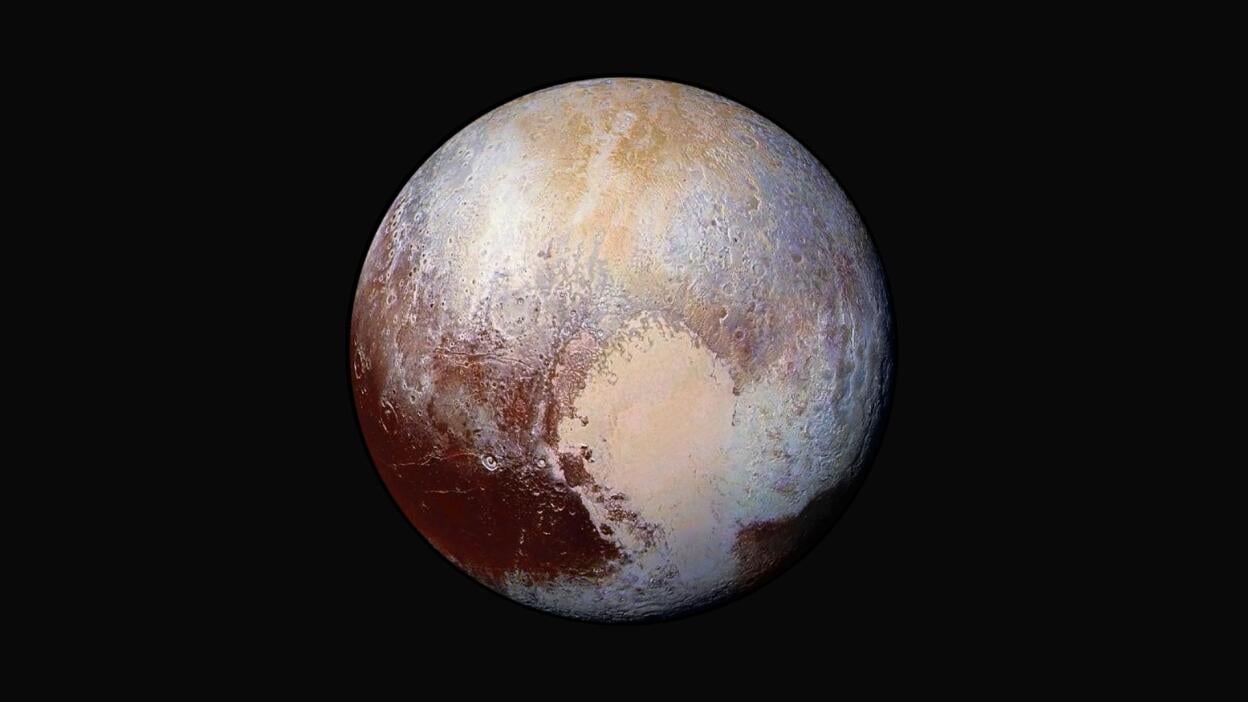 Pluto’s 2006 status change from planet to dwarf planet is still a sore subject for many, including a fourth grader in Tampa, Florida. Credit: NASA / Johns Hopkins University Applied Physics Laboratory / Southwest Research Institute
The vote cut the official planet count from nine to eight and produced a wave of public resistance that has not diminished in twenty years. Arizona’s connection to Pluto remains especially strong. Clyde Tombaugh discovered the distant world from the Lowell Observatory in Flagstaff in 1930, a moment of national pride for older generations who grew up memorizing planetary mnemonics like “My Very Educated Mother Just Served Us Nine Pizzas.” Governor Katie Hobbs designated Pluto as the official state planet of Arizona in 2024.
A Planetary Physicist Weighs the Evidence
Philip Metzger, a planetary physicist at the University of Central Florida, has published two papers examining the scientific and historical basis for planetary classification. His 2019 study in the journal Icarus reviewed asteroid classification from 1801 to the present and found that scientists considered asteroids to be planets for roughly 150 years. The shift in the 1950s occurred because of growing understanding of geophysical differences between asteroids and larger planets, not because of orbital crowding.
Kaela – We are looking into this.
— NASA Administrator Jared Isaacman (@NASAAdmin) April 9, 2026
A second 2022 paper also published in Icarus argued that large moons share the same intrinsic geological complexity as traditional planets and are functionally treated as planets in modern planetary science literature. Metzger told Mashable that NASA’s stance could help shift the broader consensus.
“Some scientists argue that Pluto counts as a planet because of its complex surface and active geology, even if it shares its region of space with many other icy bodies,” Metzger said. “NASA can help contribute to consensus that the IAU definition was inappropriate, so it actually could be quite helpful for the administrator to take this on.”
What Spacecraft Revealed About Pluto
NASA’s New Horizons spacecraft flew past Pluto in 2015 and transmitted images that transformed scientific understanding of the distant world. The photographs showed a bright heart-shaped region on the surface, mountains of water ice, and evidence of recent geological activity. These findings strengthened arguments that Pluto behaves more like a planet than a simple frozen relic of the early solar system.
 NASA Administrator Jared Isaacman spoke to the Daily Mail about his support for classifying Pluto as a planet again. Credit: Reuters
Kaela specifically cited that heart-shaped feature as one reason she finds Pluto so appealing. Her attachment to space exploration runs in the family. Her parents had one of their first dates at the same Tampa museum in 2004, and the family watches rocket launches from their neighborhood when conditions permit. Kaela’s younger brother Austin Polkinghorn is an avid follower of Elon Musk’s ventures. Kaela herself wants to fly in a rocket someday, with Pluto as her intended destination.
The IAU spokesperson noted that while the 2006 decision remains an emotional issue, scientific classifications are determined through international consensus and evidence-based processes. Changes can be made if supporting evidence shifts, but the process cannot be altered unilaterally by any single space agency. A fourth grader’s handwritten letter has pushed a decades-old solar system discussion from a classroom exercise to the desk of the nation’s top space official.