
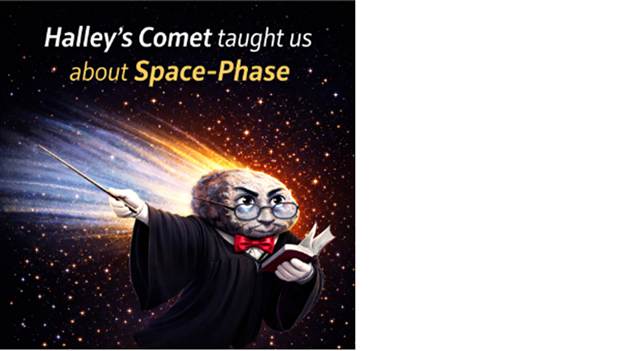
Independent researcher James E. Beecham, MD wanted the Truth about Reality, so he conducted a thought experiment, as Einstein used to do.
West Palm Beach/Palm Beach County, April 18, 2026 — Researcher Announces That Halley’s Comet is Teaching Us Space’s Secrets: A Thought Experiment Opened the Door
West Palm Beach, Florida — April 2026
Independent researcher James E. Beecham, MD wanted the Truth about Reality, so he conducted a thought experiment, as Einstein used to do. Beecham began with a simple question addressed ‘to Halley’s Comet’:
“If space isn’t empty… teach us how it behaves.”
And the answer, Beecham argues, has been repeating itself every 76 years.
THE THOUGHT EXPERIMENT BREAKTHROUGH
‘For centuries, Halley’s Comet has been studied as a predictable traveler governed by empty space and the old-style gravity of force-across-distance’, says Beecham.
But Beecham’s research tells him space is not empty, and gravity doesn’t work like that, so he applied his thought experiment.
WHAT “PROFESSOR HALLEY” HAS REVEALED SO FAR
Motion may condition space itselfSpace may exhibit memory that influences future motionActivation may occur at threshold boundariesDirectional behavior reflects structured space
‘Yes, the observations of the comet’s behavior are well-known’ Beecham says, ‘but what I wanted Halley’s Comet to teach was how these observed behaviors arise under an updated set of rules for our reality.’
These Comet behaviors are familiar—but their meaning may not be:
The comet accelerates and decelerates in a patterned wayIt suddenly “turns on” near the SunIts tail always aligns in a specific directionIt returns along a remarkably consistent path decades later
‘These are not random features, says Beecham, ‘To me they are responses.’
According to Beecham, these responses happen because of a capable medium in space.
‘Our model holds that space is not empty, but behaves like it is filled with a capable, structured medium that can:
Store memoryGuide motionRespond directionallyTrigger threshold changes
In our view:
Halley’s Comet is not just moving through space—it is interacting with it, and showing us how it works.’
THE IMAGE THAT CHANGES THE STORY
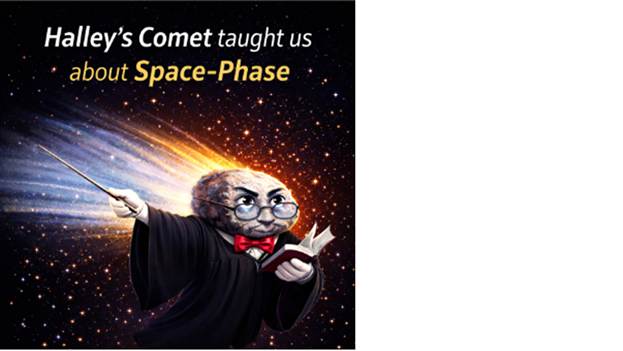
To communicate the idea, Beecham presents Halley’s Comet as a “professor” in a newly released paper titled ‘Halley’s Comet as a Natural Probe of Space-Phase (SP3): Constraints on Memory, Relaxation, and Pressure-Conditioned Motion Across Scales’. https://doi.org/10.5281/zenodo.19640786
According to Beecham, Space-Phase has specific behaviors which guide the Comet’s reactions, as follows:
Near the Sun → space becomes highly conditionedFar away → space relaxesA faint “memory corridor” guides the comet’s returnA threshold boundary is crossed where activity suddenly beginsA directional structure aligns the tail
From this perspective, a central lesson emerges, according to Beecham:
If this view is correct, then Space itself behaves in a way that can retain, influence, and respond to motion.
THE SHOCKING PART
According to Beecham, this same pattern of Space-Phase behaviors appears beyond comets:
Atoms → stable states with sudden transitionsWater → wave propagation without lossAtmospheric phenomena → objects that appear, persist, disappear
One set of behaviors. Across all scales.
A DIRECT CHALLENGE
The announcement challenges a long-standing assumption:
If space is empty, why does Halley behave as if it is not?
TESTABLE — NOT JUST INTERPRETATION
The research outlines measurable predictions:
Persistent paths formed by repeated motionThreshold activation zonesDirectional alignment tied to energy sourcesGradual relaxation of prior conditioning
‘If these tests confirm,’ says Beecham, ‘then space is not passive—it is capable.’
A RETURN TO FOUNDATIONS
The work echoes earlier insights:
Maxwell: energy resides in a mediumEinstein: a universe without a medium is difficult to conceive
But now, Beecham argues:
‘We can ask the universe directly—and Halley’s Comet is answering.’
BOTTOM LINE
Beecham asked Halley’s Comet a simple question:
If space isn’t empty, teach us how it behaves.
And the answer may already be written in its motion.
ABOUT THE RESEARCHER
James E. Beecham, MD (ret.), has authored over 400 papers exploring the concept of Space-Phase as a physical medium (see: jamesebeecham.com).
His work includes:
Explaining early galaxy maturity in space telescope observationsReframing planetary motion as interaction with a mediumProposing a unified framework for structure and motion across scales
Contact Info:
Name: James E. Beecham, MD
Email: Send Email
Organization: jamesebeecham.com
Website: https://jamesebeecham.com
Release ID: 89189223
In case of encountering any inaccuracies, problems, or queries arising from the content shared in this press release that necessitate action, or if you require assistance with a press release takedown, we urge you to notify us at error@releasecontact.com (it is important to note that this email is the authorized channel for such matters, sending multiple emails to multiple addresses does not necessarily help expedite your request). Our responsive team will be readily available to promptly address your concerns within 8 hours, resolving any identified issues diligently or guiding you through the necessary steps for removal. The provision of accurate and dependable information is our primary focus.