
Track your investments for FREE with Simply Wall St, the portfolio command center trusted by over 7 million individual investors worldwide.
The White House has directed U.S. agencies to deploy nuclear reactors for space use, targeting operations in orbit by 2028 and on the Moon by 2030.
This new federal initiative formally brings nuclear power into future space infrastructure plans.
NuScale Power (NYSE:SMR), the only SMR developer with U.S. NRC design approval, is now a direct contender for related government contracts.
NuScale Power enters this new policy push with a share price of $11.41 and a mixed recent track record. The stock is up 22.7% over the past week, while returns over the past year and year to date show declines of 21.9% and 30.0% respectively. Over a 3-year period, the stock return is 30.0%, with a 5-year return of 14.1%.
For investors watching NYSE:SMR, the move into potential space applications introduces a fresh angle beyond conventional grid power. The federal focus on space reactors could broaden how the company is assessed, with future developments likely to hinge on contract awards, technical fit for space use, and NuScale’s ability to adapt its SMR designs to non-terrestrial environments.
Stay updated on the most important news stories for NuScale Power by adding it to your watchlist or portfolio. Alternatively, explore our Community to discover new perspectives on NuScale Power.
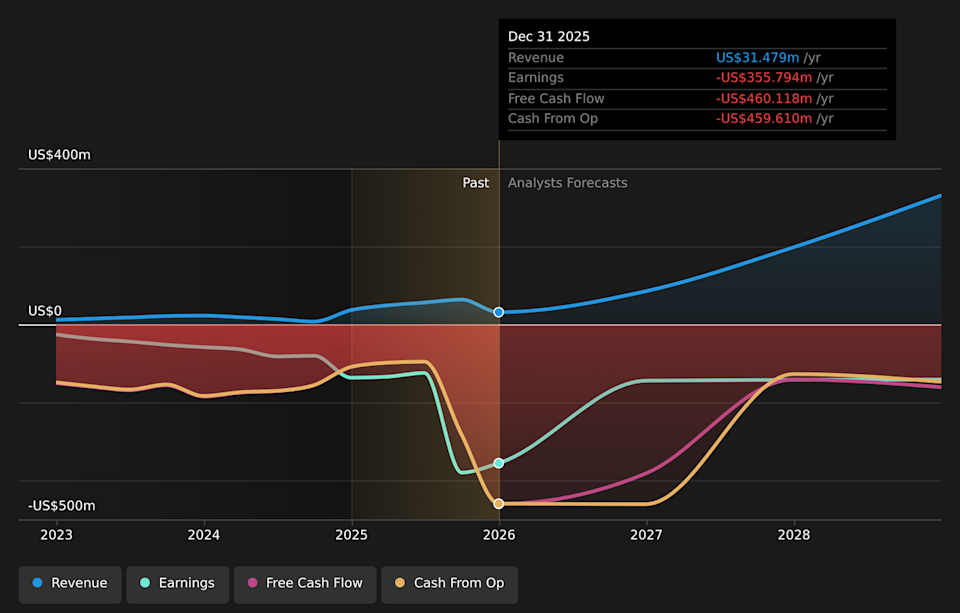 NYSE:SMR Earnings & Revenue Growth as at Apr 2026
We’ve flagged 3 risks for NuScale Power. See which could impact your investment.
The U.S. space nuclear initiative effectively opens a new potential use case for NuScale Power’s small modular reactors, moving the conversation beyond terrestrial grids into power for satellites, lunar bases and defense applications. Because NASA and the Pentagon plan to run competitive vendor processes, NuScale is unlikely to be the only contender, but its existing U.S. NRC-approved design could shorten qualification steps relative to peers that are earlier in development. For investors, the key question is whether NuScale can adapt its SMR technology to space-specific requirements, such as lower mass, radiation-hardened systems and autonomous operation, within the timelines targeted for late 2020s deployment. The opportunity also brings execution and funding questions, as space reactors may require new partnerships, bespoke engineering and potentially different regulatory pathways from NuScale’s current commercial projects. Overall, the news adds another potential revenue stream and reinforces the role of nuclear in future infrastructure, but it does not change the near term reality that NuScale is still working to convert its pipeline into built and operating reactors.
The focus on space nuclear power aligns with the narrative that NuScale’s SMR design could be used in more settings, supporting expectations around future deployment and long-term cash flow once commercialization progresses.
At the same time, the company is already contending with project timing, funding needs and regulatory work on ENTRA1 and other efforts, so adding a space-focused track could stretch resources and complicate execution.
The narrative centers on grid and industrial customers such as RoPower and data centers, so the specific requirements and risks of space reactors are not fully reflected and may introduce new variables for timelines and capital intensity.
Knowing what a company is worth starts with understanding its story. Check out one of the top narratives in the Simply Wall St Community for NuScale Power to help decide what it’s worth to you.
 NuScale remains unprofitable with no commercial reactors sold or built yet, so taking on space reactor work could add development risk before any contracts translate into operating assets.
The Pentagon plans to carry at least two vendors through design review and testing, which means NuScale would face competition from other reactor developers and could invest time and capital without securing long term awards.
 A formal national initiative for space nuclear power highlights government interest in compact reactors, which may support demand for SMR technology across both space and terrestrial applications.
If NuScale’s NRC-approved design proves adaptable for space use, that regulatory head start could be a differentiator when agencies evaluate technical readiness and safety.
From here, watch how quickly NASA and the Pentagon move from policy to concrete program details such as request-for-proposal timelines, technical specifications and budget allocations. For NuScale, any indication that its existing SMR design is shortlisted, or that it forms partnerships tailored to space systems, would help clarify how material this initiative could become compared with its current grid and industrial projects. It is also worth keeping an eye on NuScale’s cash position, capital-raising activity and project pipeline to see whether space-related work adds to execution complexity or is phased in alongside established efforts like RoPower and ENTRA1.
To ensure you’re always in the loop on how the latest news impacts the investment narrative for NuScale Power, head to the community page for NuScale Power to never miss an update on the top community narratives.
This article by Simply Wall St is general in nature. We provide commentary based on historical data and analyst forecasts only using an unbiased methodology and our articles are not intended to be financial advice. It does not constitute a recommendation to buy or sell any stock, and does not take account of your objectives, or your financial situation. We aim to bring you long-term focused analysis driven by fundamental data. Note that our analysis may not factor in the latest price-sensitive company announcements or qualitative material. Simply Wall St has no position in any stocks mentioned.
Companies discussed in this article include SMR.
Have feedback on this article? Concerned about the content? Get in touch with us directly. Alternatively, email editorial-team@simplywallst.com