
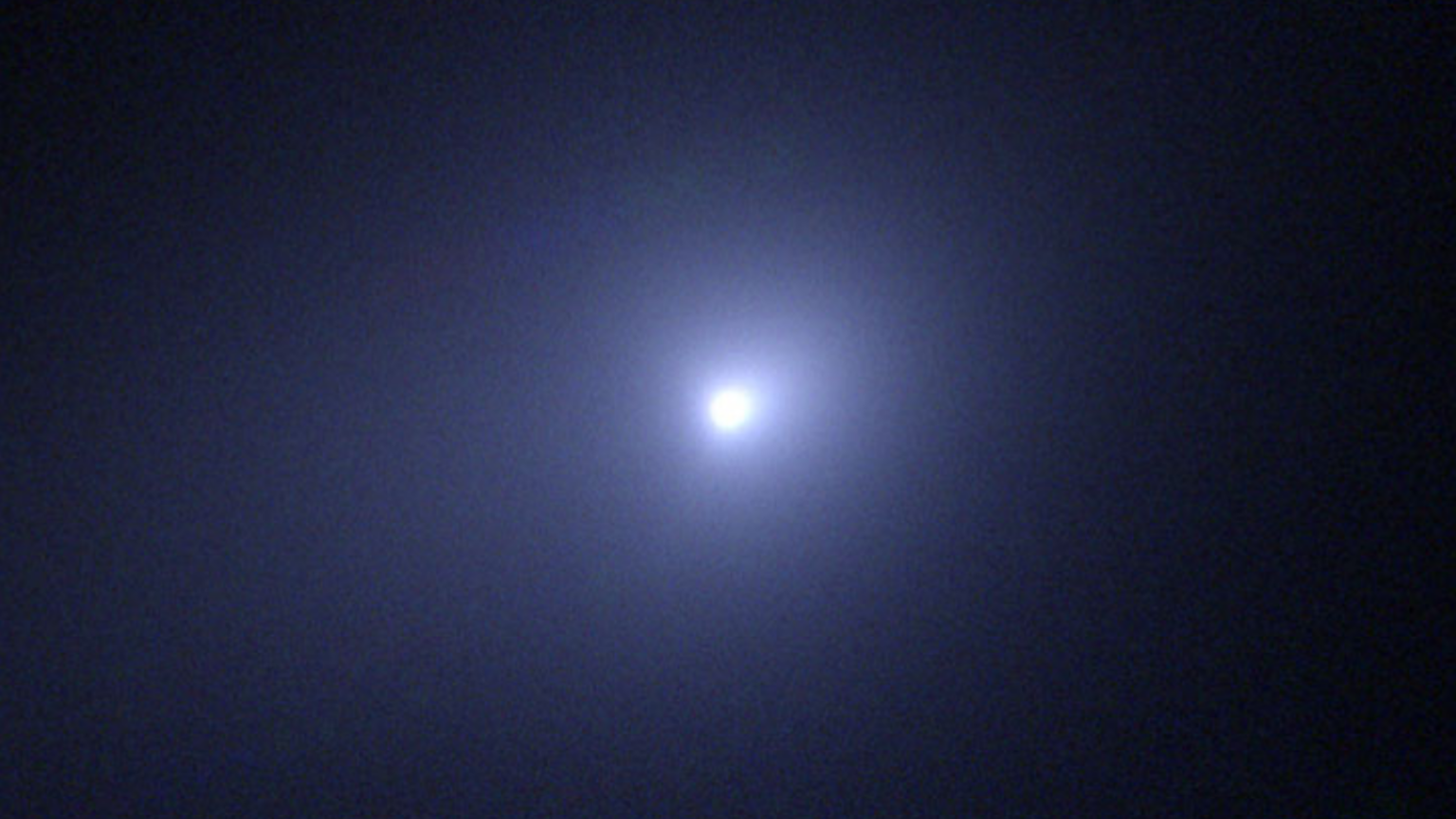
The interstellar comet 3I/ATLAS’ chemistry was changing as it made its close approach to the sun last fall, a new study has found.
3I/ATLAS is fascinating to scientists because it is just the third object ever found passing through our solar system that was born around another star. Thus, it offers an opportunity to investigate the raw materials that existed in other star systems as they were forming planets, asteroids and comets.
In the new study, researchers observed 3I/ATLAS using the Subaru Telescope, an 8.2-meter optical-infrared telescope located near the summit of Maunakea, Hawaii, on Jan. 7, 2026.
“By applying the observational and analytical techniques we have developed through studies of solar system comets to interstellar objects, we can now directly compare comets hailing from both inside and outside the solar system and explore differences in their composition and evolution,” team leader Yoshiharu Shinnaka, of the Koyama Space Science Institute in Japan, said in a statement.
You may like
By studying the colors of 3I/ATLAS’ coma, the bubble of gas that surrounds comets regardless of their origins, Shinnaka and colleagues estimated the ratio of carbon dioxide to water around the interstellar invader.
They discovered that this ratio had changed since 3I/ATLAS made its close approach to the sun on Oct. 29, 2025.

Observations of 3I/ATLAS made in November 2025 by Europe’s JUICE Jupiter spacecraft. (Image credit: ESA/Juice/MAJIS)
This discovery didn’t just suggest that the chemistry of 3I/ATLAS is changing, however. It also provided hints about the internal structure of this interstellar object.
That is because a comet’s coma forms from gas that escapes from its frozen core when it passes close to the sun, and solar radiation causes solid ice to immediately change into gas, a process called sublimation.
The change in coma chemistry observed by the team implies that the internal chemistry of 3I/ATLAS differs from its external chemistry.
“With the full-scale operation of survey telescopes in the coming years, many more interstellar objects are expected to be discovered,” Shinnaka said. “Through studies of such objects, we hope to gain a deeper understanding of how planetesimals and planets formed in a wide variety of stellar systems, including our own solar system.”
The team’s research is set to appear in the Astronomical Journal on April 22. A peer-reviewed version appears on the paper repository site arXiv.