
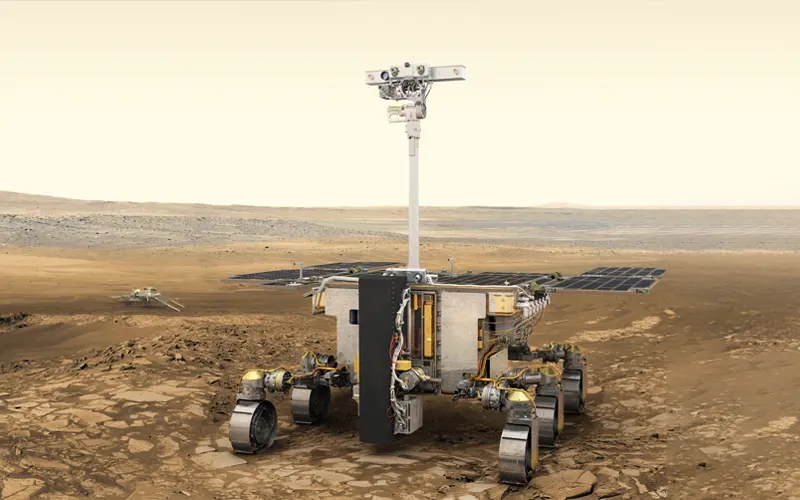
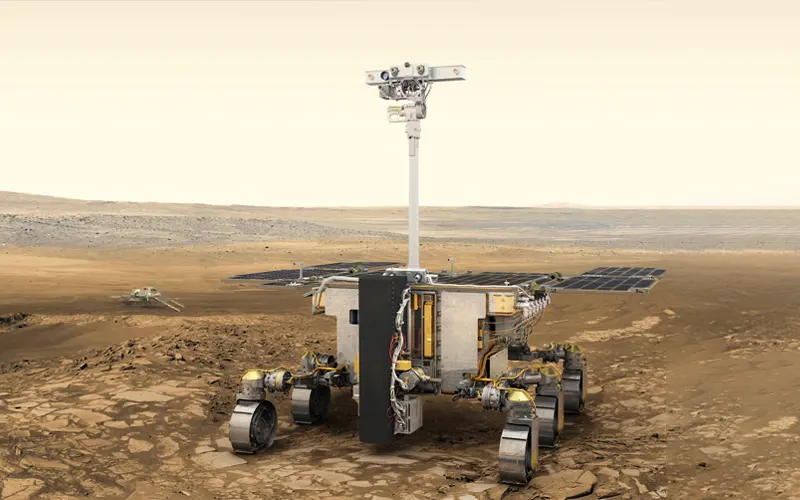
 Credit: ESA/ATG medialab
NASA has selected a SpaceX Falcon Heavy to launch the European Space Agency’s Rosalind Franklin Mars rover no earlier than late 2028. The US space agency’s responsibility to procure launch services for the rover stems from a May 2024 partnership agreement that tasked NASA with this element of the mission as part of its contributions.
The Rosalind Franklin rover was initially expected to be launched in 2022 as part of the ExoMars mission, a joint initiative between ESA and the Russian space agency Roscosmos. After cutting ties with Russia following its invasion of Ukraine months before the expected launch, ESA Member States made the decision in November 2022 to continue developing the mission independently.
ESA awarded a new €522 million contract to Thales Alenia Space on 9 April 2024 to develop elements of the mission previously provided by Roscosmos and to maintain and upgrade existing ESA-built elements. Just over a month later, on 16 May 2024, ESA signed an agreement with NASA under which the US space agency committed to providing launch services, braking engines for the rover’s landing platform, and radioisotope heater units for the rover’s internal systems.
NASA announced on 16 April 2026 that a SpaceX Falcon Heavy would launch ESA’s Rosalind Franklin mission from Kennedy Space Center in Florida. The value of the contract was not disclosed, nor did the agency share any updates on its other contributions to the mission, which are being managed under the Rosalind Franklin Support and Augmentation project.
Despite the agency moving ahead with securing launch services for the Rosalind Franklin rover, there are indications that NASA’s support for the mission may be coming to an end.
According to a 9 April report published by The Planetary Society, NASA’s Rosalind Franklin rover participation element is one of 53 NASA science missions the White House has proposed cutting as part of NASA’s FY2027 budget request. The budget does not, however, explicitly outline the cancellation of the 53 missions, with the report noting that it instead omits mention of the terminated missions, a departure from standard budgetary practice that obscures the full scope of the proposed cuts.
In June 2025, as Washington was proposing similar cuts to NASA’s FY2026 budget, ESA Director of Science Carole Mundell explained that while important, NASA’s contributions were not irreplaceable.
“We value deeply the collaboration between Europe and NASA, but we do have the technical capabilities in Europe today, should it be necessary to reproduce missing elements,” said Mundell.
The uncertainty around NASA’s support will not, as a result, prevent ESA from moving forward with the mission’s launch in 2028. Should the agency successfully land its rover on the surface of the Red Planet, a feat that will be a first for ESA, Rosalind Franklin will then be tasked with drilling below the Martian surface in search of ancient signs of life.
Keep European Spaceflight Independent
Your donation will help European Spaceflight to continue digging into the stories others miss. Every euro keeps our reporting alive.