
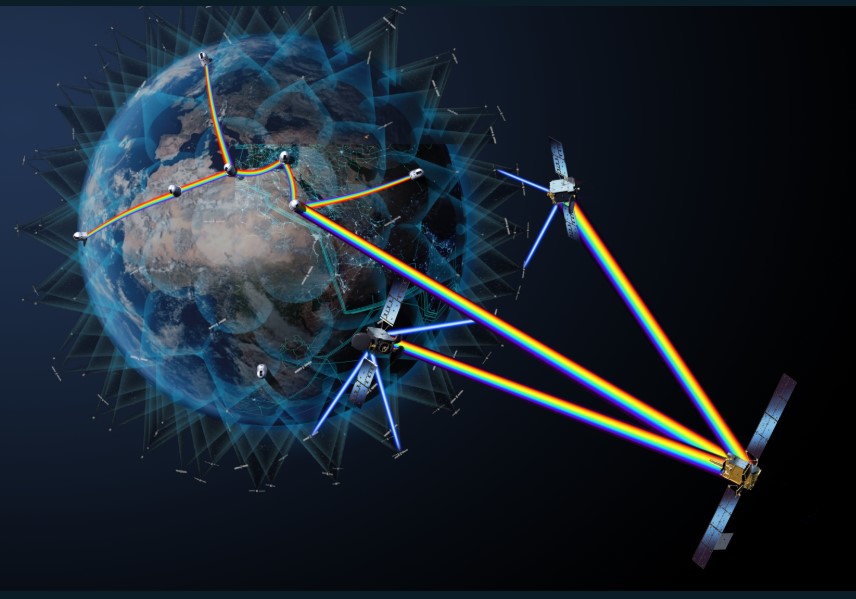
The European Space Agency (ESA) signed a €18.6 million contract with Canada’s Kepler Communications on 14th April. The company will lead a team to test ESA’s HydRON orbital laser-based communications network. HydRON, aims to move data between ground systems and satellites in multiple orbits in real time. The program envisions extending fibre‑like connectivity into space by means of optical links instead of conventional radio transmissions and limited ground stations.
HydRON is organized in elements. In the first, a constellation of low‑Earth‑orbit satellites will relay information via optical connections. In the second, the system will reach higher orbits, linking different orbital layers and the supporting ground infrastructure. The third element, which Kepler Communications is now entrusted with, focuses on bringing industry into the network to test how various technologies and services can operate together in orbit. More to the point, this structure emphasizes building interoperable capabilities across multiple partners and sectors.
Kepler will employ its own satellites to host payloads contributed by several European partners. Vyoma GmbH will provide a space situational awareness payload to track objects in orbit and help monitor satellites and debris. Additionally, optical communication hardware will come from TESAT, MBRYONICS Ltd, and Astrolight UAB. The arrangement underlines ESA’s aim to validate a European‑led, resilient space communications infrastructure.
Why HydRON is so fast
The project highlights that optical communications can complement traditional radio frequencies, which face increasing congestion. Laser links are expected to carry larger data volumes with less interference and heightened security. HydRON aims to demonstrate terabit‑per‑second data rates and to show how space‑based networks can integrate with ground fibre systems. In addition to speed, interoperability is a central goal, ensuring technology from different European companies can operate together within a single network. This is described as a key step for Europe’s competitiveness in optical communications and for future flexible space systems.
“HydRON will serve as the world’s first multi-orbital optical communications network with a terabit per second capacity, offering resilient and efficient data transfer to address the challenges of bringing connectivity to multiple users securely, quickly and reliably,” said Laurent Jaffart. “Today’s signature with Kepler Communications continues our collaboration on the project, as they contribute their expertise in concert with their consortium to deliver within Element 3; the component of HydRON that’s key to building new industrial capabilities, demonstrating new service concepts, fostering system extensions, and promoting international cooperation and interoperability.”
“HydRON is a key initiative in advancing sovereign optical communications and enabling high-capacity data transport,” said Mina Mitry. “Element 3 represents a critical step in broad interoperability testing and delivering real-time access to data for various applications.”
“With HydRON Element 3 and further HydRON evolutions, ESA will respond to the needs of its Member States for high speed and secure communications across air, High-Altitude Pseudo-Satellites (HAPS), maritime and – in the longer term – deep space communications,” said Harald Hauschildt.
 Published by James Hydzik
James Hydzik is a technology geek focused on the junction of engineering, writing, and coffee. He joined Orbital Today in 2020 to help make sense of the Johnson government’s decision to buy OneWeb. Since then, he has taken on interviewing and editor-in-chief roles. James learned the ropes of editing and writing with Financial Times magazines, The World Bank, PwC, and Ericsson. Thus far, interviewing New Space movers has put the biggest smile on his workaday face. The son of an Electrical Engineer, James understands the value of putting complex topics into clear language for those with a lay person’s understanding of the subject. James is a European transplant from the United States, and as ex-KA3LLL, he now holds European amateur radio licenses. His next radio project is a portable 10GHz EME (moonbounce) station, as it combines his childhood interests in antennas and space.