
Researchers at the University of Florida are helping scientists around the world better understand the structure and future of the cosmos.
Zachary Slepian, Ph.D., an associate professor of astronomy at UF, is part of the international collaboration behind the Dark Energy Spectroscopic Instrument, or DESI. The ambitious five-year survey has produced the largest high-resolution three-dimensional map of the universe ever created, charting the positions of more than 47 million galaxies and quasars across billions of years of cosmic history.
“DESI is a big U.S. Department of Energy survey of the sky, and it has resulted in the largest 3D map of the universe ever to be created by humankind,” Slepian said.
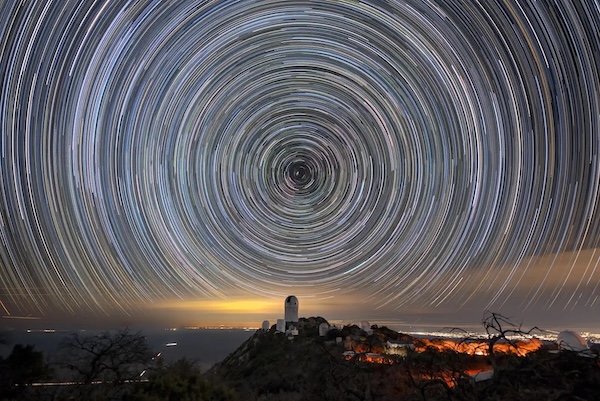
Mounted on the Nicholas U. Mayall Telescope at Kitt Peak National Observatory in Arizona, DESI uses 5,000 robotic fiber optic positioners to collect light from thousands of galaxies at once. By splitting that light into its component colors, scientists can measure each galaxy’s distance and apparent motion due to both the Universe’s expansion and the galaxy’s own velocity, allowing them to build a massive three-dimensional map of the universe.
The scale of the project represents a dramatic leap forward for astronomy.
“It means that, basically, we succeeded in this really, really ambitious quest to try to expand our picture of the cosmos by a factor of 50 or so in number of galaxies,” Slepian said.
Previous surveys mapped about 1 to 1.5 million galaxies. DESI is expected to catalog roughly 50 million galaxies and quasars, giving astronomers far more data to study how the universe has expanded over time.
“So really, DESI has kind of changed the game in terms of how big a dataset we have to work with,” he said.
Slepian has been involved in the project for nearly a decade. He began working on DESI in 2016 after completing his doctorate and taking a postdoctoral position at Lawrence Berkeley National Laboratory, which manages the project.
His contributions span nearly every stage of the project, from collecting observations for targeting the survey to designing the analyses used to study the data. Slepian also spent nights helping collect observations for the survey itself, coordinating remotely with telescope operators.
At UF, Slepian and his research group are now analyzing the enormous dataset to study how galaxies cluster across the universe. Together, they are studying patterns that offer critical clues about dark energy, the mysterious force thought to make up about 70 percent of the universe and drive its accelerating expansion.
“Dark energy is definitively and literally the biggest unknown in science,” Slepian said.
Scientists know that the universe is expanding, and that the expansion is accelerating. Dark energy appears to be responsible and, depending on its properties, could determine the ultimate fate of the cosmos.
DESI data has already produced hints that dark energy’s density in space may change over time rather than remain constant, a possibility that could reshape scientists’ understanding of the universe.
The work relies heavily on high performance computing resources at UF. Slepian’s team processes the enormous dataset using HiPerGator, the most powerful university supercomputer in the United States.
“I don’t know of any other university in the U.S. where I would have been able to get the number of graphics processing units in the timeframe that I needed to do this analysis,” Slepian said.
The DESI data has supported the research of multiple doctoral students at UF and has contributed to the work of several postdoctoral scholars in his group.
Even though the telescope observations for DESI’s original survey are now complete, the scientific work is just beginning. Researchers have analyzed only a small portion of the data so far. Over the next several years, Slepian’s team and other DESI collaborators will continue studying the full dataset, which spans billions of years of cosmic history.
As scientists continue analyzing the map, they hope the unprecedented view of the universe will reveal new insights about dark energy, cosmic structure and the fundamental science that has shaped the universe.
“UF really has a front row seat,” Slepian said.
DESI is supported by the DOE Office of Science and by the National Energy Research Scientific Computing Center, a DOE Office of Science national user facility. Additional support for DESI is provided by the U.S. National Science Foundation; the Science and Technology Facilities Council of the United Kingdom; the Gordon and Betty Moore Foundation; the Heising-Simons Foundation; the French Alternative Energies and Atomic Energy Commission (CEA); the Secretariat of Science, Humanities, Technology and Innovation (SECIHTI) of Mexico; the Ministry of Science and Innovation of Spain; and the DESI member institutions.
Read more from The Berkeley Lab here.