
Agency
13/04/2026
273 views
0 likes
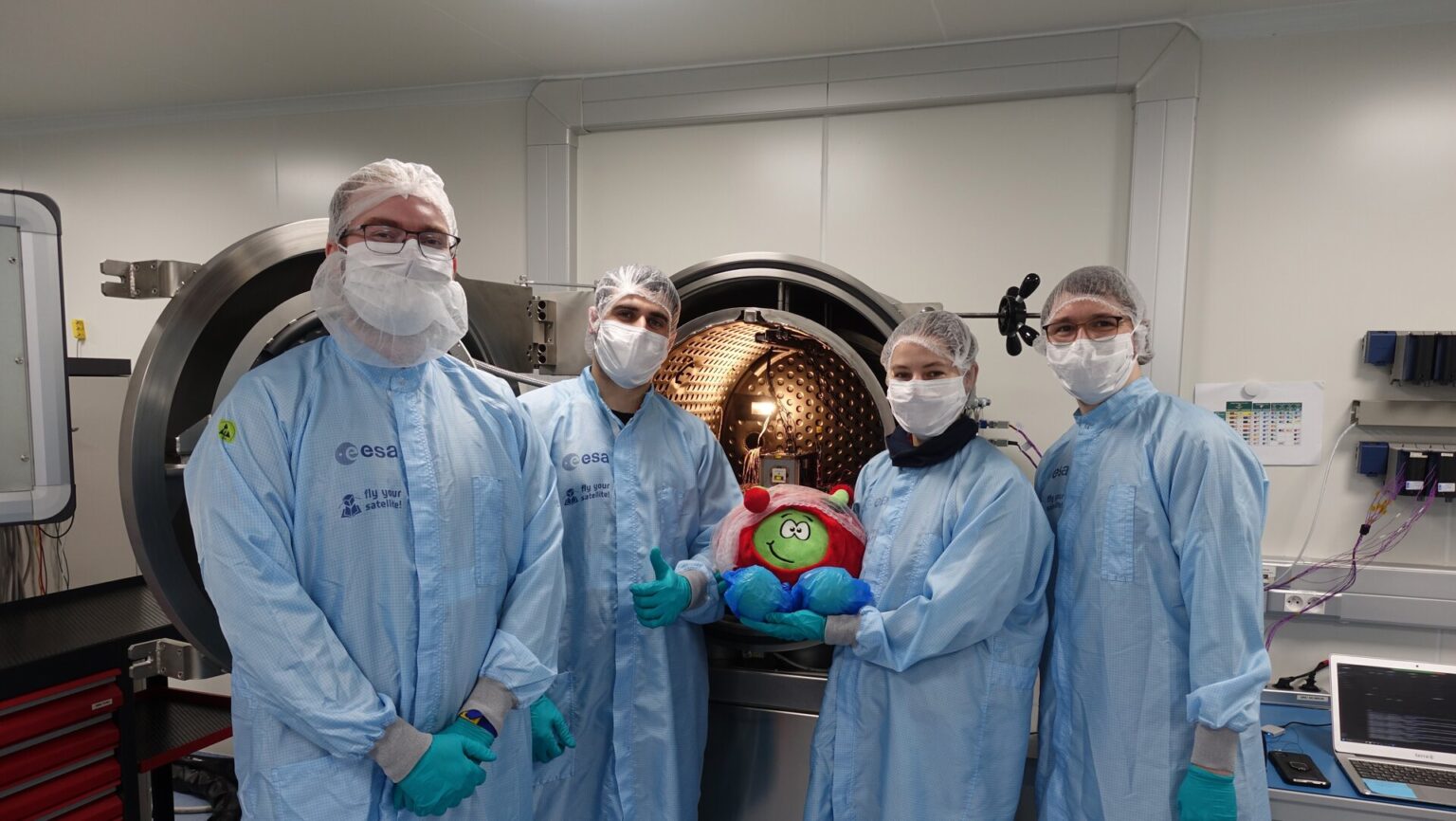
From 16 to 27 February 2026, students from the TUDSaT team, Technical University Darmstadt (Germany) conducted an environmental test campaign of their satellite TRACE at the CubeSat Support Facility, located at ESA ESEC Galaxia. The campaign was carried out within the Fly Your Satellite! Test Opportunities Programme, an initiative of the ESA Education Office that provides student satellite teams with access to professional testing facilities and technical expertise.
Selected for the programme in September 2025, the TUDSaT team travelled to Redu to test their Proto Flight Model (PFM) satellite. The campaign focused on vibration testing using a 20 kN shaker and Thermal Vacuum (TVAC) testing, two essential steps in preparing a satellite for the extreme conditions of launch and space. Beyond the technical milestones, the campaign provided invaluable hands-on experience for the student team, highlighting the importance of practical testing in the education of the next generation of space engineers and scientists.
Proto Flight Model fit check inside the CubeSat deployer
The satellite tested during the campaign was the Proto Flight Model (PFM) of TRACE. In satellite development, a Proto Flight Model refers to a spacecraft that serves both as the qualification model and the flight unit. Instead of building separate engineering and flight versions, the PFM is tested at defined levels to demonstrate that it can withstand the stresses of launch and the harsh conditions of space while ultimately becoming the satellite that will fly. To verify the robustness of their satellite, the team carried out two key types of environmental testing that simulate major stresses encountered during a mission.
The first part of the campaign consisted of vibration testing using the 20 kN shaker at the CubeSat Support Facility. During a rocket launch, satellites experience intense mechanical loads and vibrations generated by the launch vehicle. Shaker tests attempt to reproduce these forces on the ground to ensure the spacecraft structure and components can safely withstand the journey to orbit.
During one of the high-level vibration tests, the team detected an unusual noise. Out of caution, it was decided to continue the vibration testing sequence while postponing the subsequent functional tests until the origin of the noise could be fully understood. Once the campaign concluded and the team returned to their premises, a detailed investigation will be conducted to determine the source of the noise.
The second part of the campaign focused on Thermal Vacuum (TVAC) testing, which simulates the vacuum of space and the large temperature variations experienced in orbit. Because of the observations made during the vibration campaign, the TVAC test plan was adapted to prioritise data collection and system observation. The revised objectives focused on:
Collecting temperature data during hot and cold plateaus under high vacuum
Supporting correlation with the thermal model of the satellite
Observing any physical deformation or structural response due to temperature changes
With these objectives, the campaign proved highly valuable. The team successfully gathered important thermal data that will help them refine their thermal analysis and system modelling.
TUDSaT team inspecting their satellite
Beyond the technical outcomes, the campaign represented a major educational milestone for the TRACE students. Access to test facilities such as the CubeSat Support Facility allows students to experience the full lifecycle of space hardware development, from design and assembly to qualification testing, exposing them to real engineering challenges.
Student satellite missions play an increasingly important role in the development of the European space ecosystem. By designing, building and testing real spacecraft, students acquire the technical, analytical and teamwork skills required in modern space projects. Most importantly, the experience contributes to training the next generation of scientists, engineers and space professionals, ensuring that Europe’s future space missions will continue to benefit from skilled and motivated talent.
Test opportunities are available not only to satellite teams and teams who have previously participated in Fly Your Satellite! opportunities but also to others, such as sounding rocket teams and experiment teams such as those participating in the ESA Academy Experiments programme.
To learn more about the programme, click here.
Like