

In an era where the skies are becoming increasingly crowded with satellites and the flow of data between them is growing exponentially, the European Space Agency (ESA) is launching a series of missions that could fundamentally change how we communicate in space. On March 30, 2026, ESA backed seven new CubeSats aboard SpaceX’s Transporter-16 mission, with the ambition of pioneering high-throughput laser communication, inter-satellite networking, and in-orbit AI processing. These groundbreaking advancements promise to address the challenges of overloading radio frequencies and pave the way for a faster, smarter, and more secure global space network.
The Future of Space Data Transfer
ESA’s mission strategy aims to tackle the growing demands of space data transmission, an area rapidly filling up with satellites and the data they generate. As Earth observation, maritime monitoring, and communication networks expand, the need for reliable and high-speed data transfer methods becomes urgent. The radio frequency spectrum that many satellites depend on is quickly reaching its limits, and ESA’s new missions are designed to test innovative solutions that could break through these barriers.
By utilizing optical laser communication, ESA intends to vastly improve how satellites exchange information. Unlike traditional radio frequencies, laser communication offers high-speed, secure data links that are less prone to interference. This new technology could enable more efficient transmission of vast quantities of data, including high-resolution images and real-time information needed for critical applications like climate monitoring and emergency response.
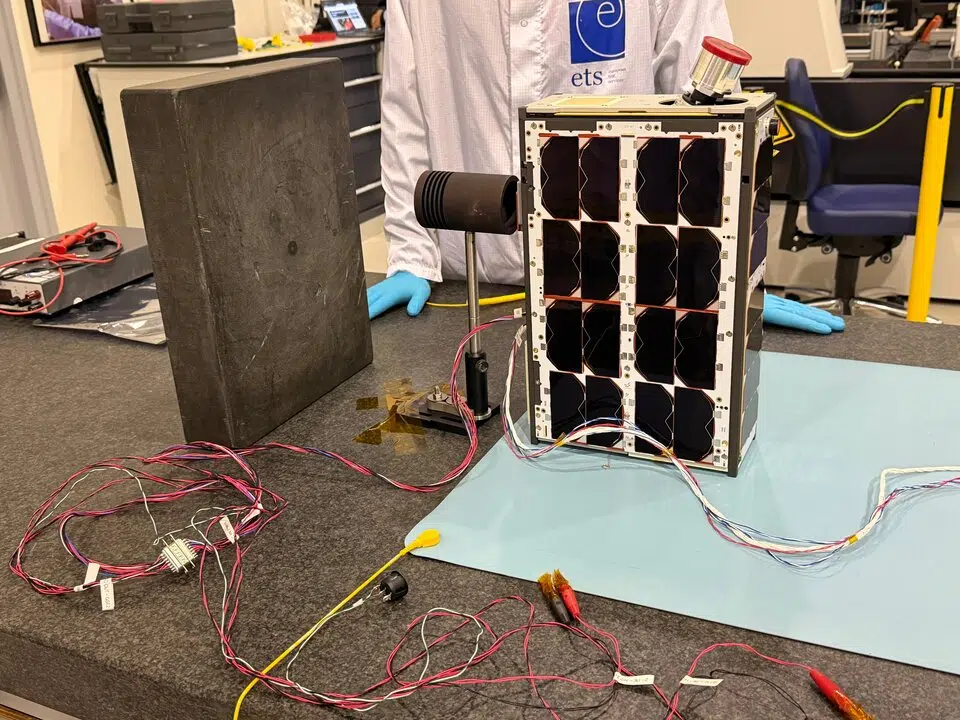 OptiSat ready for integration before integration with its deployment system
Credit: ESA
ESA’s Technological Innovation: CubeSats and Laser Communication
Among the key players in these missions are the CubeSats developed under the Greek Connectivity Programme. Five of these small satellites are focused on advancing Greece’s capabilities in space-based optical communication. One such satellite, OptiSat, will test a SCOT20 laser communication terminal developed by the German company TESAT, aiming to establish high-speed laser links with other satellites in Low Earth Orbit (LEO).
The other Greek satellites, part of the ERMIS Constellation, will demonstrate a variety of cutting-edge technologies, including 5G satellite connectivity and the ability to download vast amounts of Earth observation data via laser communication. These missions could be pivotal for future satellite constellations that will need to handle large-scale, real-time data streams without overloading traditional communication networks.
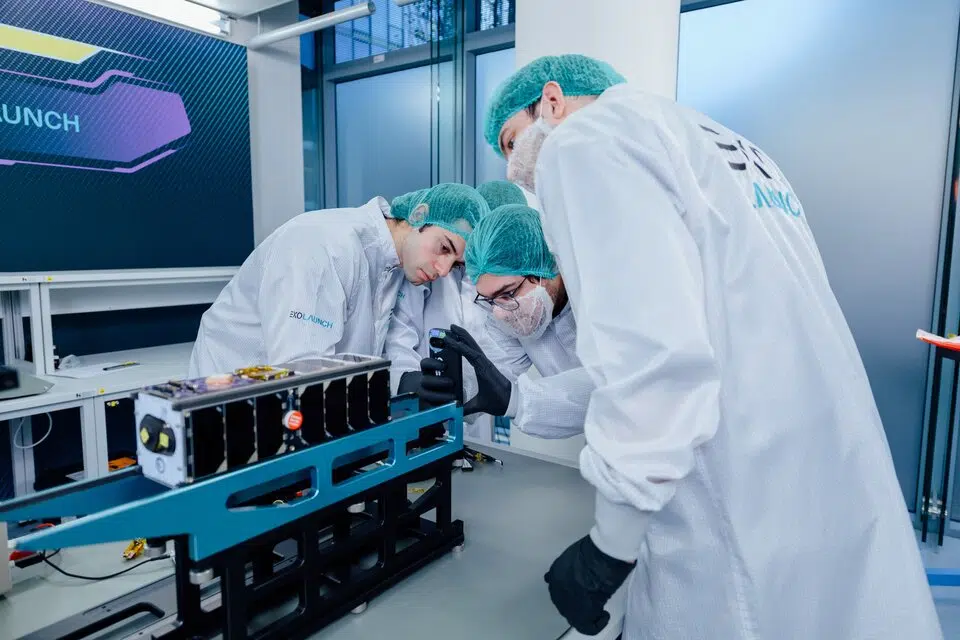 PeakSat integrated with its deployment system
Credit: ESA
Commercial Partnerships and the Future of Space Networks
ESA’s collaboration with commercial entities under the Pioneer Partnership Projects marks a critical step toward making space infrastructure more affordable and accessible. One of the notable missions, led by Spire Global, will test inter-satellite optical links, vital for future space networks that require data to be relayed between satellites in orbit and back to Earth without bottlenecks.
Another commercial mission, VIREON, aims to offer high-resolution Earth observation data on a daily basis, making it possible to monitor vital resources like water quality, forests, and agriculture. This could be a game-changer in global environmental monitoring.
Lastly, ESA’s partnership with Belgian company EDGX is introducing “edge computing” to space, processing data on satellites themselves rather than sending it back to Earth for analysis. This could significantly reduce bandwidth requirements and increase the speed and efficiency of satellite data transfer.