
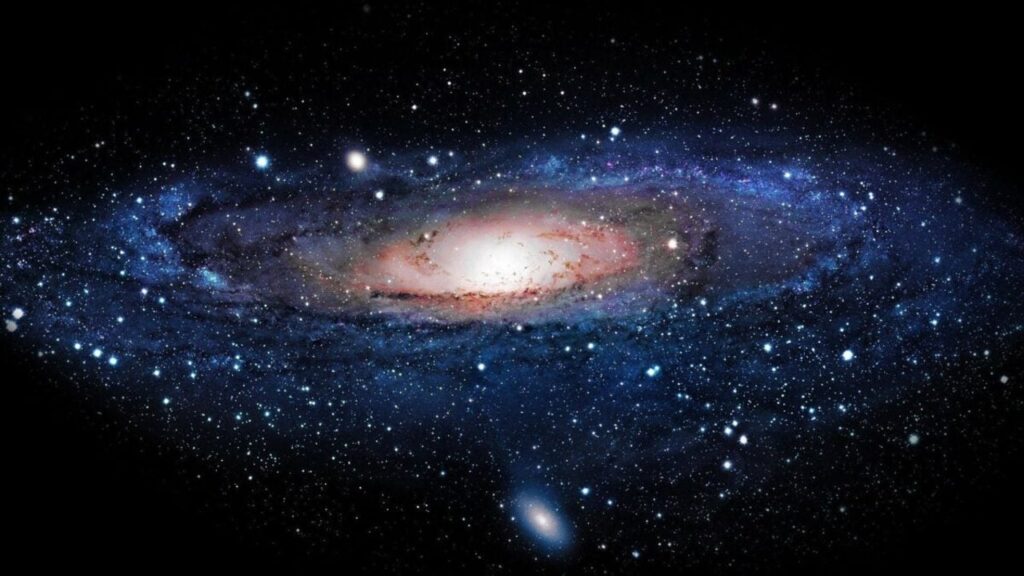
We are all talking these days about Artemis II, and it’s no wonder, as it is the first time we are sending four astronauts to visit and photograph the far side of the Moon. But, fortunately for science, there are many more studies underway at this time.
The first stars were massive, hot, and bright, and they formed from primordial clusters of hydrogen and helium. They lived intensely and died young, but not before producing new elements in their stellar remnants that would later give rise to new generations of stars. Scientists know all this, but there are still many questions to be answered about those ancient stars.
The oldest star ever found by humankind
A group of astronomers has found the most chemically pristine star to date, which could make it the oldest known star in the cosmos. The star may have formed in the first billion years after the Big Bang, a celestial relic that is part of the second generation of objects in the universe.
The discovery, published in Nature Astronomy, offers an exceptional insight into the evolution of ancient stars and how they gave rise to the smaller, more enduring stars commonly found today.
“These pristine stars are windows to the dawn of stars and galaxies in the universe,” said Alexander Ji, assistant professor of astronomy and astrophysics at the University of Chicago and lead author of the new study, in a statement.
In the beginning, the universe was a hot, murky, and dense soup of particles that cooled and expanded over time. Scientists believe that the first stars began to form only a few hundred million years after the Big Bang, about 13.7 billion years ago.
The first generation of stars formed from primordial hydrogen and helium. However, in their cores, atoms fused to form heavier elements. When those first stars exhausted their fuel and exploded, a new generation was forged from their remnants. As this process repeated, each generation of stars contained more heavy elements.
“All the heavy elements in the universe, which astronomers call metals, were produced through stellar processes: from fusion reactions that take place in the interiors of stars to supernova explosions or collisions between very dense stars,” Ji explained.
The first generation of stars is faint and has not yet been observed directly. Astronomers hoping to gather clues about the early evolution of stars are looking for those that are metal-poor, meaning they have low amounts of heavy elements like iron and carbon.
The team responsible for the recent discovery set out to search for ancient stars, meticulously reviewing the catalogs compiled by the Sloan Digital Sky Survey for anomalous readings. In April 2025, the team traveled to the Magellan Telescopes at the Carnegie Science Las Campanas Observatory in Chile to take a closer look at a short list of candidate stars.
A particular star stood out for having less than 0.005% of the metallic content of the Sun. “The more we observed it, the more it seemed to be real,” said Natalie Orrantia, an astronomy student at the University of Chicago and co-author of the study, in a statement.
80,000 light years away from Earth
The star, named SDSS J0715−7334, is located about 80,000 light-years from Earth. A more detailed analysis of the star’s composition confirmed that it is the new holder of the stellar purity record, making it the most chemically pristine star ever observed.
In fact, SDSS J0715-7334 is twice as metal-poor as the previous record holder (J1029+1729). This exceptionally pristine star has particularly low amounts of iron and carbon.
Using data from the Gaia mission of the European Space Agency, the team responsible for the discovery was able to identify the star as a “galactic immigrant.” The star may have formed in another part of the cosmos and was later attracted to the Milky Way.
The discovery also helps scientists better understand how stars became smaller over time, which could be due to the absence of cosmic dust during the early universe.