
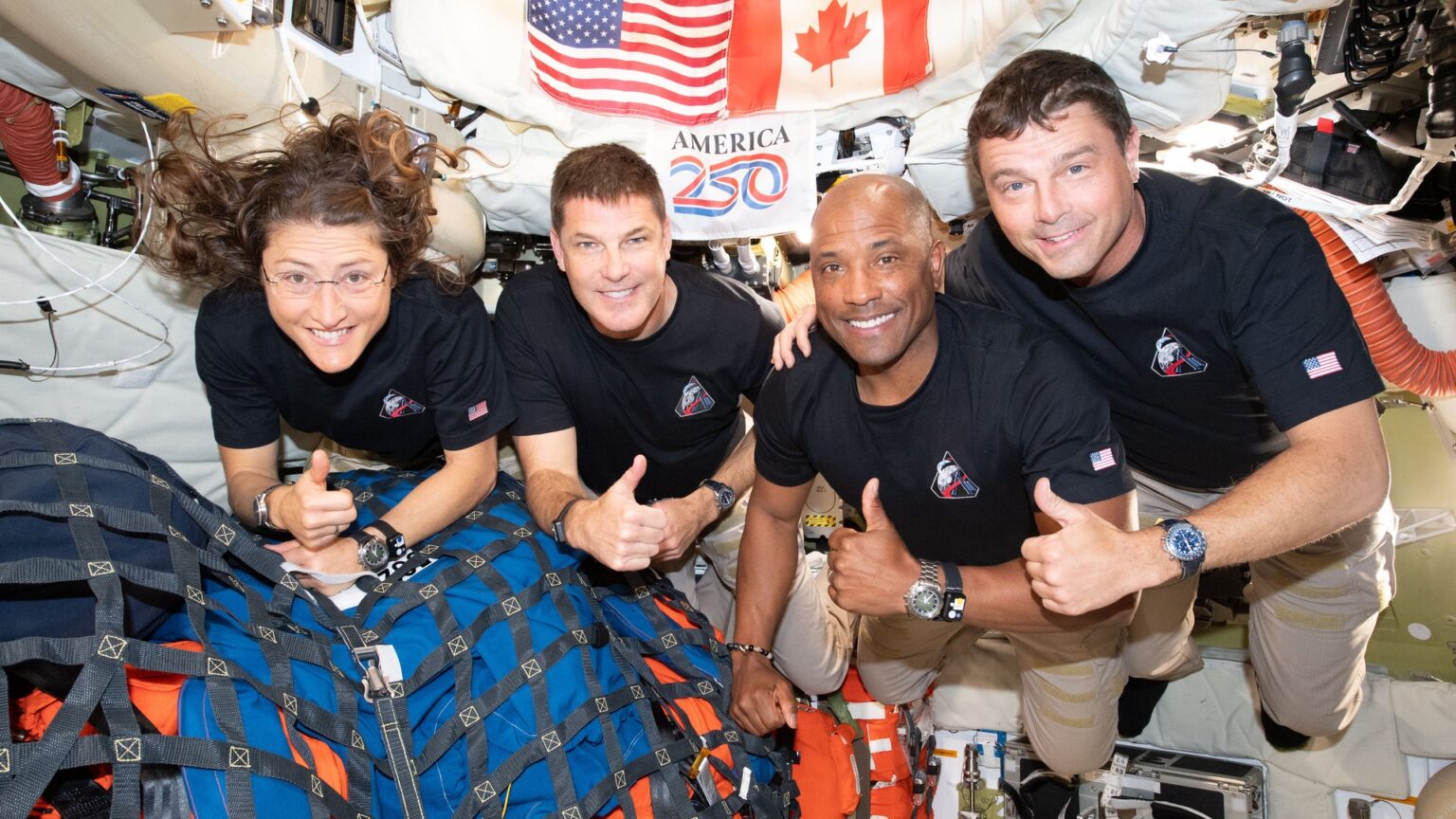
A day after Artemis II astronauts completed their trip around the moon, taking them farther than any other humans have gone in space, they were celebrated at NASA’s Johnson Space Center in Houston.
Artemis II consisted of NASA astronauts Reid Wiseman, Christina Koch, Victor Glover and Canadian Space Agency astronaut Jeremy Hansen.
On stage, Wiseman marveled over the fact that just 24 hours ago, he was looking at the Earth from a window in the Orion spacecraft.
“Here we are, back in Ellington [Field], at home,” he said.

Download the SAN app today to stay up-to-date with Unbiased. Straight Facts™.
Point phone camera here
The four Artemis II crew members, Wiseman said, are now “bonded forever” through their experience.
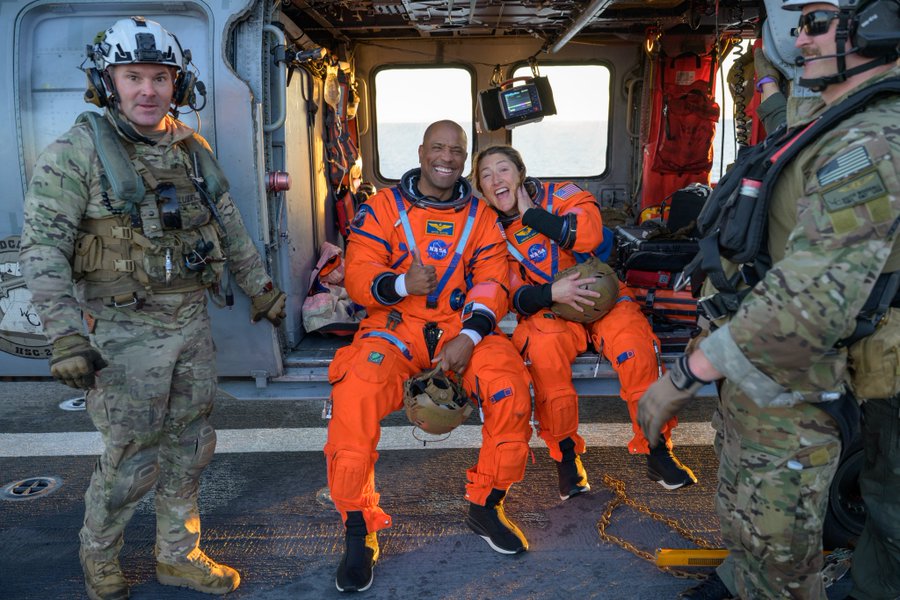 (Courtesy of NASA)
“No one down here is ever going to know what the four of us just went through,” he said. “And it was the most special thing that will ever happen in my life.”
Before the launch, “it feels like it’s the greatest dream on Earth,” Wiseman said. “And when you’re out there, you just want to get back to your families and your friends. It’s a special thing to be a human, and it’s a special thing to be on planet Earth.”
Glover, in his remarks, admitted: “I have not processed what we just did, and I’m afraid to start even trying.”
When the astronauts’ journey started, Glover said, he wanted to make it a point to thank God in public.
“I want to thank God again, because even bigger than my challenge trying to describe what we went through, the gratitude of seeing what we saw, doing what we did, and being with who I was with — it’s too big to just be in one body,” Glover said.
Glover took a moment to thank the families of the crew.
“I love you, but not just those five beautiful cocoa-skinned ladies right there,” he said, referring to his own wife and kids. “All of you.”
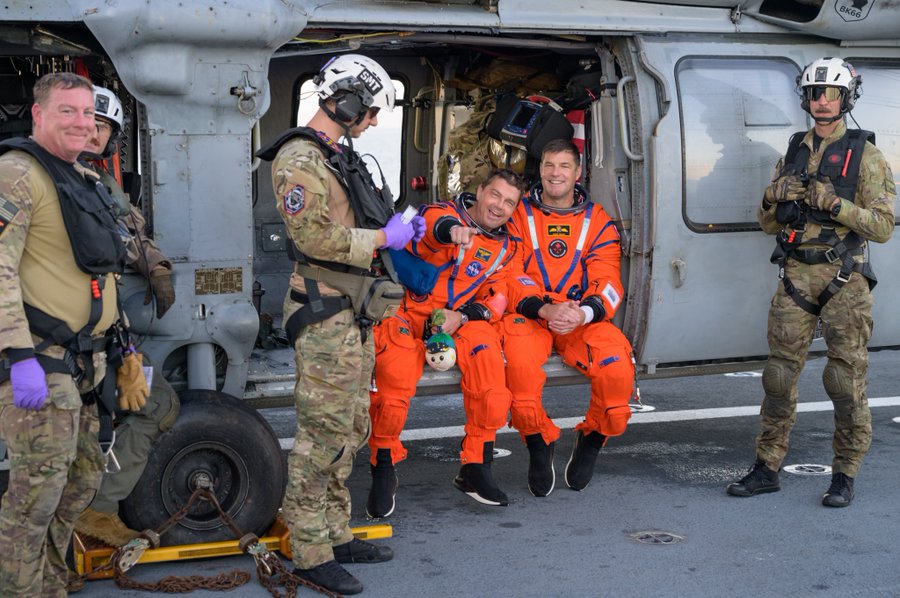
Koch said her journey began with mission manager, Sean Duvall, knocking on crew quarters to let her know it was time for lunch. It ended with a nurse on the NASA recovery ship asking her for a hug.
In the last 10 days, Koch said, she found out what a crew is.
“A crew is a group that is in it all the time, no matter what, that is stroking together every minute with the same purpose, that is willing to sacrifice silently for each other, that gives grace, that holds accountable,” she said. “A crew has the same cares and the same needs, and a crew is inescapably beautifully, dutifully linked.”
What struck Koch up in space wasn’t just seeing the “tiny” Earth, but the “blackness” surrounding it.
“Earth was just this lifeboat hanging undisturbingly in the universe,” she recalled.
While Koch said she hasn’t “learned everything that this journey has yet to teach me,” she does know one thing.
“That is planet Earth: You are a crew,” she said.
Taking the stage, Hansen joked that it was the farthest he’d been from Wiseman in a while.
“You haven’t heard us talk a lot about the science, the things we’ve learned, and that’s because, they’re there, and they’re incredible — but it’s the human experience that is extraordinary for us, and it sounds like maybe for you too,” Hansen said.
During their mission, went 252,756 miles from earth, breaking Apollo 13’s record of 248,655 miles from 1970. They saw a solar eclipse during a lunar flyby, and were able to name two craters. One was deemed Integrity, which was name of their capsule, and the other Carroll, after Wiseman’s wife, who died of cancer in 2020.
Start your day with fact-based news.
The mission was historic for many reasons, among them being that Glover was the first Black man to fly around the moon, and Koch was the first woman. Hansen is also the first Canadian to circumnavigate the moon.
“We often say that we stand on the shoulders of giants. After seeing them return from this mission, I have to say their shoulders now seem even broader for the next generation to stand on,” Vanessa Wyche, director of NASA’s Johnson Space Center, said.