
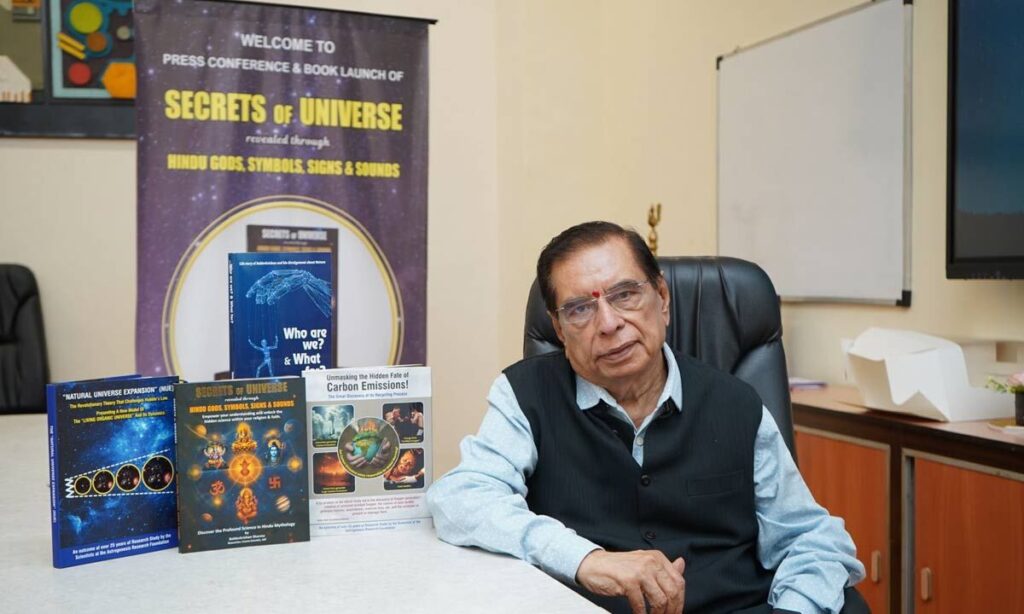
Bengaluru: In an age when questions about existence, consciousness, and the universe continue to intrigue scientists and spiritual thinkers alike, conversations that bridge these realms are becoming increasingly relevant. Exploring this intersection, we engage with Baldevkrishan Sharma, author of Secret of the Universe, whose work delves into the deeper cosmic truths and spiritual blueprints shaping human life. In this exclusive interaction, he reflects on the inspiration behind his book, the philosophy that drives it, and the broader insights it offers into understanding our place in the universe.
Q) What first sparked your interest in looking at Hindu gods and symbols through the lens of science and the universe?
As a Cosmologist, I have developed a deep understanding of the Universe’s functioning, its laws, and governing principles. In my earlier work, Natural Universe Expansion, I introduced a time dimension to Hubble’s Law and proposed a new model titled the Living Organic Universe (LOU).
Alongside this, I have studied the Vedas, Upanishads, and other Hindu philosophical texts, which describe Gods, symbols, signs, and sounds.
This book emerges from connecting these two domains, integrating my knowledge of cosmology with Vedic wisdom by effectively joining the dots.
Q) You’ve had quite a journey, from innovation and business to deep research. What inspired this shift in direction?
Research has always been a natural inclination for me, which I have been able to pursue fully after retiring from Marshalls Wallcoverings. During my entrepreneurial journey, time constraints limited focused research; however, over the past three decades, I continued to gather and develop knowledge in parts.
Today, I am integrating these insights into a coherent, structured body of work, as reflected in my four published books, with several more currently in progress.
Q) Your book suggests that Hindu symbols and deities were used to communicate complex scientific ideas. Could you share one example that illustrates this clearly?
For example, Ganesha may be interpreted scientifically as a symbolic representation of the Earth–Moon system as a composite living entity, with the Moon as the brain and the Earth as the physical body. To make this concept accessible, it is conveyed through a simple narrative portraying Shiva, Parvati, and Ganesha as human-like figures. The story of Ganesha’s beheading and restoration with an elephant head serves as a medium to communicate deeper scientific principles.
Symbolically, the elephant head (larger in proportion) represents the Moon, while the potbelly body signifies the Earth. The posture and trunk orientation subtly indicate anticlockwise motion, reflecting the dynamics of the Earth–Moon system. Thus, mythology emerges as a scientific abstraction expressed through symbolism, making complex cosmic concepts understandable. For details, refer to “Secrets of the Universe”, Chapter 2 (Pages 11–42).
Q) How is your interpretation of Hindu mythology different from the way it’s usually understood?
Traditionally, Hindu mythology is often viewed as religious narratives or symbolic stories meant for devotion and cultural continuity.
My interpretation goes a step further, I see these symbols as a structured knowledge system, where ancient seers encoded cosmic laws, natural phenomena, and universal principles into stories for easy understanding.
Instead of viewing these depictions literally or purely mythologically, I approach them through a scientific and cosmological lens, decoding their deeper meaning and relevance.
Q) When you decode these symbols, what kind of cosmic or natural principles do they point to?
Ganesha, often depicted as a king, may be interpreted as the ruler of the Earth–Moon system, a composite living entity. Shiva, portrayed as a meditative figure in the Himalayas, symbolically represents dark matter and dark energy, which constitute the majority of the Universe, while visible matter accounts for only a small fraction. In this situation, Shiva represents the parent cosmic body, while the Earth–Moon system, symbolised by Ganesha, reflects its functional brain system. Icons such as the crescent Moon and the flow of the Ganga from Shiva’s head-mount further signify it as a cosmic brain.
The Shivling represents the abstract cosmic form of Shiva, with the ritual of pouring water symbolising the Earth’s connection to this parent dark-matter body system. Similarly, the symbols of Brahma, Vishnu, Parvati, Gayatri, Durga, and others are decoded in the book. For details on Shiva, refer to “Secrets of the Universe”, Chapter 3 (Pages 61–97).
Q) Do you see parallels between ancient Indian knowledge systems and modern scientific thinking?
Ancient Indian knowledge is drawn from the Vedas, which are Sanskrit verses interpreted as narratives for a general audience. The modern scientific thinking is presented by the author for the first time in the book Secrets of the Universe.
Q) Were there any discoveries or insights during your research that genuinely surprised you?
All the above scientific connections between the narratives, the cosmic bodies, and the laws governing them are insights gained during the research.
There seems to be a growing curiosity around mythology, science, and philosophy today. Why do you think people are drawn to this intersection now?
Today’s generation is questioning more than ever before. People no longer want to accept ideas blindly; they seek logic, relevance, and deeper meaning.
This intersection offers exactly that: it connects ancient wisdom with modern scientific understanding, making traditional narratives satisfying to the common people.
Q) For younger audiences in particular, how can such complex ideas be made more relatable and engaging?
By simplifying without diluting. Our ancestors used stories, symbols, and characters to explain complex cosmic principles. I follow the same approach: decode the symbolism and present it in simple, logical language that Gen Z can relate to and connect with.
Q) How does this book build on the themes you explored in your earlier works?
My earlier work is in cosmology; the book titled Natural Universe Expansion focuses on the laws and structure of the Universe. This book, the Secrets of the Universe, connects those scientific principles with Vedic symbolism, effectively bridging cosmology with cultural knowledge and traditions.
Q) In your view, what role can ancient wisdom play in helping us understand the world we live in today?
Ancient wisdom provides foundational insights into life and the Universe. When interpreted correctly, it complements modern science and helps us understand existence more holistically.
Q) Some may see this approach as interpretative or unconventional. How do you respond to that perspective?
Every new perspective begins as unconventional. My work is based on pattern recognition, logic, and correlation between science and symbolism. I invite readers to explore and evaluate, and if need be, interact and discuss with me.
Q) If there’s one key idea you’d like readers to take away from the book, what would it be?
That our traditions are not mere stories and narratives, but they are encoded scientific knowledge systems, waiting to be understood.
Q) Is there any specific reason why you chose to launch your book on Ram Navami?
This is coincidental, but an auspicious day always brings positivity, divine energy, and a blessing for a successful launch of this sacred knowledge dwelt in the book Secrets of the Universe revealed through Hindu Gods, Symbols, Signs & Sounds.
Q) What’s next for you? Are there more ideas or areas you’re looking forward to exploring?
This is just the beginning. I am working on additional books, including advanced cosmology and space mechanics, to continue exploring the creation of life, a deeper connection between a human and the Universe, and the Universe’s achievement of its objectives through human activities and other living bodies.
Author Baldevkrishan Sharma’s perspectives offer a transformative bridge between ancient wisdom and modern understanding. As we conclude, his message remains clear: the universe’s greatest secrets are often hidden in plain sight, waiting for us to look within.