
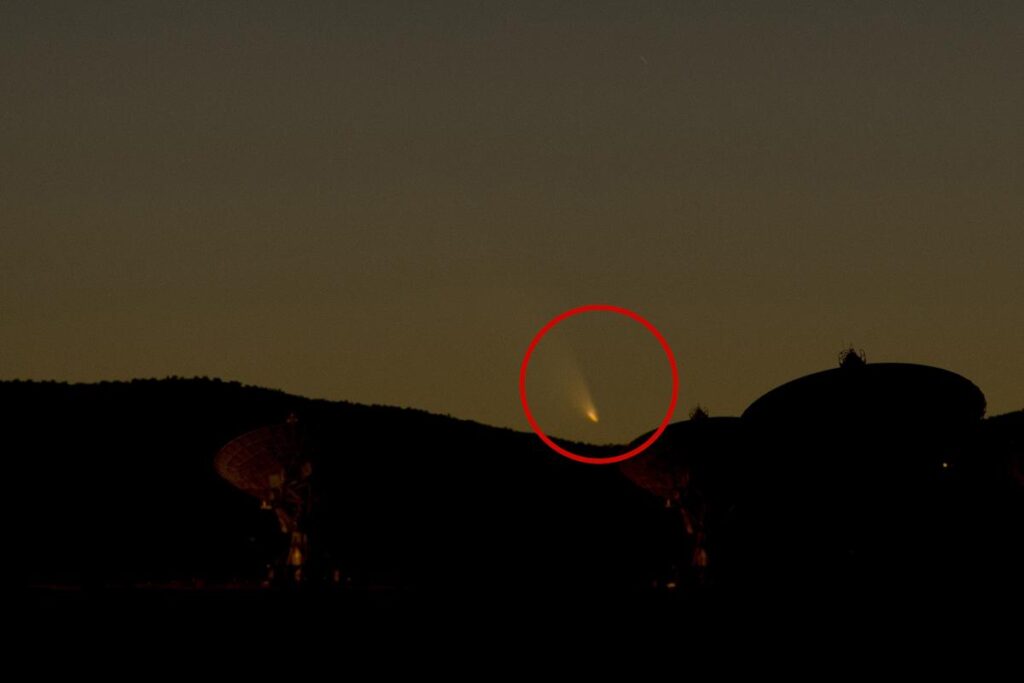
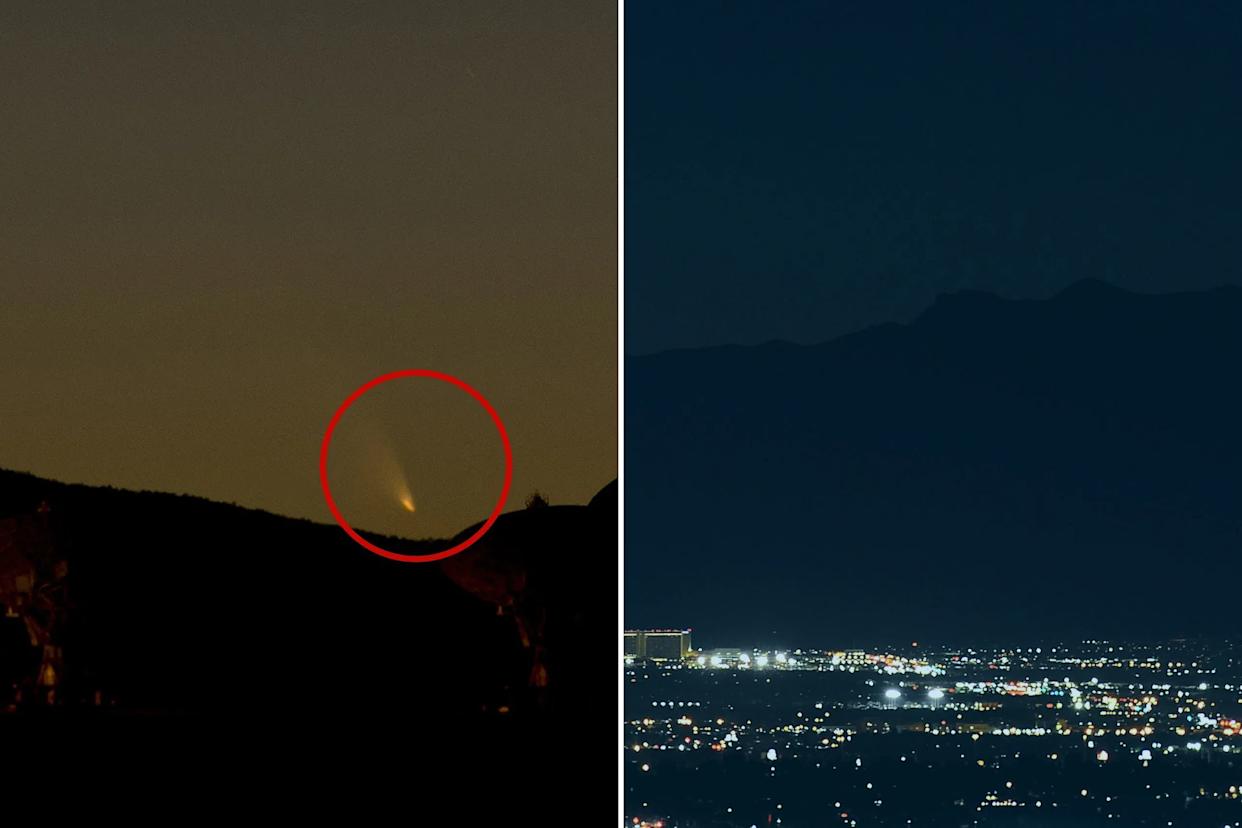
For the first time in 170,000 years interstellar comet Pan-STARRS will be passing through our celestial neighborhood.
It’s a real flash in the “Pan.”
The Artemis II moon mission may have concluded, but there are still some cosmic wonders on the horizon. For the first time since the prehistoric age, interstellar comet C/2025 R3 (Pan-STARRS) will be passing through our neck of the solar system, offering Earthlings a rare chance to glimpse this celestial drifter.
First spotted by the Pan-STARRS survey at Haleakala, Hawaii, on Sept. 7, 2025, the iceball only orbits the sun once every 170,000 years, making this celestial cameo super rare, Space.com reported.
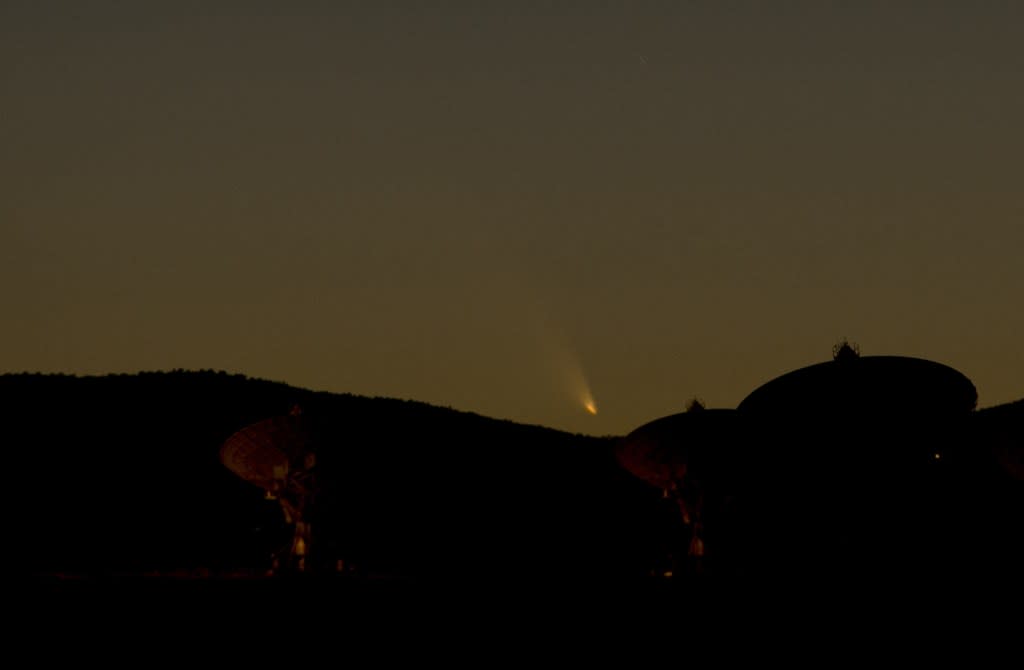
Comet PanSTARRS sets over the Very Large Array radio telescope antenna dishes March 12, 2013 near Magdalena, New Mexico. AFP via Getty Images
The dirty snowball will brighten over the next 10 days as it approaches our inner solar system, thereby making it easier to spot. Pan-STARRS will reach perihelion — its closest point to the sun — on April 19.
But it will only come within 0.5 AU — half the Earth-sun distance — meaning that it won’t disintegrate like other “sungrazer” comets, Forbes reported.
Meanwhile, Pan-STARRS will make its closest approach to Earth on April 27 — when it will be at its brightest– but will unfortunately be impossible to see from the Northern Hemisphere.
How to watch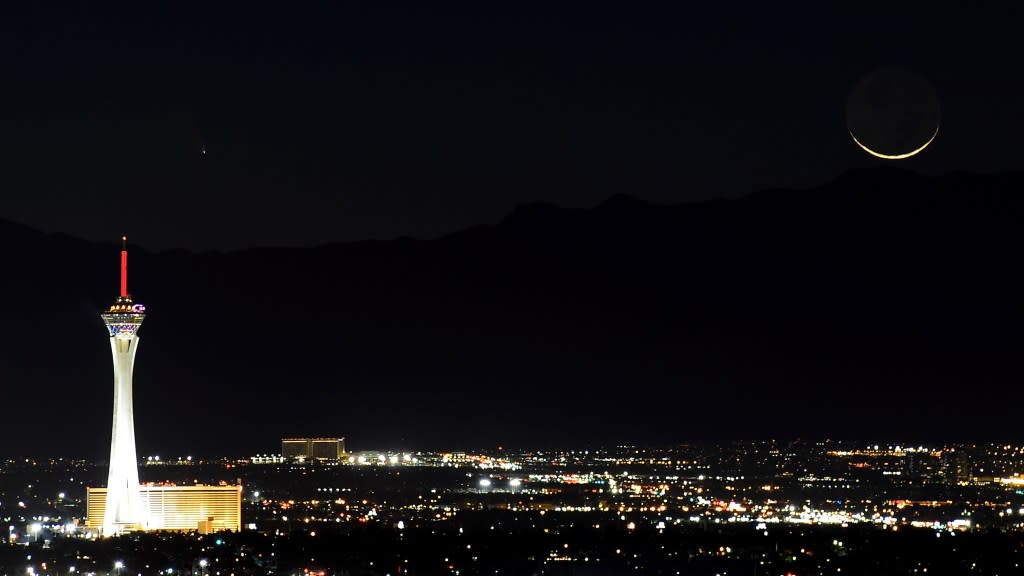
The comet Pan-STARRS and a waxing crescent moon above the Stratosphere Casino Hotel and the Las Vegas skyline at night. Getty Images
How does one take advantage of this once-in-many-lifetimes opportunity? Take a gander between April 10-20, when the comet is becoming increasingly radiant but not yet obscured by the sun’s glare.
During that window, STARRS-gazers in the Northern Hemisphere are urged to look low in the eastern sky about an hour and a half before sunrise.
“If you want to catch the comet, your best chance is over the next week or so as the comet brightens, but it remains observable in a relatively dark sky,” said Nick James, head of the comet section at the British Astronomical Association. “You will need to get up early, a couple of hours before sunrise, and have a good, low, eastern horizon.”
Observes should search within the constellation Pegasus, which the comet is currently traversing near the iconic Great Square of Pegasus — 4 stars of nearly equal brightness: Scheat, Alpheratz, Markab and Algenib.
Skywatchers should look for a soft, diffuse coma, potentially with a tail that’s just starting to sprout. This process could be accelerated as solar heating intensifies.
While Pan-STARRS is visible to the naked eye, a pair of 10×50 binoculars (or similar dimensions) will be helpful during the rising dawn.