
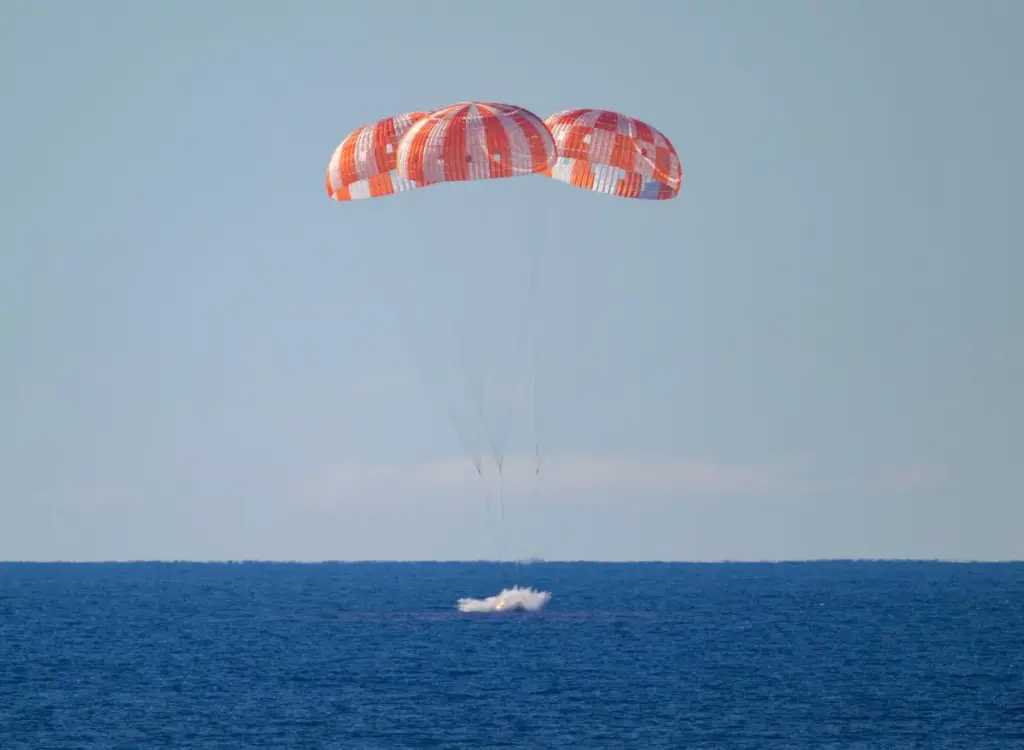
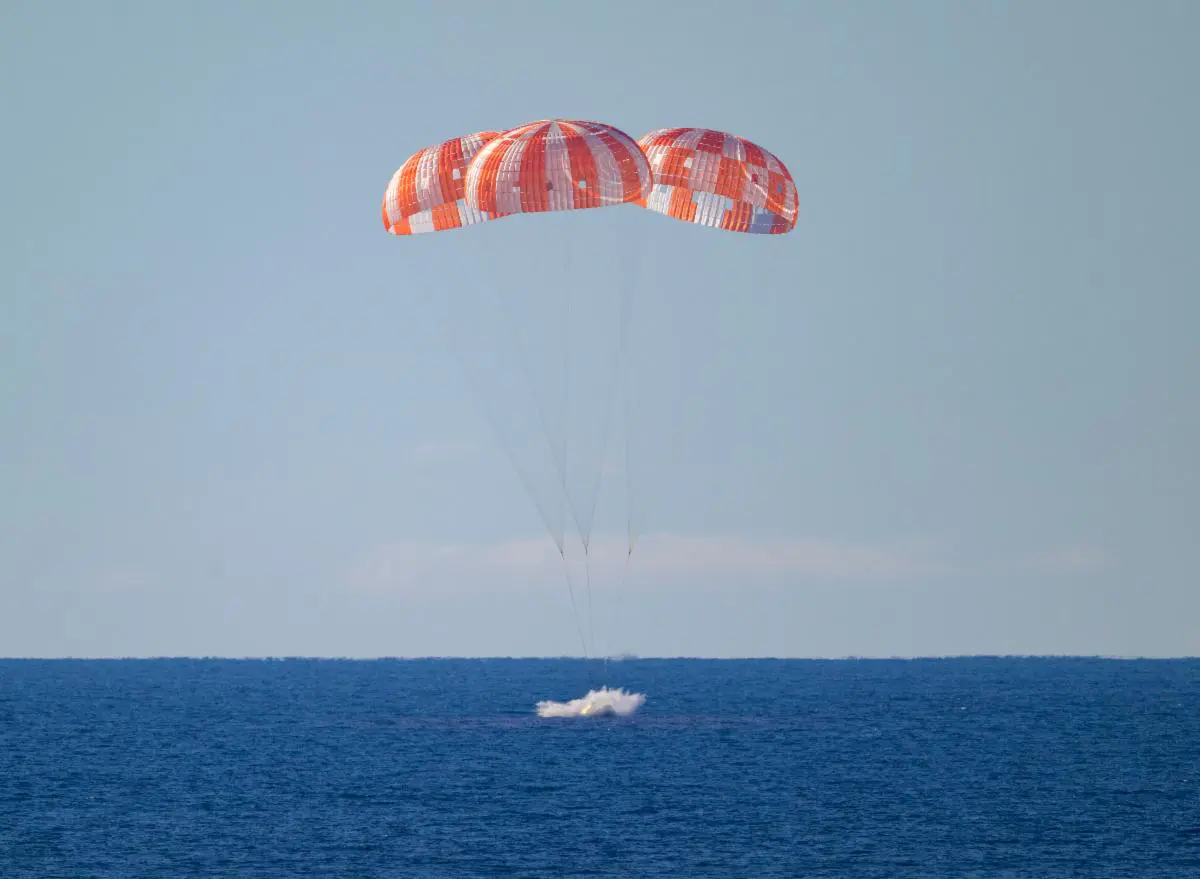
The Artemis II mission has returned to Earth after a 10-day test flight that took astronauts farther from the planet than any humans have previously travelled.
The Orion, carrying NASA astronauts Reid Wiseman, Victor Glover and Christina Koch, along with Canadian Space Agency astronaut Jeremy Hansen, splashed down in the Pacific Ocean off the coast of California at 5:07 p.m. PDT on Friday, April 10, 2026, near San Diego. NASA said the mission reached a maximum distance of 252,756 miles from Earth.
NASA Administrator Jared Isaacman described the mission as “a truly historic achievement” and thanked President Donald Trump and members of Congress for providing “the mandate and resources” for the Artemis program.
Following splashdown, NASA said a combined NASA and US military team assisted the crew from the capsule in open water and transported them by helicopter to the USS John P. Murtha for initial medical checks. The crew was expected to return to NASA’s Johnson Space Center in Houston on Saturday, April 11.
NASA said the crew travelled 694,481 miles during the mission, and that the lunar flyby exceeded the previous record for farthest distance travelled by humans, set by Apollo 13 astronauts in 1970.
Artemis II launched on NASA’s Space Launch System rocket at 6:35 p.m. on April 1 from Launch Pad 39B at Kennedy Space Center in Florida. NASA said the first day of the mission focused on checking spacecraft systems, including preparations for the transit to the Moon, and that four CubeSats from international partners were deployed to Earth orbit.
On the second day, NASA said Orion’s service module fired its main engine to place the crew on a trajectory that brought them to within 4,067 miles of the lunar surface at closest approach.
NASA Associate Administrator Amit Kshatriya said the spacecraft’s “entry, descent, and landing systems performed as designed” and credited a multinational workforce for the outcome.
NASA said the mission included a full in-flight evaluation of Orion with astronauts aboard for the first time, including tests of life support systems intended to confirm the spacecraft can sustain humans in deep space. The agency said crew members also conducted piloting demonstrations, taking manual control of the spacecraft to validate handling and collect data intended to guide future rendezvous and docking operations for Artemis III and subsequent missions.
NASA said the crew completed tests covering crew exercise, emergency equipment and procedures, and the Orion crew survival system spacesuits, among other spacecraft systems.
The agency said the astronauts also supported scientific investigations, including the AVATAR study on how human tissue responds to microgravity and deep space radiation, and other performance studies aimed at collecting health data for long-duration missions.
During the April 6 lunar flyby, NASA said the crew captured more than 7,000 images of the lunar surface and documented a solar eclipse from Orion’s perspective. NASA said the imagery included views of earthset and earthrise, lunar surface features, and the Milky Way, and that the crew also reported meteoroid impact flashes on the night side of the Moon and proposed potential names for two lunar craters.
NASA said the mission’s science and operational data will be used to inform future missions, including preparations for Artemis III. The agency said Artemis III, planned for next year, will involve a new Orion crew testing integrated operations with commercially built Moon landers in low Earth orbit.
More information on Artemis is available at https://www.nasa.gov/artemis.