
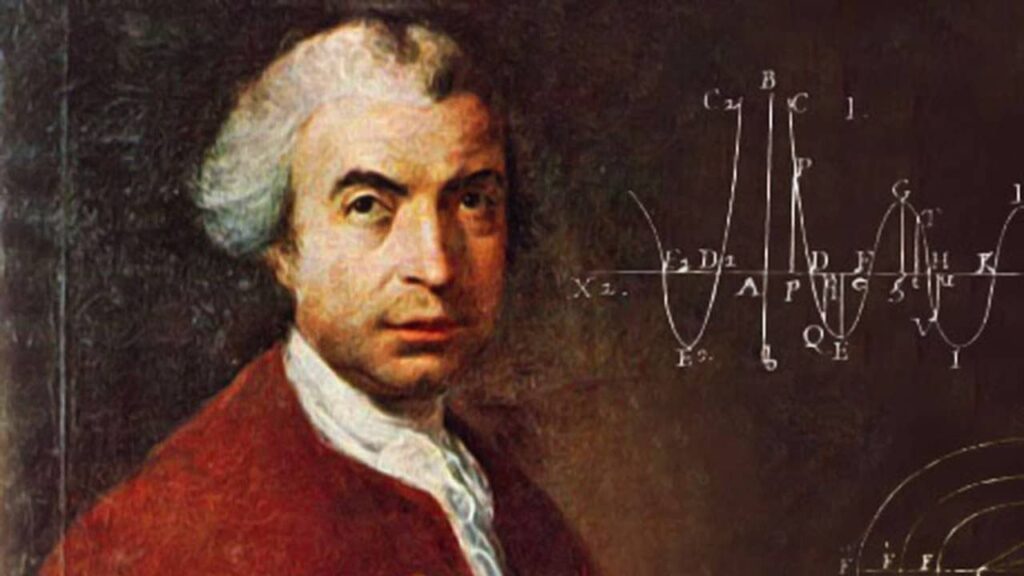
 Portrait of Joseph Boscovich. Credit: YouTube.
In the 18th century, the scientific world was drunk on Newtonian certainty. The universe was a clockwork mechanism, predictable and solid, with clear laws. But Father Roger Joseph Boscovich (Ruđer Josip Bošković), a polymath from Dubrovnik, Croatia, wasn’t satisfied. He proposed a radical idea: matter is not continuous, but made of point-like particles interacting through invisible forces.
In doing so, Bošković imagined a dynamic, quantized cosmos—one that foreshadowed atomic physics and quantum mechanics by nearly two centuries. Yes, this scholar proposed a version of quantum theory.
The Polymath of Dubrovnik
Born on May 18, 1711, in Dubrovnik (then the Republic of Ragusa), Bošković was the definition of a Renaissance man. He was a physicist, mathematician, astronomer, philosopher, poet, diplomat, and a priest of the Society of Jesus.
He began his education at the local Jesuit college before moving to the Collegium Romanum in Rome. By 1740, he was teaching mathematics; by 1744, he was ordained. He spent time in the classroom and out in the field, even leading engineering investigations to fix cracks in the dome of St. Peter’s Basilica.
Bošković distinguished himself as a pioneer in various fields: from classical mechanics and physics to astronomy and natural philosophy, where he developed a theory of natural forces that influenced the further development of science. He also led investigations into cracks in the dome of St. Peter’s Basilica in Rome, proposing a solution that ended up stabilizing the structure.
His intellect was undeniable. Later scientific giants like Werner Heisenberg and Friedrich Nietzsche would refer to him as a master of natural philosophy. But his greatest legacy wasn’t in what he built, but in what he thought.
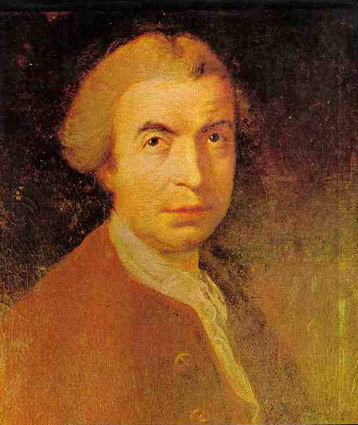 Portrait by Robert Edge Pine, London, 1760.
The Radical Idea
To understand why Bošković was so ahead of his time, you have to understand the world he lived in. Physics in the 18th century was dominated by Isaac Newton. Matter was viewed as hard, massy, and movable particles. Physical systems could simply be described by forces, mass, and acceleration.
Bošković looked closer and saw something more fluid. In his 1758 masterpiece, Theoria Philosophiae Naturalis, he argued that matter wasn’t “solid” in the way we think. Instead, he envisioned point-like particles (entities with no dimension) governed by a single fundamental law of forces.
×
Thank you! One more thing…
Please check your inbox and confirm your subscription.
This is where the famous “Bošković force curve” comes in. He suggested that the force between particles changes based on distance:
At tiny distances: The force is repulsive (stopping matter from collapsing on itself).
At medium distances: It switches to attractive (holding matter together).
At large distances: It follows gravity.
This alternating push-and-pull created stable equilibrium points. Essentially, Bošković was describing the stability of atoms and the bonds between them long before we had the tools to see them (or before his ideas could be proven). He was the first to formalize the idea that attractive and repulsive forces are what allow stable structures to exist in nature.
A Precursor to Quantum Theory?
 The first page of figures from Theoria Philosophiæ Naturalis from 1763.
By viewing matter as discrete points rather than a continuous blob, he anticipated the discrete units of quantum mechanics, such as a photon (a quantum of light) or the electron (a quantum of charge, though it’s a fundamental particle).
His vision of forces interacting across space anticipated the concept of a field later developed by Michael Faraday and subsequently James Clerk Maxwell. In fact, Faraday admitted he developed his electric field concepts inspired by Bošković.
Yet, Bošković’s influence goes even deeper.
He argued that human reason has limits when probing the deepest levels of matter. He suggested that at the atomic level, precise description might be impossible—a philosophical “proto-uncertainty principle” that Heisenberg would mathematically prove centuries later.
Croatian philosopher Zlatko Juras even suggests Bošković may have accidentally stumbled upon concepts resembling dark energy. Juras notes that Bošković described a repulsive force at vast cosmic distances, which parallels our modern understanding of the expansion of the universe.
Similarly, philosopher Roko Pešić argues that Bošković’s treatment of space and time—viewing them as discrete rather than absolute—offers a conceptual bridge to Einstein’s relativity. “He distinguished between actual and potential space,” Pešić notes, “which corresponds to the modern quantum interpretation of virtual processes becoming actualized at the moment of measurement.”
Faith and the Fabric of Reality
 The Cathedral in Dubrovnik.
For Bošković, science was not a departure from faith; it was a way to understand it. As a Jesuit, he believed the universe’s order was a direct reflection of Divine reason. The unity and orderliness of natural law is a reflection of divine order, wrote Bošković.
Professor Zvonimir Čuljak from the University of Zagreb points out that Bošković’s physics was deeply rooted in metaphysics. He viewed the world not as a chaotic accident, but as an “infinitely complex set of determining conditions.”
He rejected the cold, mechanical determinism of some of his contemporaries. Instead, Bošković believed in a dynamic order where God sustained creation—a universe that was lawful, yet alive with possibility. This synthesis allowed him to propose a world that was mathematically precise but metaphysically rich. Bošković believed that the universe is an orderly, interconnected system whose structure reflects God’s rational design, and he argued that this could be known by reason alone, not merely from experience.
In Theoria Philosophiae Naturalis, Bošković emphasized that the entire universe is governed by a single law of forces, in line with the Catholic idea of a single God governing everything. His science blended with philosophy and religion.
The laws of nature were an expression of God’s rationality and perfection. In his view, nature is not chaotic or random. It is a complex and harmonious system describable by mathematical laws. All this indicates the existence of an intelligent order behind all natural phenomena. The harmony in his theory of natural forces shows how the forces in nature follow unique mathematical patterns, expressing God’s will and the rational structure of the world.
There are limits of human reason and knowledge, emphasized Bošković, anticipating the epistemological humility that we would see only later in quantum theory. For him, human reason is a powerful instrument, but limited in its ability to fully understand natural phenomena, especially at the deepest, atomistic level. This attitude supports epistemological humility — the awareness that knowledge of nature is always partial and that there are fundamental limits to the precision and completeness of human perception — which underlies the modern uncertainty principle in quantum physics. Therefore, Bošković, through his philosophical and scientific work, laid the foundation for the skepticism and openness to new knowledge that characterize modern physics today.
Rediscovering a Titan
Ruđer Bošković’s ideas had an early influence on atomic theorists and natural philosophers in Europe, primarily through his theories of forces and his model of the atom, which anticipated the idea of quantization. His “beautiful theory”, as he called it, introduced the concept of allowed and forbidden paths, which is the immediate predecessor of the quantum theory later developed by Planck, Bohr, and others.
Yet, after the suppression of the Jesuit order in 1773, Bošković’s fame waned. For a long time, he was a footnote. It wasn’t until the 20th century that the scientific community looked back and realized what he had done. Werner Heisenberg was particularly vocal in his admiration, crediting Bošković’s “point force” concept as a vital step toward quantum field theory.
He was, in many ways, ahead of his time. Scientists have since recognized Bošković as one of the most important pioneers of field theory. His ideas are crucial to developing the concept that forces are closely related to energy fields and quantum states in the microworld. These scientists recognized that Bošković’s thinking was pioneering in understanding how forces and particles “talk” to each other and, at the same time, in shaping the atomistic and field-based understanding of nature.
Ruđer Bošković showed us that the universe is not just a machine. It is a dance of forces, a play of attraction and repulsion, and a mystery that invites both mathematical rigor and spiritual wonder. He planted the seeds for the scientific revolutions of the future, proving that sometimes, to see the furthest, you have to look back.
This article originally appeared in December 2025 and was slightly updated with new information.