


NASA
The Artemis II crew – (clockwise from left) Mission Specialist Christina Koch, Mission Specialist Jeremy Hansen, Commander Reid Wiseman, and Pilot Victor Glover – take time out for a group hug inside the Orion spacecraft on their way home.
For just about every space mission, there are high-octane bookends: the launch and the reentry. Artemis II’s historic lunar mission is expected to complete the latter on Friday evening.
Entering the Earth’s atmosphere, though, is easier said than done. At its peak velocity, the Orion spacecraft containing the astronauts is projected to be flying 6 miles every second, and its exterior is expected to reach temperatures in the thousands of degrees. All of this happens in a matter of minutes.
“When we’re in a really time-critical, dynamic environment, we don’t have as much of an opportunity to exchange information and talk through nuances and failures,” Artemis II entry flight director Rick Henfling said during a news conference on Wednesday. “And so, what’s different for entry is that there’s more of a reliance on the operations teams as the experts to provide a recommendation and safely ensure that the astronauts return.”
Sign up for the Hello, Houston! daily newsletter to get local reports like this delivered directly to your inbox.
RELATED: Artemis II astronauts take questions while 178,000 miles away from Earth
NASA officials have stated the crew, the spacecraft and Mission Control in Houston are prepared to handle splashdown on Friday evening. Here’s what you can expect.
What happens during reentry?
Reentry is called so because it involves the Orion spacecraft reentering the Earth’s atmosphere.
Over the course of a matter of minutes, the spacecraft will travel from nearly 76 miles above the Earth’s surface, through the atmosphere, and splash down off the coast of San Diego.
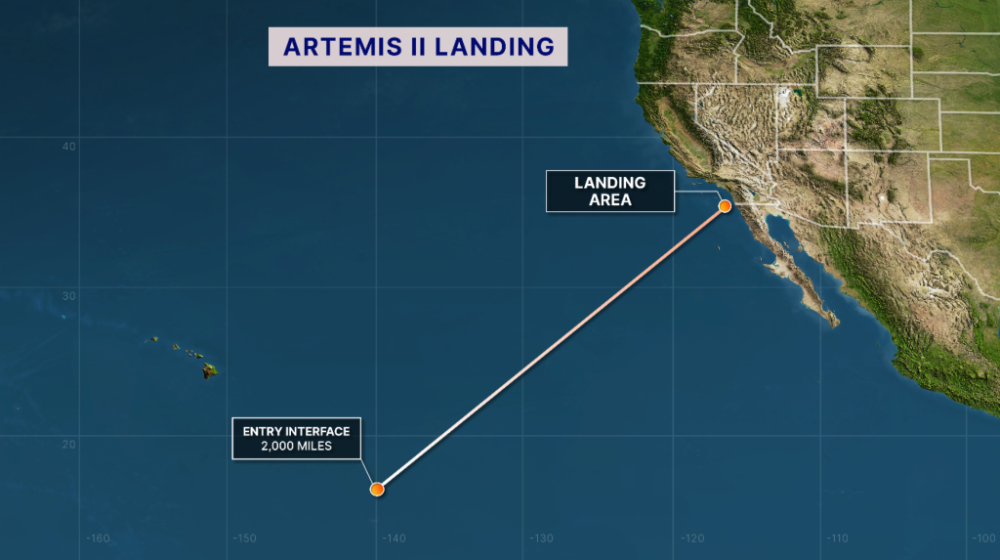
NASA
Ground track map displaying the Artemis II Orion parachute sequence. This graphic was presented by Artemis II Flight Director Rick Henfling during the mission status briefing to the media and public on April 8, 2026 at NASA’s Johnson Space Center in Houston.
NASA is estimating splashdown for 7:07 p.m. CDT Friday. Here’s an estimate of what happens before that:
6:33 p.m. CDT: the Orion crew module, where the astronauts are, will separate from the service module
6:37 p.m. CDT: the crew module will do one final engine burn to set it on an exact course for splashdown
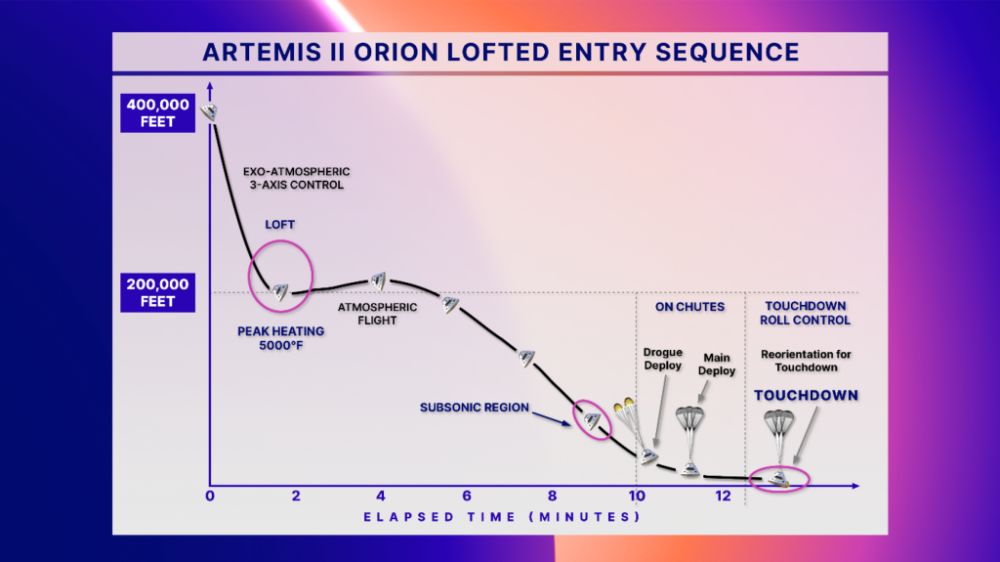
6:53 p.m. CDT: Orion enters the atmosphere. Shortly after that, the spacecraft will lose communication with Mission Control for about 6 minutes.
7:07 p.m. CDT: Splashdown. NASA and the U.S. Department of Defense will coordinate recovering the four astronauts and the Orion spacecraft.
NASA
Infographic featuring the Artemis II Orion lofted entry sequence. This graphic was presented by Artemis II Flight Director Rick Henfling during the mission status briefing to the media and public on April 8, 2026 at NASA’s Johnson Space Center in Houston.
Why will the astronauts lose communication with Mission Control?
About 24 seconds after reentering the Earth’s atmosphere, plasma will build up around the spacecraft, inhibiting the crew’s ability to communicate with Mission Control, according to Henfling. The blackout will last for about 6 minutes.
How fast will the spacecraft go?
NASA estimates the maximum velocity during entry will be 34,965 feet per second. Fast as that is, it is short of the record set by Apollo 10’s 36,397 feet per second, according to Henfling.
How hot will the spacecraft get?
Anywhere from 3,000 to 5,000 degrees Fahrenheit, according to NASA.
Will the astronauts get hot?
Not necessarily. NASA officials have said the crew will have their visors down and wear pressurized suits, which should keep their bodies relatively cool, regardless of the temperature inside the Orion spacecraft.
Is the spacecraft ready for reentry?
NASA says yes. The engineering team conducted a review of the Orion spacecraft based on images of its exterior, which show “no concerns, no issues seen that would make us have any pause for the reentry,” according to Orion deputy program manager Debbie Korth.
How can I watch?
NASA will cover reentry and splashdown on its own livestream. It also be on streaming services Netflix, Apple TV, HBO Max, Amazon Prime, Discovery+, Peacock and Roku.