
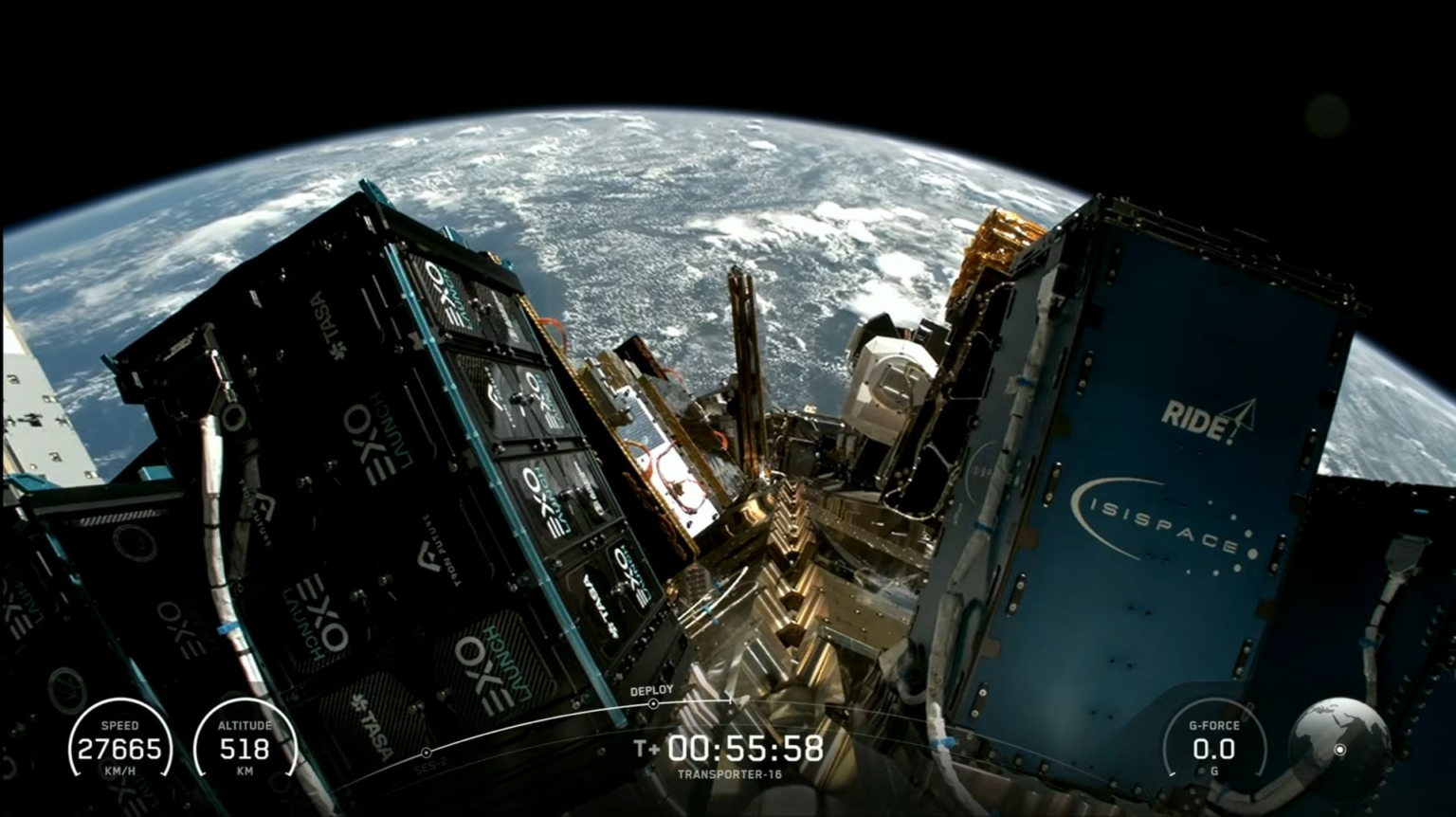
Space is getting crowded – and not just with satellites, but with the massive amounts of data they’re generating. The amount of information being generated and passed through orbit is exploding. From high-resolution Earth observation images to global maritime monitoring, it’s also become a critical link in our infrastructure. But there’s another space this growing crowd of satellites is dependent on that is also filling up fast – the radio frequency spectrum. If we want to keep expanding our orbital infrastructure, we need to rethink how we move data around. On March 30, 2026, the European Space Agency (ESA) supported a series of eight CubeSats and one specialized payload on SpaceX’s Transporter-16 rideshare mission with the overarching goals of testing high-throughput laser communication, inter-satellite networking, and in-orbit artificial intelligence processing to make space data transfer faster, more secure, and vastly more efficient.
Five of the CubeSats aboard Transporter-16 were developed under ESA’s Greek Connectivity Programme and focused on building up the country’s space-based optical capabilities. OptiSat, operated by Planetek Hellas, is a cereal-box sized CubeSat flying a SCOT20 laser communication terminal built by German manufacturer TESAT. Its primary mission is to establish secure, high speed laser links with other small satellites in Low Earth Orbit (LEO).
Another satellite, PeakSat, was entirely developed by the Aristotle University of Thessaloniki. It features an ATLAS-1 laser terminal from the Lithuanian company Astrolight, and intends to demonstrate improved space-to-ground laser communications by beaming data down to newly upgraded optical ground stations in Greece.
Video on the fundamentals of satellite communication. Credit – Norsat International YouTube Channel
The other three Greek satellites are all part of the ERMIS Constellation. Led by the National and Kapodistrian University of Athens, it is intended to test different types of communications technologies. Two of the satellites – ERMIS-1 and ERMIS-2 will test 5G connectivity for satellite-enabled Internet of Things (IoT) applications as well as regular radio inter-satellite links. ERMIS-3, which is slightly larger, will also feature an ATLAS-1 laser terminal, and will test the pointing and tracking systems needed to download massive hyperspectral Earth observation images directly to ground stations via laser.
Three additional CubeSats on the Transporter-16 launch fall under ESA’s Pioneer Partnership Projects umbrella. These are intended to help commercial companies develop working space infrastructure at a reasonable cost. The first, led by Spire Global, is known as Mission Saas (assumedly for Software as a Service – a common business model for modern software start-ups). It is again focused on de-risking inter-satellite optical links. Traveling overhead at 17,000 miles per hour means there’s a relatively short time when a satellite has access to a ground station to transmit all its data. By relaying some of that data to a satellite trailing in the same orbit, it can be relayed quickly to the right place at the right time.
Fraser talks about the potential limit to how many satellites can be in orbit at once.
Mission VIREON consists of two 16U CubeSats attempting to deliver cost-effective, high-resolution Earth-Observation data. Such pictures delivered on a daily basis would be a game-changer for crop, forest, and water quality monitoring.
It will probably come as no surprise what the extra “payload” is. Belgian company EDGX attached a hand-sized digital data processing unit, which contains a GPU and advanced AI optimization. It’s intended to be a demonstrator of the idea of “edge computing” in space – which admittedly would significantly lower the data bandwidth required for a lot of the other missions. It also happens to mesh nicely with SpaceX’s long-term goal of setting up AI data centers in orbit.
Technically all of these missions are “technology demonstrators” – but realistically they likely represent an inevitable future for most satellites in orbit. We’re continuing to deploy satellite mega-constellations at an ever-increasing pace, and in the long run traditional radio frequencies won’t be able to satisfy demand for data transfer. By shifting to optical communication methods, and completing at least some of the data-intensive algorithms in orbit, ESA and its commercial partners are trying to lay the groundwork for a planet-wide internet that is faster and smarter – but it remains to be seen if it can deal with the potential hazards, from orbital debris to polluted night skies, that go along with it.
Learn More:
ESA – Seven missions launched to test optimised data transfer from space
UT – Watch a Real-Time Map of Starlinks Orbiting Earth
UT – Google’s Plan for Space-Based Computing
UT – How Mega-Constellations Are Learning to Manage Themselves