
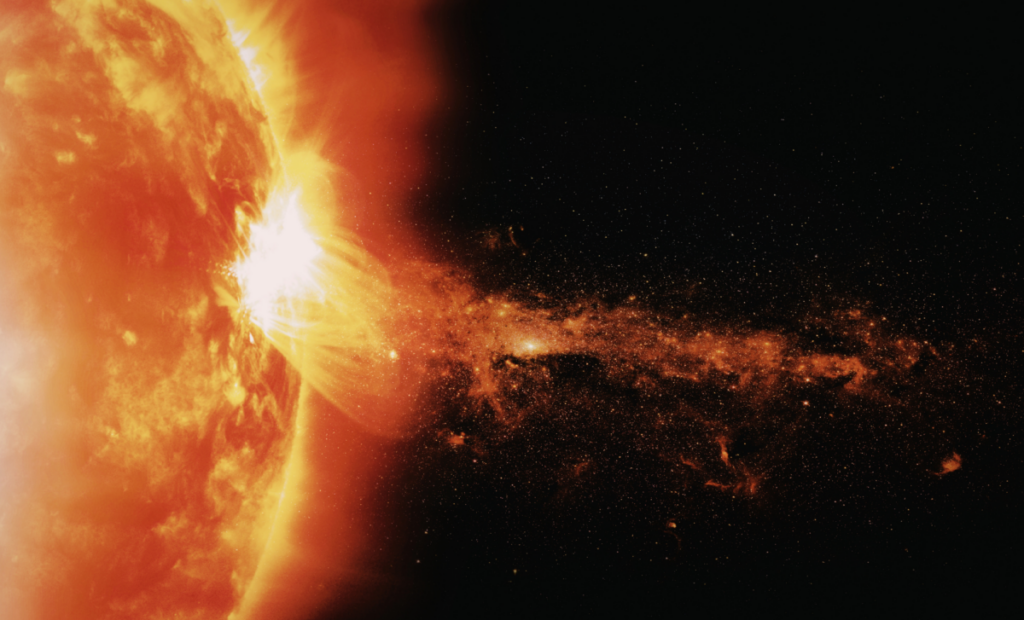
Astronomers using the Daniel K. Inouye Solar Telescope (DKIST) have captured a solar flare that defies all expectations, shaking the foundations of solar physics. This new discovery, reported in two studies, New Solar Flare Observations Challenge Leading Theories and Spectroscopic Analysis and RHD Modeling of the First Ca II H and H-epsilon Flare Spectra, has revealed previously unseen spectral behaviors during the flare’s decline, leaving scientists with more questions than answers. For the first time, researchers detected unusually strong spectral lines of calcium II H and hydrogen-epsilon, marking a dramatic shift in understanding how solar flares interact with the Sun’s atmosphere.
The Unexpected Solar Flare Discovery
On August 19, 2022, solar astronomers captured an unexpected surprise as the Daniel K. Inouye Solar Telescope observed the fading remnants of a C-class solar flare on the Sun. Unlike anything previously recorded, this flare emitted powerful spectral lines of calcium II H and hydrogen-epsilon, two light signatures that had never been observed in such intensity during the flare’s decline. These spectral lines revealed crucial insights into the behavior of the solar chromosphere, the layer of the Sun’s atmosphere that lies between the visible surface and the corona.
What makes this discovery so significant is the unexpected strength of these lines. The readings defied current expectations based on existing solar flare models. The observed lines weren’t just an anomaly; they suggested a deeper, more complex process at work in the Sun’s atmosphere, one that scientists are only beginning to understand.
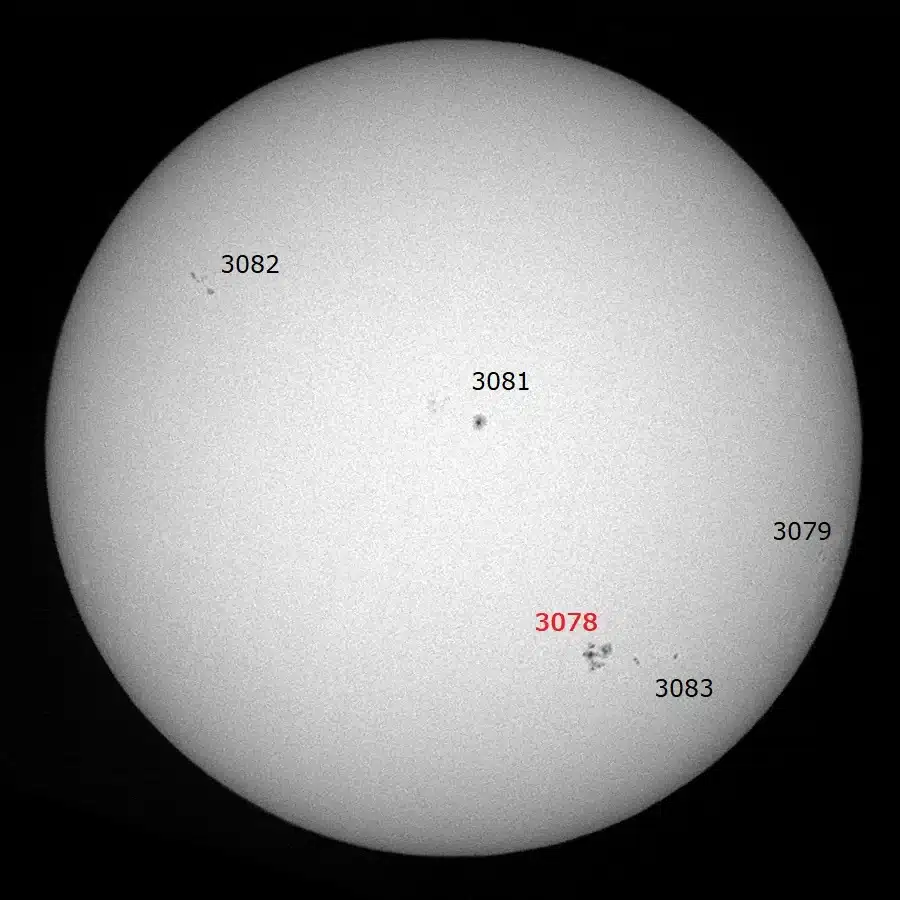 A visible image of the Sun on August 19, 2022, showing sunspots and their active regions, including 3078 where the DKIST observed unusual spectral lines.
Credit: CESAR Helios Observatory.
The Role of High-Resolution Observations in Solar Research
Capturing these unexpected solar flare emissions would have been impossible without the cutting-edge technology of DKIST. The high-resolution capabilities of this telescope allowed scientists to observe the flare in unparalleled detail, providing a crucial window into the complex interactions occurring in the solar atmosphere. This marks the first time researchers were able to observe these spectral lines so clearly, offering a rare glimpse into the inner workings of the Sun during a solar flare’s decline.
The team behind this breakthrough had originally set out to observe the “ramp-up” phase of a solar flare, but instead, they captured the flare in its decay stage. What they found was beyond their expectations: the emissions from the flare’s remnants were much stronger and more complex than anticipated, forcing the team to revisit their models.
“The data we collected not only surprised us but also pointed out weaknesses in our models of solar physics,” said Tamburri.
This unexpected finding challenges existing models of flare heating, which typically predict a decrease in flare intensity as the event winds down. Instead, the flare continued to emit powerful energy signatures, suggesting that something beyond the current models is at play. For researchers, this is an exciting opportunity to refine and improve solar flare models, and further observations will be key to unlocking the full mystery.
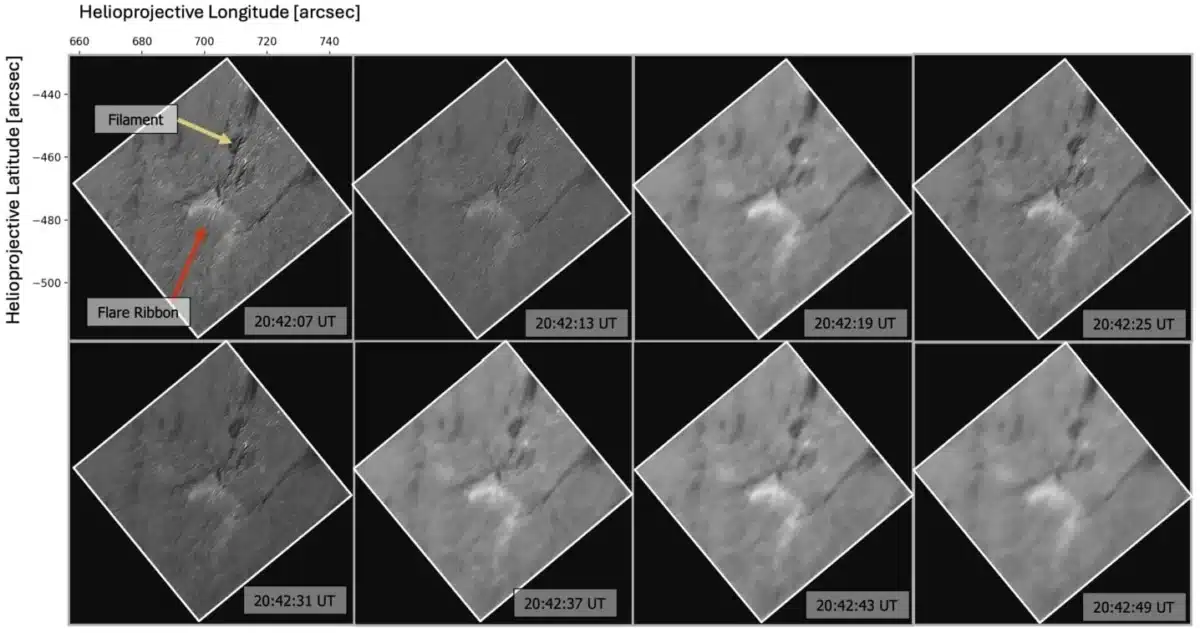 This sequences shows the evolution of a bright flare ribbon using the Visible Broadband Imager on the Daniel K. Inouye Solar Telescope. The flare occurred in active region 13078.
Credit: Tamburri, et al.
How Solar Flares Heat the Atmosphere
Solar flares, powerful bursts of energy caused by the release of magnetic field tension in the Sun’s atmosphere, have long been a subject of fascination. These events follow a sequence of stages: a precursor stage, an impulsive (explosive) stage, and a decay stage. During the impulsive stage, high-energy protons and electrons are released, causing intense emissions of x-rays and gamma rays. As the flare enters its decay phase, scientists expect a gradual cooling and reduction in emissions. However, the data from the August 2022 observation suggests a much more complex process.
During the decay phase, researchers had expected a more typical cooling of the flare’s energy, but instead, they observed a surprising persistence of emissions. The findings reported in New Solar Flare Observations Challenge Leading Theories and Spectroscopic Analysis and RHD Modeling of the First Ca II H and H-epsilon Flare Spectra contradict the established understanding of flare behavior. According to models, the flare’s energy should dissipate in one of two ways: through the spread of heat across the solar atmosphere or by beams of high-energy particles. Yet, the data showed that neither model could fully explain the ongoing emissions. The Sun’s energy behavior during a flare is more intricate than scientists had previously realized, and these new observations will challenge solar physicists to rethink their approach.
The Future of Solar Flare Research
The implications of this discovery extend far beyond a single solar flare event. The unexpected behavior of the calcium II H and hydrogen-epsilon lines has opened a new avenue for solar flare research. Scientists are now tasked with refining existing models to better match the observed data and explain the lingering emissions.
As solar research continues to evolve, the combination of high-resolution instruments like DKIST and advanced modeling techniques will be essential in providing a more accurate picture of the Sun’s violent behavior. The integration of detailed observations with sophisticated simulations will likely yield groundbreaking insights into the solar processes that drive flare activity and shape the Sun’s atmosphere.
Future flare observations will likely focus on capturing all phases of flare activity, from the initial burst to the cooling phase, in order to build a more comprehensive understanding. As technology and models continue to improve, we can expect even more detailed discoveries that will help scientists unlock the mysteries of solar flares, ultimately leading to a more complete understanding of the Sun’s influence on our solar system.