
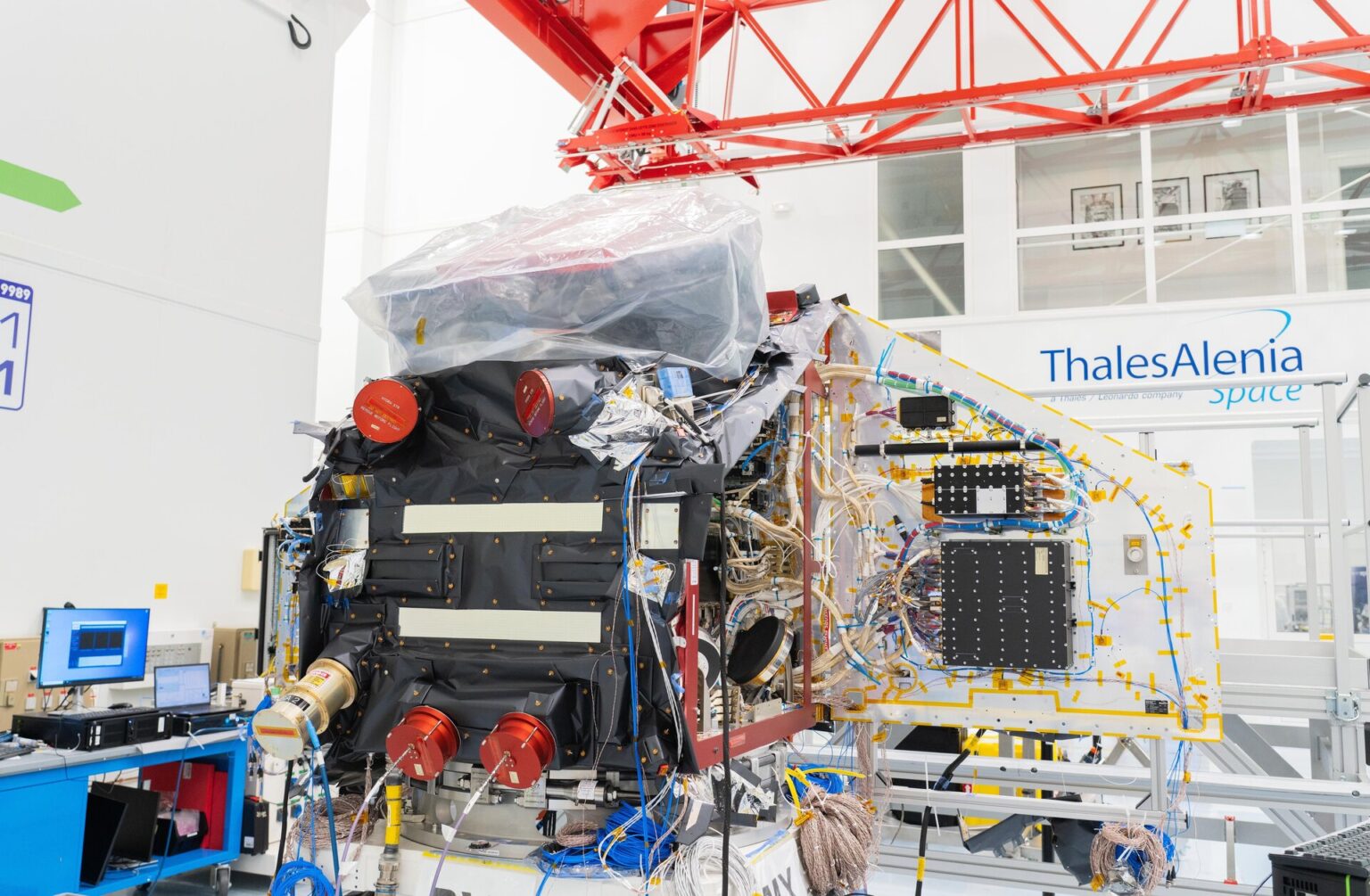
ESA’s Earth Explorer FLEX satellite carries a novel high-resolution imaging spectrometer designed to shed new light on plant activity from space.
FLORIS, which stands for Fluorescence Imaging Spectrometer, measures solar-induced vegetation fluorescence – a faint glow emitted by plants during photosynthesis. By capturing this subtle signal globally, scientists can derive quantitative indicators of photosynthetic efficiency, enabling the assessment of vegetation health and ecosystem productivity.
The FLORIS instrument is built around two push-broom imaging spectrometers that share a common telescope fore-optics system. This dual-spectrometer architecture enables simultaneous measurements at different spectral resolutions.
The separation between the two spectrometers is achieved optically along the satellite’s flight direction using a double-slit assembly. This assembly incorporates folding mirrors coated with dedicated pass-band filters, ensuring that each spectrometer receives its intended portion of the optical signal.
Before light enters the telescope, it passes through a polarisation scrambler assembly, which performs several critical functions:
defines the instrument’s optical aperture
selects the spectral range – the band pass filter rejects lights below 500 nm and above 780 nm
removes polarisation effects using a dual Babinet scrambler, which is essential because even small polarisation sensitivities could compromise the extremely precise fluorescence measurements required by the mission.
Both spectrometers are based on the Offner optical design (−1×magnification), chosen for its exceptional image quality and extremely low optical distortion. Spectral dispersion is achieved using holographic gratings, allowing accurate separation of wavelengths necessary to detect weak fluorescence signals embedded within reflected sunlight.
To guarantee measurement reliability over the mission lifetime, FLORIS includes an onboard calibration unit featuring a rotating carousel mechanism. It is placed in front of the scrambler assembly.
The calibration unit allows absolute radiometric calibration using a sun-illuminated Lambertian diffuser placed directly in the optical path, or a black target for dark acquisitions. Spectral calibration is achieved by observing specific atmospheric and the sun absorption lines and so it does not require specific sources on board.
The instrument’s high-resolution and low-resolution channels each use cooled, backside-illuminated high-speed charge-coupled devices to maximise sensitivity and reduce noise.
For additional control of spectral straylight, a linear variable filter is installed in front of the high-resolution detector, ensuring the purity of the recorded fluorescence signal.
By combining innovative optics, precise calibration and highly sensitive detectors, FLORIS enables FLEX to capture fluorescence signals directly. These measurements provide scientists with a powerful new tool to better understand vegetation dynamics and their links to the carbon and water cycles.
The FLORIS instrument was developed by Leonardo in Italy.
Like