
Back to Article List
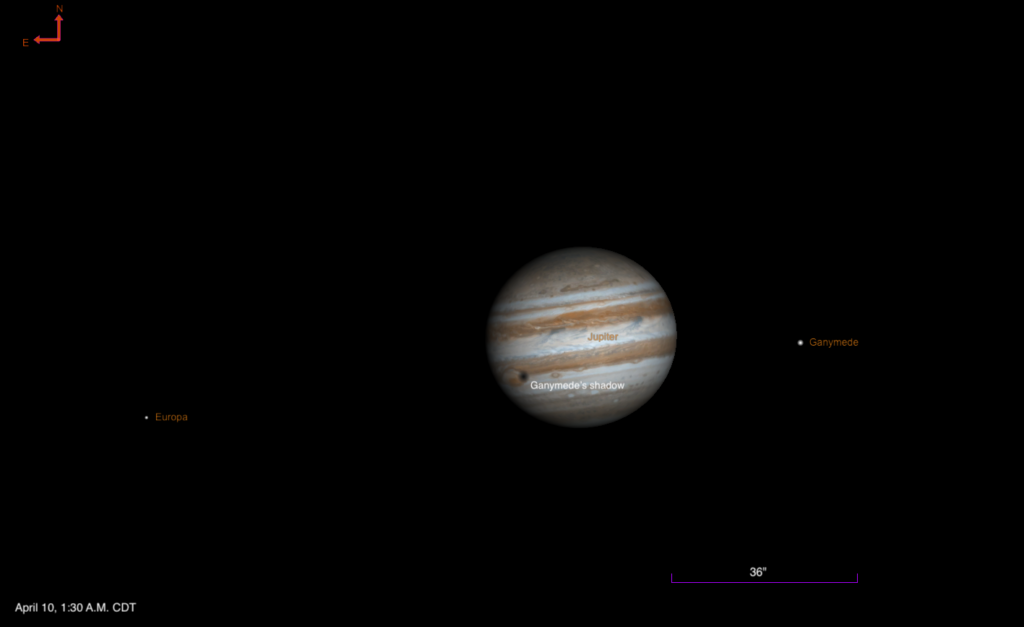
The large shadow of Ganymede crosses Jupiter’s cloud tops early this morning, visible for much of the U.S.
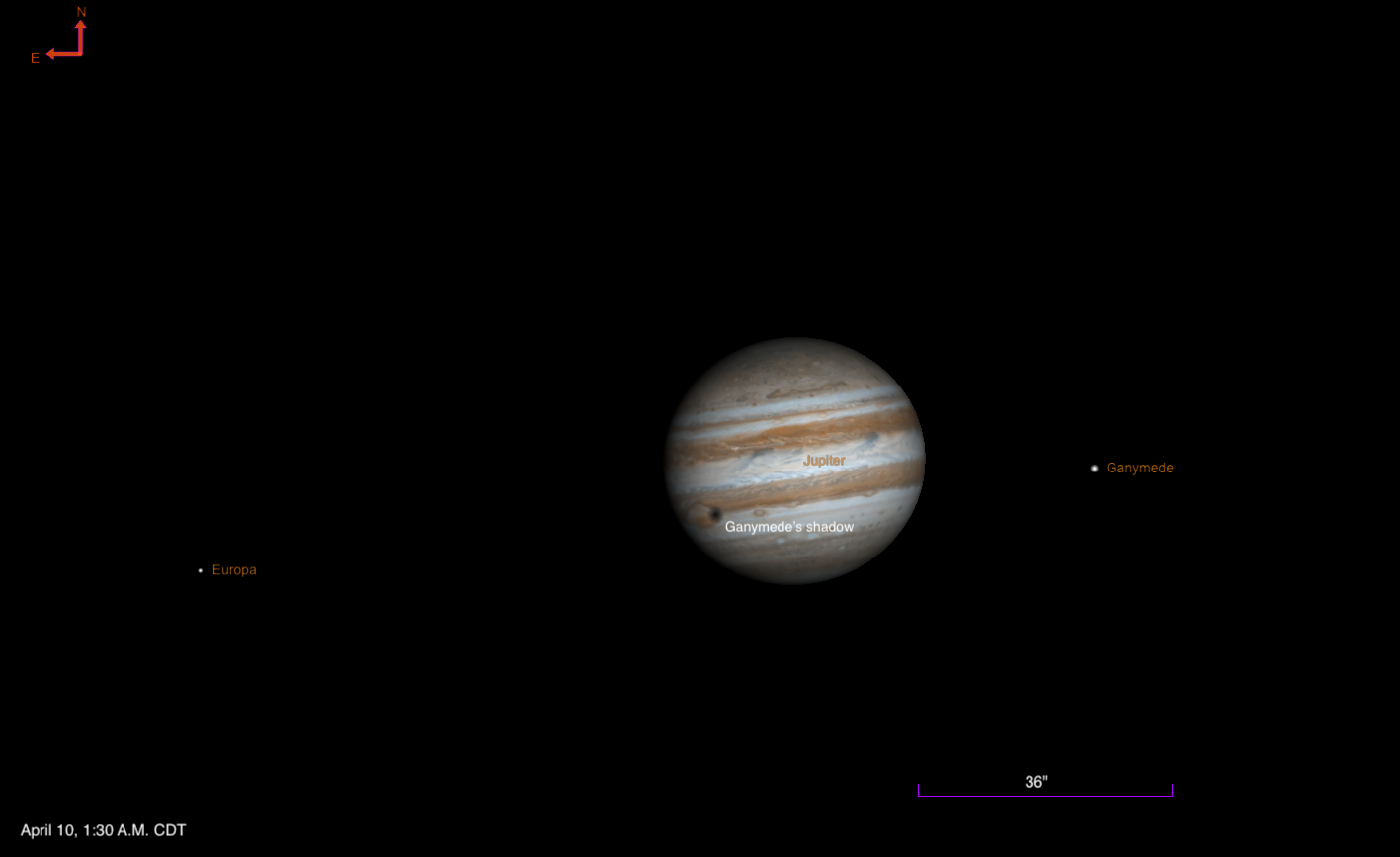
By 1:30 A.M. CDT on April 10, Ganymede’s large shadow is readily visible on the jovian disk for observers in the western two-thirds of the U.S. Io and Callisto lie farther west, outside this field of view. Credit: Alison Klesman (via TheSkyX)
Looking for a sky event this week? Check out our full Sky This Week column.
April 9: Structured spiral M96
If you’re up after midnight on the 9th in the Central time zone (early-morning hours of April 10), you can catch the start of another shadow transit this week at Jupiter. The giant planet remains in central Gemini, below the bright stars Castor and Pollux and just 2.5° west of magnitude 3.5 Wasat (Delta Geminorum). It’s easy to point a telescope to the planet, as it’s by far the brightest light in the western sky, much brighter than Castor or Pollux.
Ganymede’s large shadow is crossing from east to west, slowly sliding onto the cloud tops beginning at 12:57 A.M. CDT. The planet is too low (less than 3° high) at this time to view the event from the East Coast, but the western two-thirds of the U.S. can watch as a dark notch starts to form at Jupiter’s southeastern limb, taking roughly 8 to 10 minutes to fully appear. Ganymede itself is just west of the planet; Europa is alone to the east, although as earlier this week, don’t be fooled into thinking this is the source of the shadow. Io and Callisto lie farther west, beyond Ganymede.
Ganymede’s shadow takes more than three hours to cross the giant world; Jupiter will set across the U.S. with the transit underway.
Sunrise: 6:29 A.M.
Sunset: 7:34 P.M.
Moonrise: 2:58 A.M.
Moonset: 12:12 P.M.
Moon Phase: Waning crescent (41%)
*Times for sunrise, sunset, moonrise, and moonset are given in local time from 40° N 90° W. The Moon’s illumination is given at 10 P.M. local time from the same location.
Comet 10P/Tempel, also known as Tempel 2, is now making its way into our skies to become a summertime comet. Rising around 1 A.M. local daylight time, it’s a great option for either viewing last after an extended overnight session, or first for early risers, before the oncoming twilight brightens the sky too much.
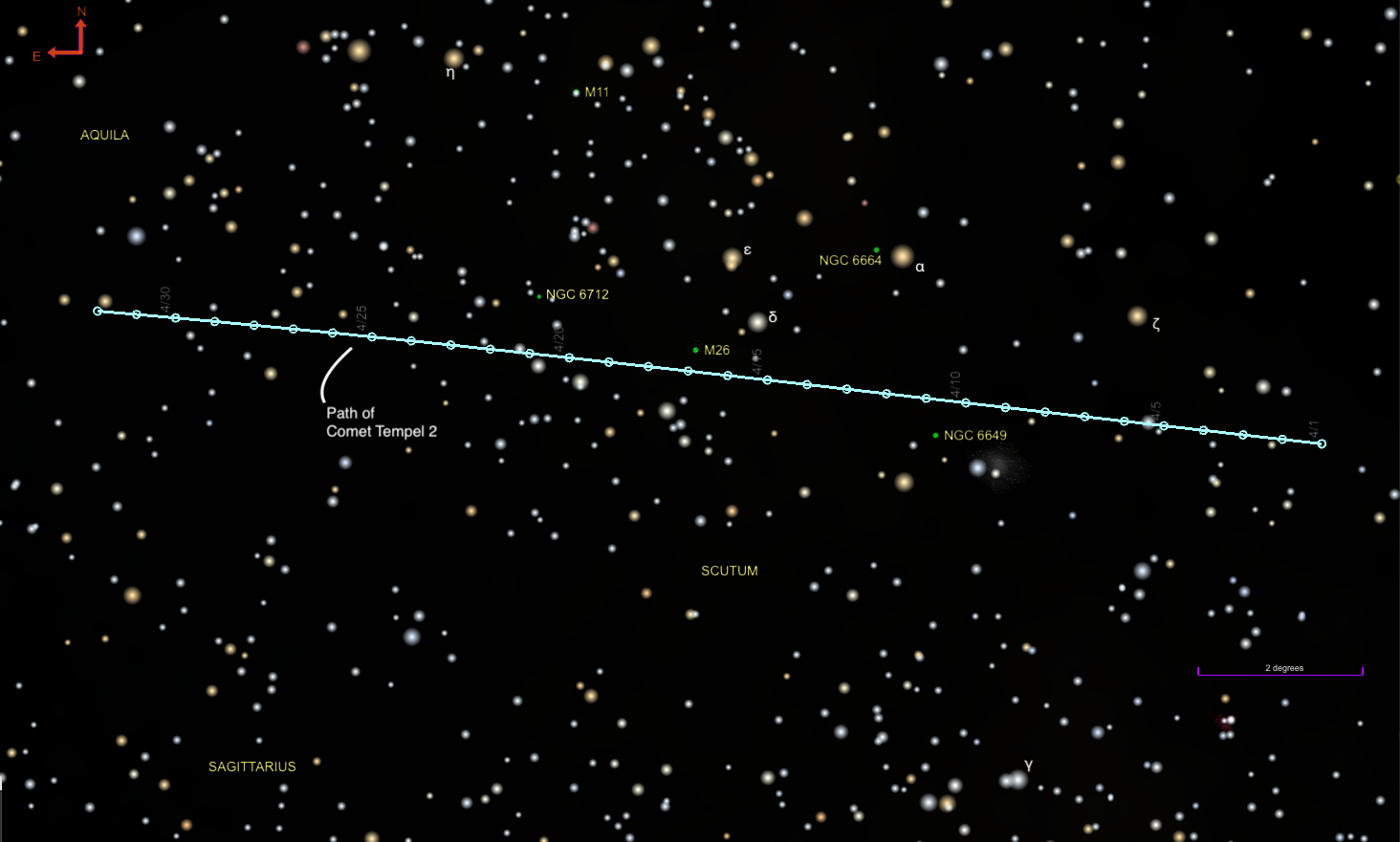
Comet Tempel 2 is settling in for a long summer stay. This month, it’s in Scutum the Shield, passing near several deep-sky objects. Credit: Alison Klesman (via TheSkyX)
Now located in Scutum, Tempel 2 is roughly 12th magnitude and brightening. It still requires a large scope, but it’s got the advantage of being high in the south early this morning: some 35° above the horizon around 5 A.M. local daylight time. On Friday, April 10, you’ll find it just under 2° southwest of 4th-magnitude Alpha (α) Scuti.
For comparison, shift your gaze east some 5.3° to land on globular cluster NGC 6712. This ball of stars is currently brighter than the comet, around 8th magnitude, but as Tempel 2 brightens, they will appear more like twins. Spanning just over 7’, compare the cluster’s appearance — size, shape, and central brightness — to the comet, both tonight and over time.