
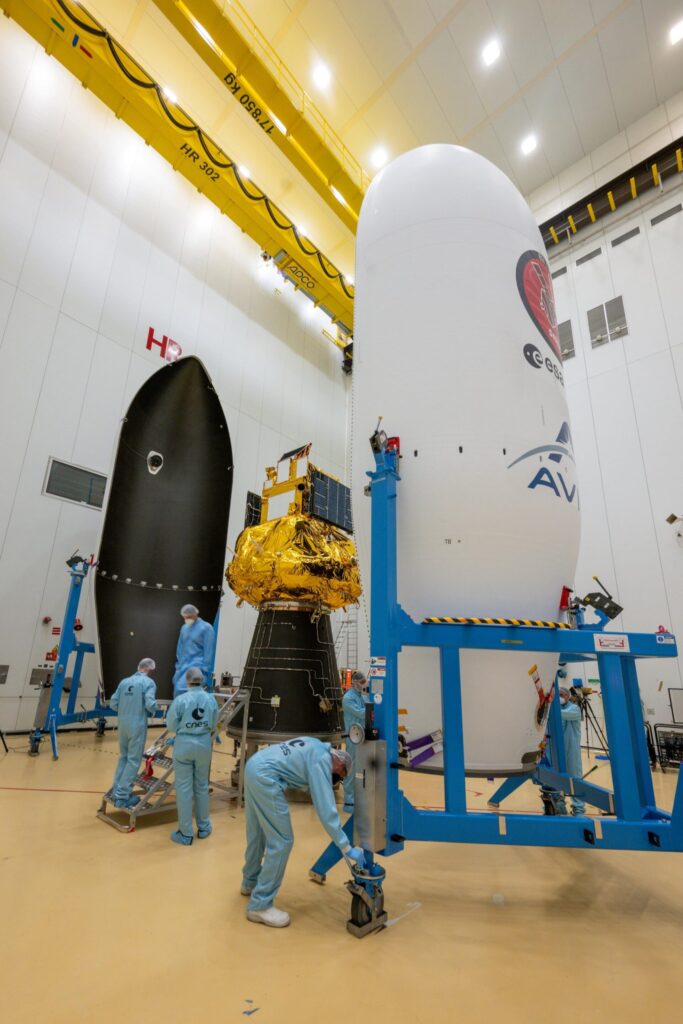
In an era of intensifying space rivalry, Europe and China have done something few expected: built a satellite together. Smile, a 2.3-tonne spacecraft, is set to launch from the European spaceport in French Guiana aboard a Vega-C rocket later this month, swinging into an elliptical orbit with an apogee of 121,000km over the North Pole.
From there, it will watch Earth’s entire magnetic shield from the outside, and try to work out what happens when the Sun turns hostile.
The mission is a joint project between the European Space Agency and the Chinese Academy of Sciences, agreed in 2016 and delayed by at least a year due to export controls on sensitive technology, safety regulations, and technical complications. Ammonia in the satellite’s heat pipes, for instance, required the components to be classified as dangerous goods before they could be transported to ESA’s research and technology centre in the Netherlands.
Why the Science Matters Now
Geomagnetic storms are not theoretical threats. In May 2024, a major solar event disrupted satellite navigation signals and high-frequency radio communications worldwide. In 1989, Quebec’s power grid collapsed during a solar storm, cutting electricity to six million people for nine hours.
A repeat of the Carrington Event of 1859, which destroyed telegraph networks globally, would cost trillions of dollars under current infrastructure conditions. Earlier warning could allow operators to shut down vulnerable systems in time.
Smile carries four instruments designed to close the gaps in current knowledge. Leicester University’s soft X-ray imager will produce the first-ever maps of the magnetosphere’s outer boundaries. An ultraviolet imager will observe auroral activity above the North Pole for up to 45 continuous hours.
“We will be able to see how our magnetic bubble changes its shape, whether it does this smoothly or in steps, and how it gets squeezed down as eruptions from the Sun pass Earth,” said Colin Forsyth, a space scientist at University College London. “We’ve never done anything like this before.”
A Partnership That May Not Be Repeated
The mission’s scientific ambition is matched by its geopolitical significance. ESA director-general Josef Aschbacher was direct about the timing: “You have to see the origins of Smile in that period.” The 2016 agreement came when international conditions were more open to east-west cooperation. That window has since narrowed.
There is currently no discussion of a follow-up mission, Aschbacher confirmed. ESA and China’s National Space Administration met in January 2026 and agreed to explore further opportunities, but nothing concrete emerged.
The launch has been pushed back to later in April following a technical problem. The mission will still catch the solar activity cycle near its maximum, making the timing scientifically valuable.
 Published by Kerry Harrison
Kerry’s been writing professionally for over 14 years, after graduating with a First Class Honours Degree in Multimedia Journalism from Canterbury Christ Church University. She joined Orbital Today in 2022. She covers everything from UK launch updates to how the wider space ecosystem is evolving. She enjoys digging into the detail and explaining complex topics in a way that feels straightforward. Before writing about space, Kerry spent years working with cybersecurity companies. She’s written a lot about threat intelligence, data protection, and how cyber and space are increasingly overlapping, whether that’s satellite security or national defence. With a strong background in tech writing, she’s used to making tricky, technical subjects more approachable. That mix of innovation, complexity, and real-world impact is what keeps her interested in the space sector.