
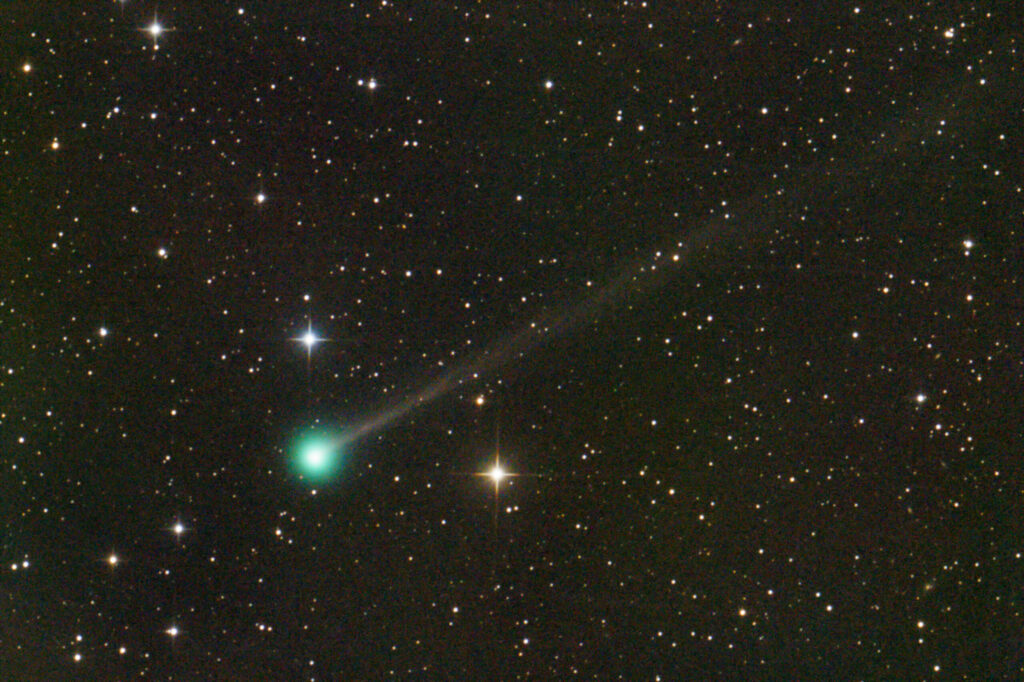
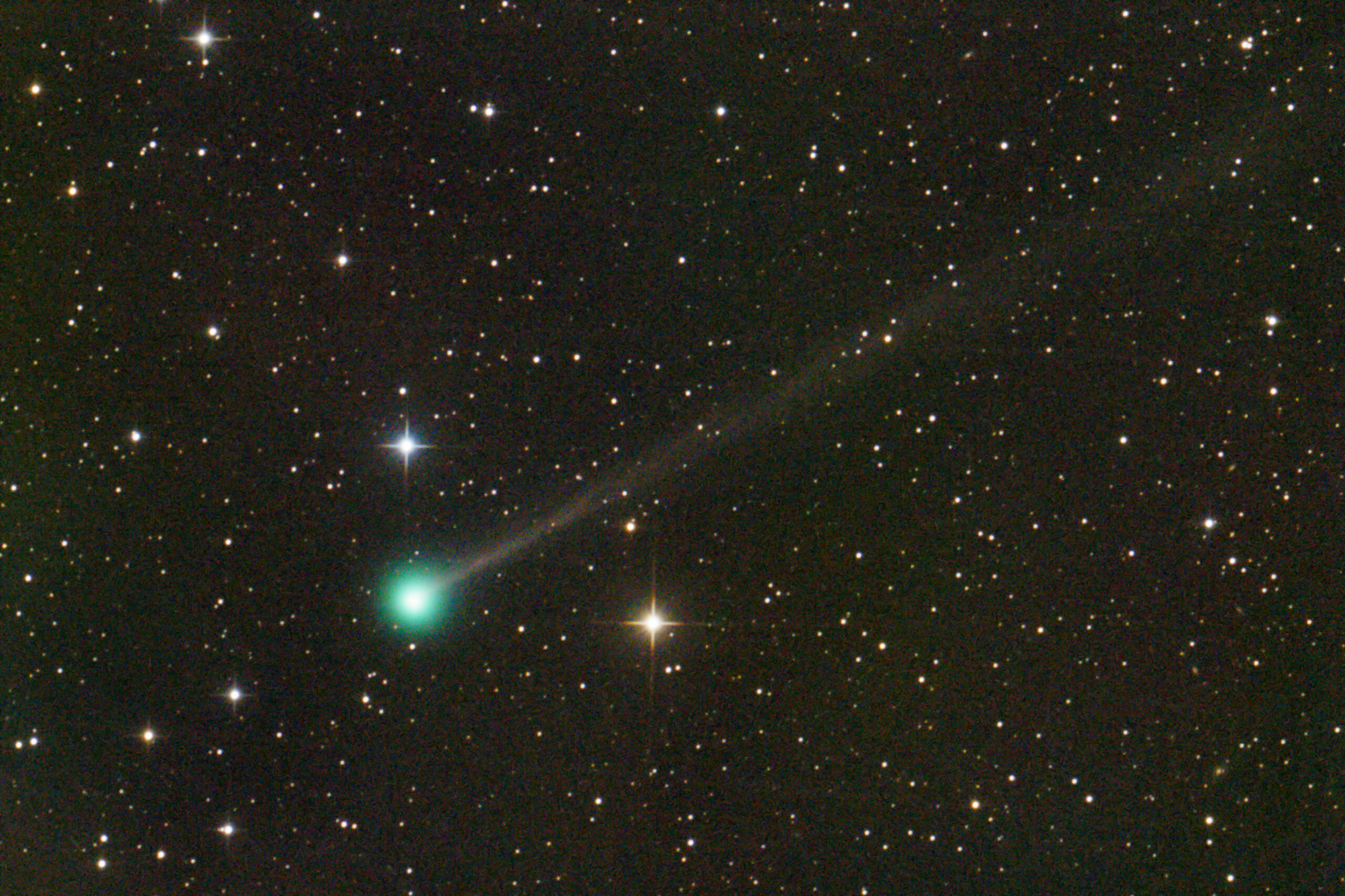
Caption: Comet C/2025 R3 (PanSTARRS) is continuing to brighten as it approaches perihelion, visible in the early-morning sky. This photo shows the comet not long ago, on March 29. Credit: Dimitrios Katevainis (Flickr, CC BY-SA 4.0)

Sky This Week is brought to you in part by Celestron.
Friday, April 10
Last Quarter Moon occurs today at 12:52 A.M. EDT.
A few hours after sunset, Hercules the Strongman is rising above the eastern horizon. As this constellation returns to the evening sky, it carries with it one of the best globular clusters visible in our sky: M13.
Shining at magnitude 5.8, this cluster is easy to find in binoculars or any telescope. Wait until late in the evening when it’s higher above the horizon — by 10:30 P.M. local daylight time, you’ll find M13 some 20° high in the east, located between the stars Eta (η) and Zeta (ζ) Herculis, two of the four points that make up Hercules’ Keystone asterism. If you draw a line between these stars, M13 is located about ⅓ of the way as you slide from Eta down to the lower right toward Zeta. (Or, more precisely, M13 is 2.5° south of Eta.)
The dense ball of aging stars spans roughly 20’ on the sky, offering a nice, big target for any observer. It is densest in the center, fizzling out into individual stars at the edges. Located some 25,000 light-years away, M13 is bright enough to be visible to the naked eye on clear, dark nights, particularly when it is high above the horizon. Astronomers estimate it is some 12 billion to 14 billion years old, containing hundreds of thousands of stars in a region roughly 145 light-years across.
Sunrise: 6:29 A.M.
Sunset: 7:34 P.M.
Moonrise: 2:58 A.M.
Moonset: 12:12 P.M.
Moon Phase: Waning crescent (41%)
Times for sunrise, sunset, moonrise, and moonset are given in local time from 40° N 90° W. The Moon’s illumination is given at 10 P.M. local time from the same location.
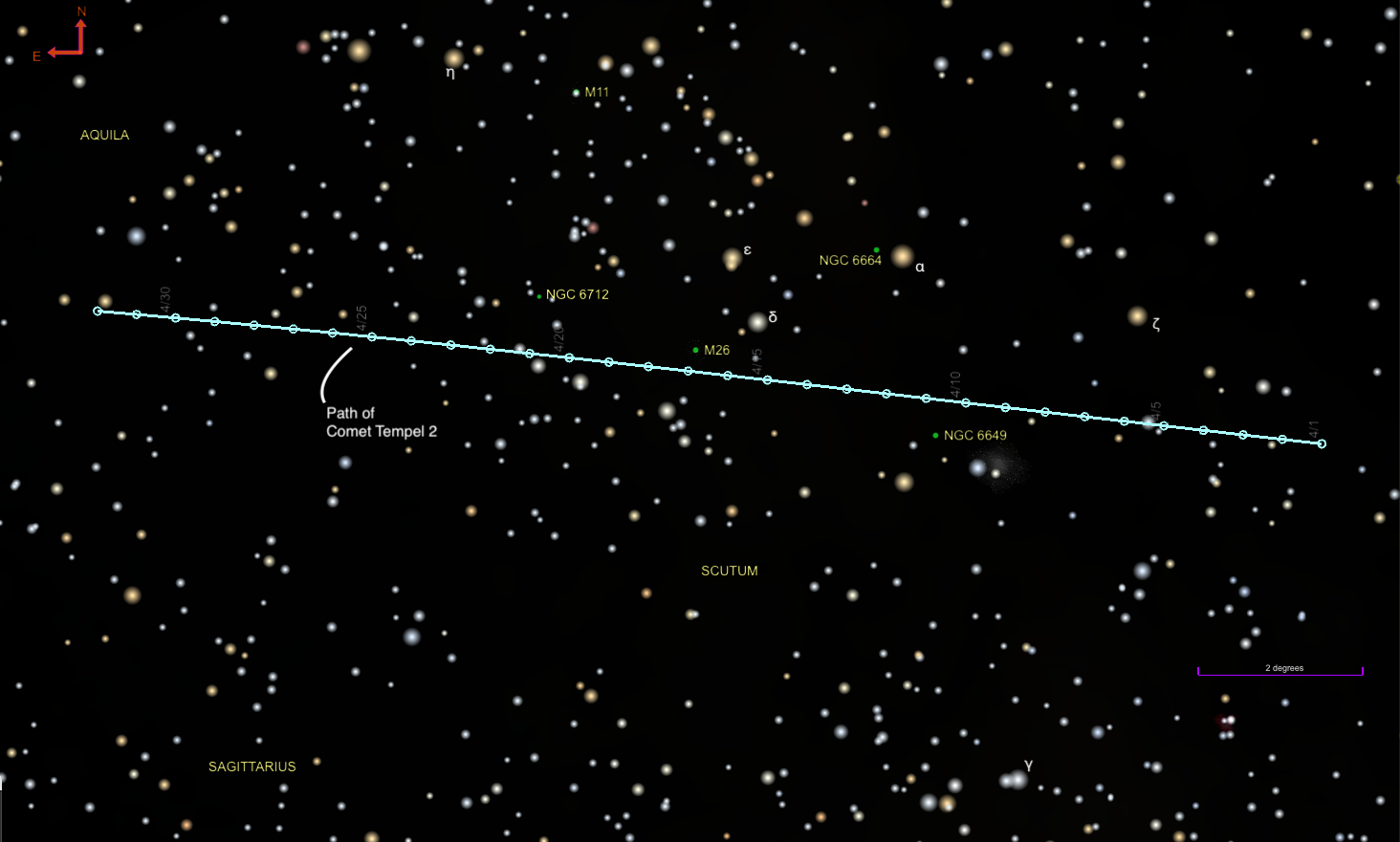
Comet Tempel 2 is settling in for a long summer stay. This month, it’s in Scutum the Shield, passing near several deep-sky objects. Credit: Alison Klesman (via TheSkyX)
Saturday, April 11
Even as Comet Wierzchoś is quickly fading, Comet 10P/Tempel, also known as Tempel 2, is making its way into our skies to become a summertime comet. Rising around 1 A.M. local daylight time, it’s a great option for either viewing last after an extended overnight session, or first for early risers, before the oncoming twilight brightens the sky too much.
Now located in Scutum, Tempel 2 is roughly 12th magnitude and brightening. It still requires a large scope, but it’s got the advantage of being high in the south early this morning: some 35° above the horizon around 5 A.M. local daylight time. You’ll find it just under 2° southwest of 4th-magnitude Alpha (α) Scuti.
For comparison, shift your gaze east some 5.3° to land on globular cluster NGC 6712. This ball of stars is currently brighter than the comet, around 8th magnitude, but as Tempel 2 brightens, they will appear more like twins. Spanning just over 7’, compare the cluster’s appearance — size, shape, and central brightness — to the comet, both tonight and over time.
Sunrise: 6:28 A.M.
Sunset: 7:35 P.M.
Moonrise: 3:32 A.M.
Moonset: 1:18 P.M.
Moon Phase: Waning crescent (32%)
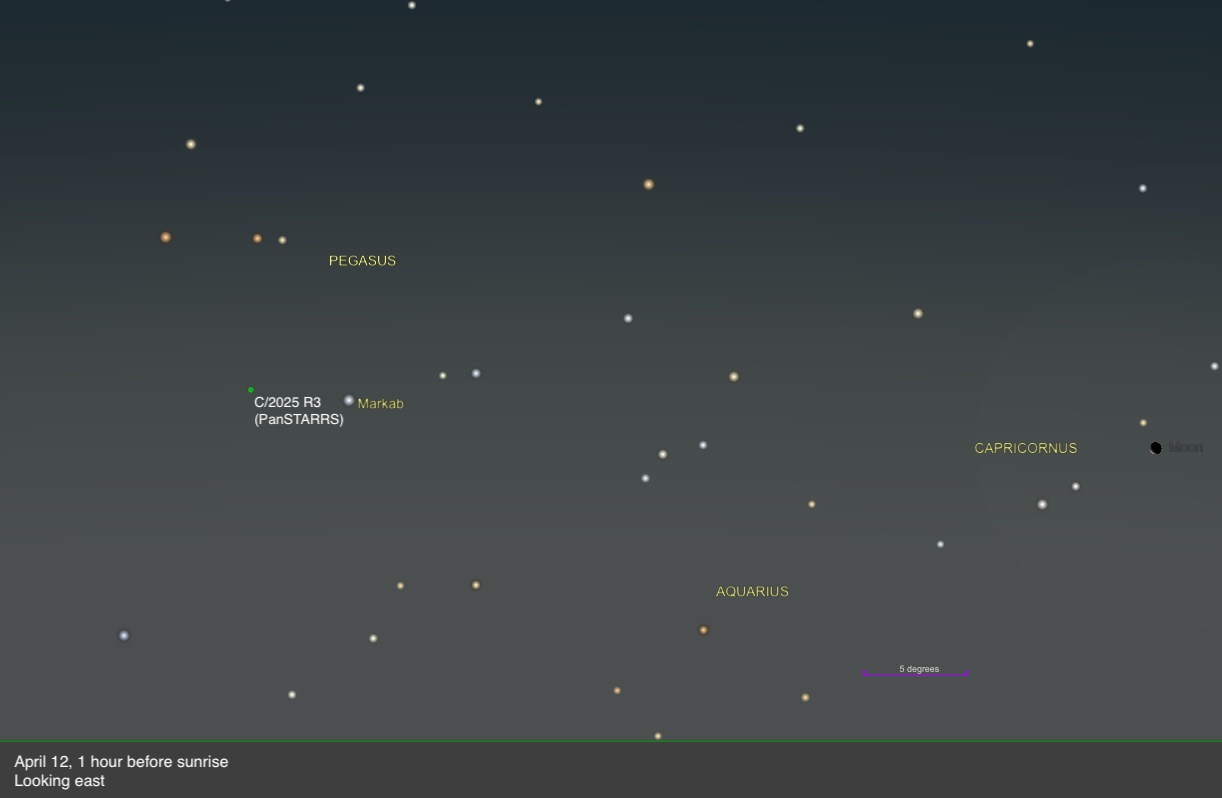
Look for the brightening Comet C/2025 R3 (PanSTARRS) in the hour before dawn, now skimming through the Great Square of Pegasus. Credit: Alison Klesman (via TheSkyX)
Sunday, April 12
While Comets Wierzchoś and Tempel 2 are faint, there’s a breakout star in the early-morning sky that’s cracked naked-eye visibility: Comet C/2025 R3 (PanSTARRS). Recently recorded at mid-5th magnitude, although this interplanetary fuzzball is technically within reach of naked eyes, your best bet will be to view it with binoculars or a small scope — or capture it with a several-second exposure using your smartphone.
This one is for early risers, though — currently flying through Pegasus the Winged Horse, the best time to look for PanSTARRS is about an hour before sunrise, when it’s reached nearly 20° high in the east, inside the Great Square of Pegasus. Today the comet is near magnitude 2.5 Markab, Pegasus’ alpha star. As the Great Square rises, Markab makes up the point farthest right as the southwesternmost point of the Square. This morning, the comet is just 5.3° northeast of this star, rendering both visible in the same binocular field of view and offering a great signpost to find it.
Astronomers expect — and hope — that this comet might reach up to 4th magnitude this month, but it is also sinking quickly toward the horizon day by day, making it more challenging to catch. About a week from now, the comet will rise just an hour before the Sun, reaching ready visibility only 30 minutes or so before sunrise, as the sky is growing quite bright. Keep following it as long as you can!
Sunrise: 6:26 A.M.
Sunset: 7:36 P.M.
Moonrise: 4:00 A.M.
Moonset: 2:24 P.M.
Moon Phase: Waning crescent (23%)
Monday, April 13
Mars passes 0.3° north of Neptune at 6 A.M. EDT; however, these faint planets rise shortly before the Sun, so the latter isn’t visible in the brightening sky.
However, there is an event late tonight that will be much easier to watch. Over at Jupiter, the solar system’s largest planet, the Galilean moons are showing off orbital mechanics in motion all week.
After sunset, Jupiter is slowly sinking in the west, the brightest point of light in Gemini the Twins. Tonight, as twilight fades across the middle of the U.S., Europa is already transiting the gas giant’s disk, moving from east to west. It travels alone until shortly before midnight on the East Coast — at 11:42 P.M. EDT, look for the small, dark blot of its shadow at the eastern limb. It may take a few minutes for you to notice its appearance. Europa slips off the western edge of the disk less than 20 minutes later and keeps moving, toward where Io previously stood alone west of the planet. (Ganymede and Callisto are east of Jupiter, in that order from closest to farthest.)
Even as Europa moves westward, Io is tracking eastward, headed toward Jupiter. The two finally cross paths, with Io standing 5” north of Europa, shortly after midnight in the Central time zone. After that, Io is closer to Jupiter, while Europa pulls away to the west. Io reaches the planet and disappears behind the western limb in an occultation at 1:15 A.M. CDT on the 14th, after the planet has set in the Eastern time zone. Europa’s shadow finally reaches that same limb and disappears roughly 20 minutes later, visible for the western two-thirds of the U.S.
Sunrise: 6:25 A.M.
Sunset: 7:37 P.M.
Moonrise: 4:26 A.M.
Moonset: 3:52 P.M.
Moon Phase: Waning crescent (14%)
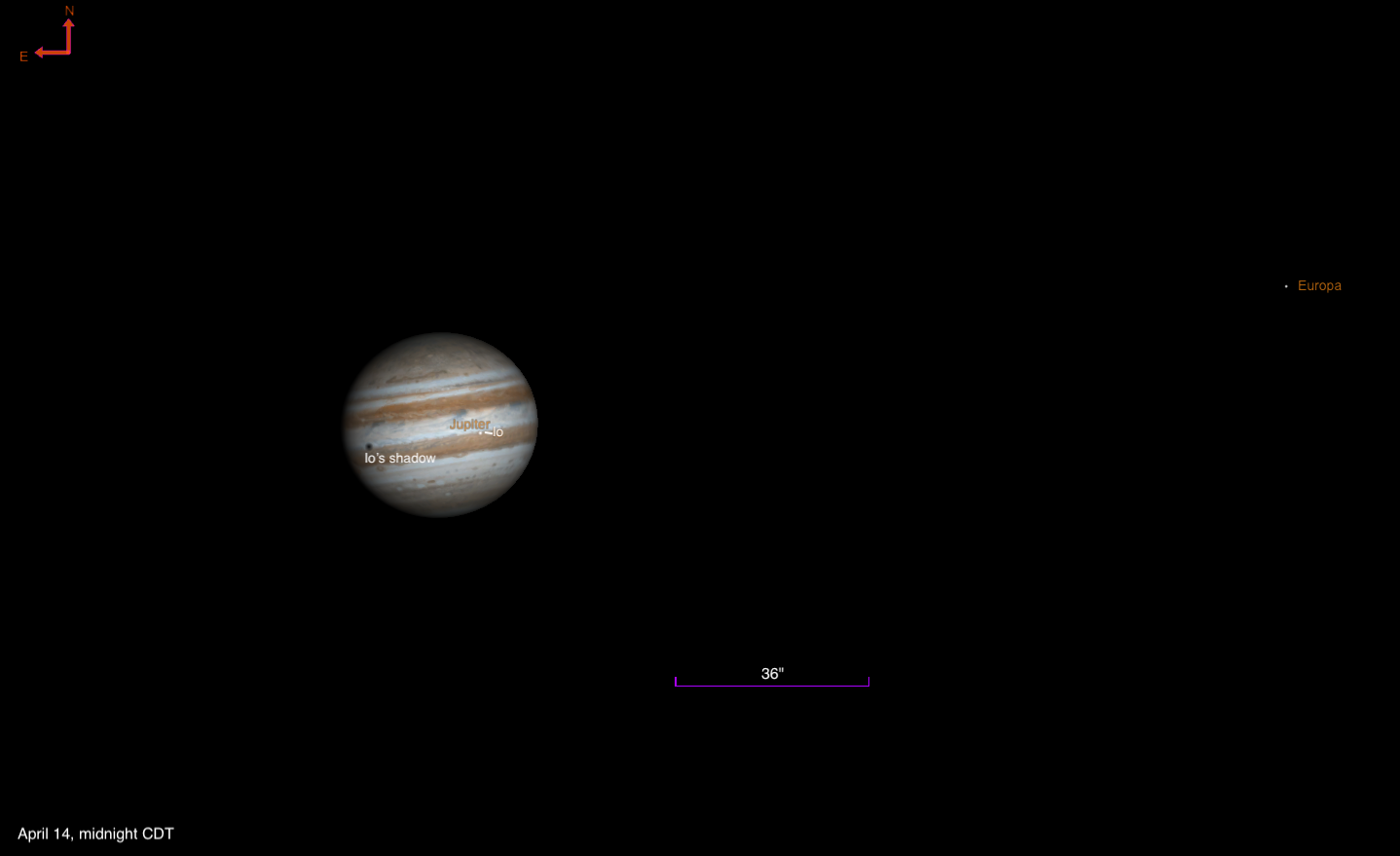
Io crosses the disk of Jupiter with its shadow overnight on April 14/15. Ganymede and Callisto lie to the east, outside this field of view. Credit: Alison Klesman (via TheSkyX)
Tuesday, April 14
We’re back at Jupiter tonight, now that Io has passed behind the planet and come back around in its tight, 1.77-day orbit to follow in Europa’s footsteps, transiting the disk this evening along with its shadow.
Look again toward Gemini in the western sky after sunset to locate Jupiter — the brightest point of light — with a telescope. The planet hangs beneath the constellation’s alpha and beta stars, Castor and Pollux. Prior to the transit, Europa is alone to the planet’s west, with Io, Ganymede and Callisto east of the giant world, in that order from closest to farthest.
Io’s transit begins at 11:25 P.M. EDT. It’s just over halfway across the disk, closer to the western limb than the eastern one, when its shadow appears at the eastern limb shortly after 12:40 A.M. EDT (now early on the 15th in the Eastern time zone). The two travel together for another hour, until Io’s transit finally ends. After that, both Io (closer) and Europa are west of Jupiter, again moving toward each other (although their paths won’t cross this time until after the planet has set across the U.S.). Io’s shadow continues its transit, finally ending at 1 A.M. MDT on the 15th, after Jupiter has set for the eastern half of the country.
Sunrise: 6:23 A.M.
Sunset: 7:38 P.M.
Moonrise: 4:50 A.M.
Moonset: 4:41 P.M.
Moon Phase: Waning crescent (8%)
Wednesday, April 15
The Moon passes 5° north of Mercury at 3 P.M. EDT. Although the pair rises only shortly before the Sun, the Moon’s visibility and Mercury’s brightness may allow you to spot them.
You’ll only have a short window to do so, however, as the Moon rises roughly an hour before the Sun and Mercury just 40 minutes ahead of sunrise. Try about 30 minutes before sunrise, when the delicate, 6-percent-lit Moon hangs just 6° above the horizon. You may spot earthshine on its darkened portion, as sunlight bounces off Earth to light up this region, already experiencing lunar night.
Mercury is much closer to the horizon, only 2.5° high in the east at this time. It hangs some 4° below the Moon, shining at magnitude 0.0. You should be able to easily spot it through binoculars; with a telescope, you may discern that its 6”-wide disk is some 66 percent illuminated.
Although Mars and Neptune — which the Moon will pass later today — are also above the horizon, they are difficult to view in the bright twilit sky. You should try to catch magnitude 1.2 Mars located 4.2° to the left of Mercury in binoculars or a telescope, but it may be challenging. Much fainter Neptune will not really be visible.
The Moon later passes 4° north of Neptune at 5 P.M. EDT and 4° north of Mars at 9 P.M. EDT.
Sunrise: 6:22 A.M.
Sunset: 7:39 P.M.
Moonrise: 5:13 A.M.
Moonset: 5:52 P.M.
Moon Phase: Waning crescent (3%)
Thursday, April 16
The Moon passes 5° north of Saturn at 2 A.M. EDT, while Mercury passes 1.4° south of Neptune at noon EDT.
Our attention is back on Jupiter in the west this evening, though, as Ganymede finally reaches the planet’s eastern limb and begins a transit overnight. First, though, Io is completing another transit as darkness falls across the East Coast, slipping away from the western limb shortly after 8:10 P.M. EDT. Its shadow is still transiting the disk, visible as the sky above the Midwest starts to darken. Io’s shadow leaves the disk just before 9:30 P.M. EDT, and now your attention can turn east of Jupiter, where Ganymede is approaching the limb.
The large moon finally starts a transit at 12:53 A.M. EDT (now the 17th in the Eastern time zone, but late on the 16th for the rest of the U.S.). It takes more than three hours to make the trip; only Pacific Coast observers will see the transit end, around 1:10 A.M. PDT on the 17th. However, even those observers won’t see the shadow transit, as it begins after the planet sets for the contiguous U.S.
Sunrise: 6:20 A.M.
Sunset: 7:40 P.M.
Moonrise: 5:38 A.M.
Moonset: 7:07 P.M.
Moon Phase: New
Friday, April 17
New Moon occurs at 7:52 A.M. EDT, leaving the sky pristine all night and setting the stage for a possible sighting of the zodiacal light after dark.
This ethereal glow is generated by sunlight scattering off dust that’s settled along the plane of the solar system. That dust is left by comets as they travel through the inner solar system, where they are heated by the Sun and spew gases and small grains from their nuclei in the process. Over time, the dust settles into orbits along the ecliptic, creating a cone-shaped glow in our nighttime sky. During the spring, this glow can be viewed after dark in the west.
At this time of year, the ecliptic rises upward toward the left when you look at the western horizon. It slices up through Taurus and into Gemini above it, then on into Cancer. After the glow of twilight has faded, look for lingering light in this region of the sky, with a wider base and pointed tip ending in Gemini or Cancer. This is the zodiacal light.
Even if you can’t view it by eye, try taking a long-exposure photo with a camera or even your phone. The glow may pop out then!
Sunrise: 6:19 A.M.
Sunset: 7:41 P.M.
Moonrise: 6:04 A.M.
Moonset: 8:24 P.M.
Moon Phase: Waxing crescent (1%)