
APOD: March 25, 1996 – Comet Hyakutake Passes the Earth
Discover the cosmos!
Each day a different image or photograph of our fascinating universe is
featured, along with a brief explanation written by a professional
astronomer.
March 25, 1996
Comet Hyakutake Passes the Earth
Credit and Copyright:
Peter McCullough
(U. Illinois Urbana-Champaign)
McCollough’s
MPEG
Movie of Comet Hyakutake taken March 23
Explanation:
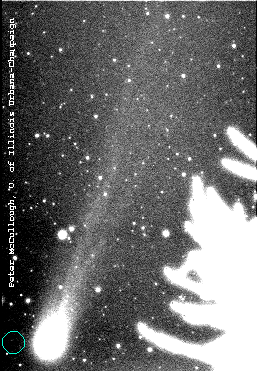
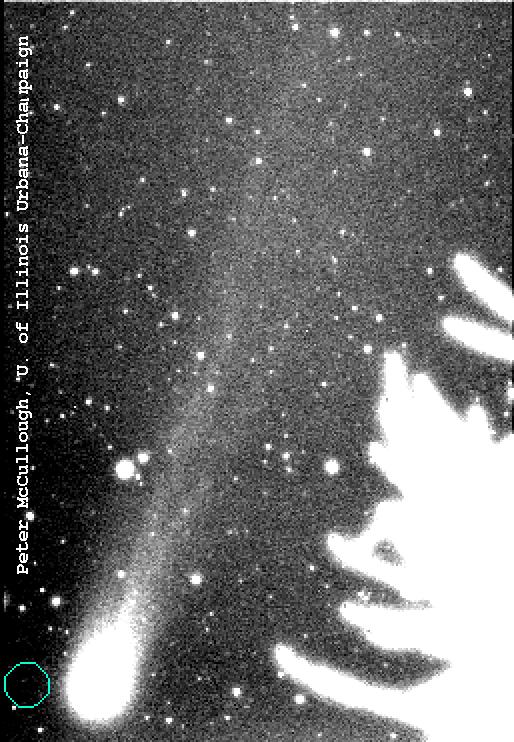
This picture
of Comet Hyakutake taken the night of March 21/22 in Illinois,
USA shows the enormous tail that has already developed. The silhouette on
the right is a foreground tree, and the superposed green circle on the left
shows the size of the full moon. Today
Comet Hyakutake
makes its closest approach to the
Earth. As the comet moves into the inner
Solar System, it will pass the
Earth at about 40
times the distance of our
Moon.
This
is not the closest a comet has
ever come, though. As recently as 1983
Comet
IRAS-Araki-Alcock
came three times closer than Hyakutake, and in 1770 Comet Lexell got yet
twice closer than that!
Asteroids – usually less massive than
comets –
frequently whiz by inside the
Moon‘s orbit, with
four
doing so far in this decade. In the distant past,
asteroids have even
struck the Earth.
Comet Hyakutake
is much brighter now than Comet IRAS-Araki-Alcock ever got, and in fact is
the brightest since Comet West in 1976.
Comet Hyakutake will be easily visible all
week.
Latest Comet Hyakutake images:
JPL,
Crni Vrh Observatory,
Slovenia,
Fayetteville
Observer-Times,
NASA’s Night of
the Comet
Tomorrow’s picture: What are Comet Tails Made Of?
Comet Hyakutake Finder Chart
| Archive
| Index
| Search
| Glossary
| Education
| About APOD |



Authors & editors:
Robert Nemiroff
(GMU) &
Jerry
Bonnell (USRA).
NASA Technical Rep.:
Sherri
Calvo.
Specific rights apply.
A service of:
LHEA
at
NASA/
GSFC