
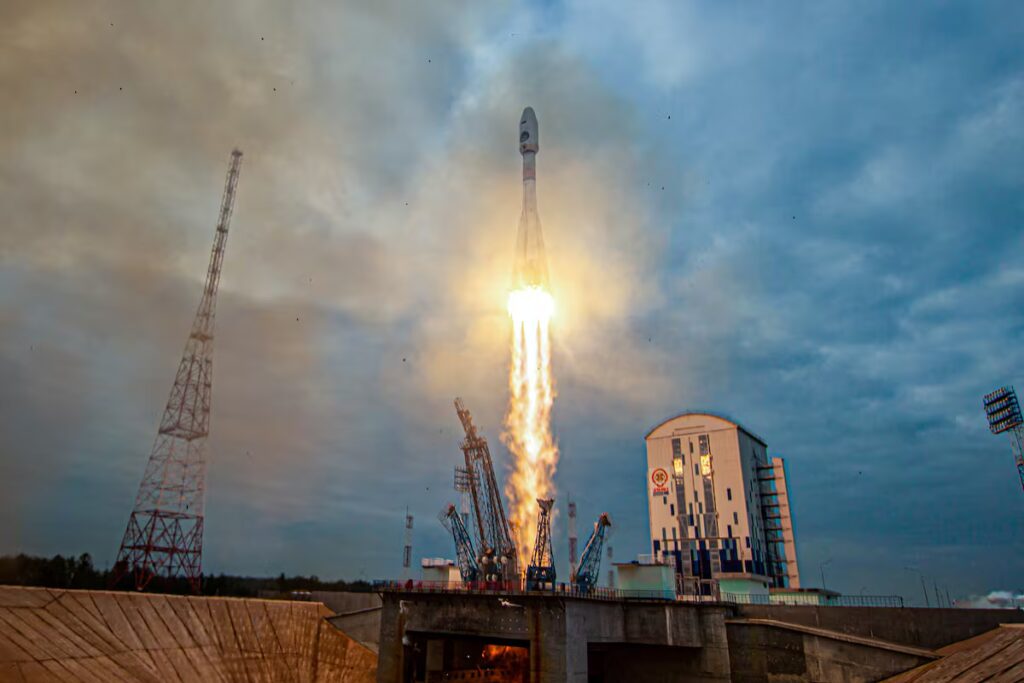
Russia is falling behind in the space race. Its space agency, Roscosmos, has once again postponed all its launches to the Moon, this time discreetly acknowledging the delay. The announcement was made by Sergei Chernyshev, vice president of the Russian Academy of Sciences, during a meeting of its presidium, while the world marvels at the photos taken by the crew of the Artemis 2 mission from the far side of the Moon. Russia is thus postponing the launch of a robotic probe to the Moon from 2027 to 2028. That same year, NASA plans to send astronauts to the Moon for the first time in the 21st century with the Artemis 4 and Artemis 5 missions, potentially securing the first victory in the new space race led by the U.S. and China.
The Russian space program aimed to compete in that race, landing its Luna-25 probe on the lunar surface in 2023. That launch was to be its first mission to the Moon in over half a century. The Soviet Union no longer existed; only the Russian Federation remained, and other powers like China and India had joined the space race. That probe was intended to be the first in history to land on the Moon’s south pole and observe its water reserves, but it crashed during its landing attempt.
Beset by budget problems, exacerbated by Russia’s invasion of Ukraine and its break with the European Space Agency (ESA), Roscosmos has once again postponed missions in a two-phase plan. The first phase involves analyzing technologies and landing sites for Russian spacecraft. The second focuses on developing lunar bases to “conquer new horizons,” according to the Russian agency.
“This program will help Russia maintain its position among the leading space powers exploring the Moon, provide it with new knowledge and technologies for lunar exploration, and ultimately enable the establishment of sovereign Russian territories on its surface,” Chernyshev said.
In the original plan, the Luna-26 and Luna-27 probes were scheduled to launch in 2023 and 2024, respectively. After several delays, the launch of the Luna-26 probe — intended to orbit the lunar poles — has now been postponed from 2027 to 2028; and in the following two years, when the U.S. and China are expected to send astronauts to the Moon, Russia should attempt to land the Luna-27a and Luna-27b rovers there.
Restoring the USSR’s space capabilities
In December 2023, Yuri Borisov, then director of Roscosmos, announced that Luna-28 was scheduled to launch in 2030 to collect soil samples from the Moon. According to Chernyshev, its new target date is now 2036.
A few months ago, in October 2025, the director of the Space Research Institute of the Russian Academy of Sciences, Anatoly Petrukovich, estimated that Luna-28 would launch in 2034. Interestingly, Luna-29 would launch two years earlier, in 2032, with the aim of drilling into the satellite, and Luna-30 would land in 2036 with a heavy exploration vehicle on board.
The Russian space program has a total budget of approximately 4.4 trillion rubles, or about $58 billion, through 2036. Of this amount, some 700 billion rubles, (around $8.75 billion), is allocated to the lunar program. NASA’s Artemis 2 mission alone cost around $4 billion dollars.
The standstill caused by the collapse of the Soviet Union, and the Kremlin’s new priorities, still weigh heavily on the Russian space agency today. “We’ve forgotten how to land on the Moon,” lamented former cosmonaut and academic Mikhail Marov in 2021. “In the 1970s we did it repeatedly, but now we’ve lost everything that made our achievements possible.”
Rival successes
While Russia postpones its space projects, its rivals continue to widen their lead. In 2023, India successfully landed its Chandrayaan-3 probe on the Moon, becoming the first country to reach the lunar south pole; NASA has sent four astronauts to orbit the Moon and observe its far side in preparation for its 2028 landing attempts; and China hopes to set foot on the Moon before 2030.
Furthermore, competition is also fierce among private space companies. Russia launched the first 16 satellites of its Bureau 1440 telecommunications network in March of this year, the Kremlin’s purported alternative to Elon Musk’s Starlink. According to its plans, Russia should have 730 satellites by 2030. However, Starlink already has more than 10,000 satellites in orbit.
This network is crucial on the Ukrainian front, where drones can circumvent the cyberwar between the two countries by receiving internet access from the satellites. When Musk cut off Starlink to its troops earlier this year, the Russian military was shaken.
Sign up for our weekly newsletter to get more English-language news coverage from EL PAÍS USA Edition