
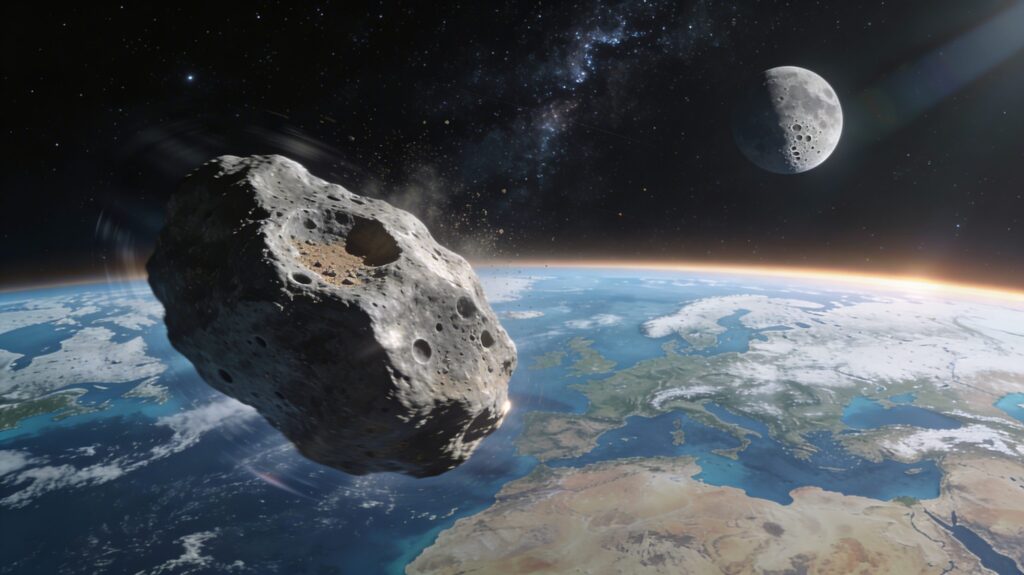
A newly discovered asteroid roughly the size of a house will make a close but safe pass by Earth tonight, 9 April 2026. The object — officially designated 2026 GD — will fly by at 6:59 p.m. EDT (22:59 GMT), coming within 155,760 miles (250,000 km) of our planet – that’s just 0.65 times the distance to the Moon.
Despite the headlines, scientists emphasize there’s no threat to Earth or the Moon. The asteroid’s trajectory is well‑known, and it’s been added to the European Space Agency’s Risk List purely for tracking purposes, not because it poses any real danger.
What We Know About Asteroid 2026 GDDiscovered: 6 April 2026 – just three days before its close approach.Size: About 16 meters (54 feet) wide – comparable to a two‑story house.Speed: Traveling around 28,030 miles/hour (45,109 km/hour) relative to Earth.Closest approach to Earth: 6:59 p.m. EDT (22:59 GMT) at a distance of 250,000 km.Closest approach to the Moon: 8:12 p.m. EDT (00:12 GMT on April 10), about 163,750 km away.
Although small compared to kilometer‑scale “planet‑killer” asteroids, an object like 2026 GD would still cause significant local damage if it entered our atmosphere — similar to the Chelyabinsk meteor in 2013, which injured over 1,000 people when it exploded over Russia. Fortunately, this one will not enter Earth’s atmosphere.
Why the Close Flyby Matters
Even harmless encounters like this are valuable scientific opportunities. Astronomers use such close passes to:
Refine asteroid orbit calculations and improve future impact prediction models.Test tracking systems run by NASA’s Center for Near‑Earth Object Studies (CNEOS) and ESA’s NEO Coordination Centre.Practice global communication and early‑warning workflows for future, riskier flybys.
Each new detection, especially one found only days before approach, underscores the importance of planetary defense programs like NASA’s DART mission and ESA’s upcoming Hera spacecraft, which study ways to deflect hazardous asteroids.
Can You See Asteroid 2026 GD Tonight?
Unfortunately, no — 2026 GD is too faint for amateur telescopes. At only 16 meters in diameter, it reflects very little sunlight. However, professional observatories in the Southern Hemisphere may capture it briefly as it speeds past. You can watch for updates or telescope imagery on NASA’s Near‑Earth Object page and ESA’s Space Safety blog later tonight.