
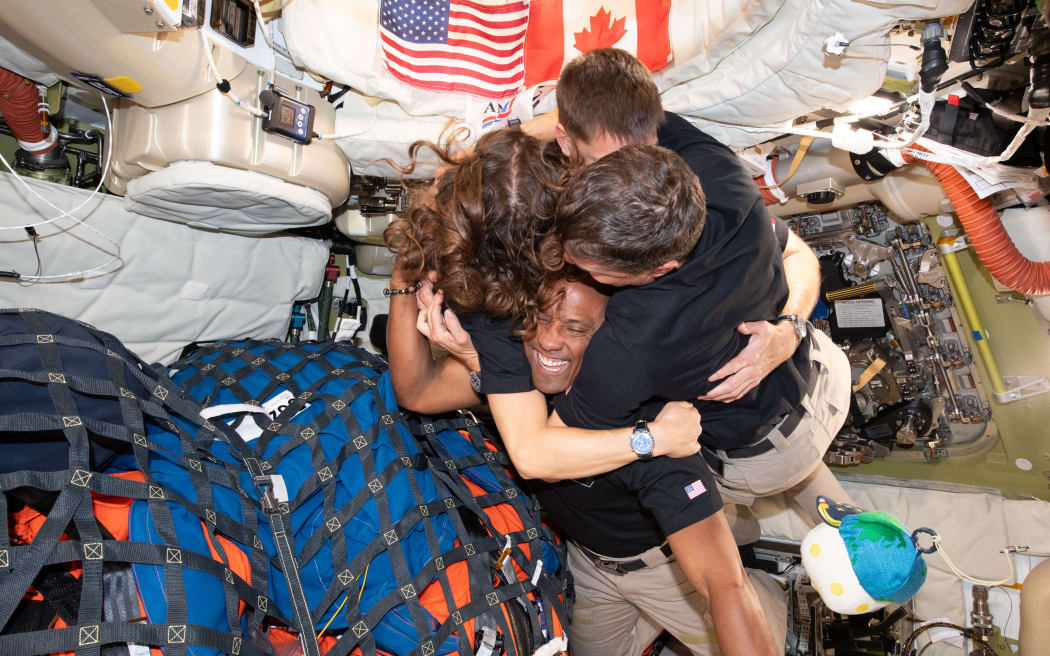
This handout picture by NASA shows Artemis II crew members Mission Specialist Christina Koch (L), Mission Specialist Jeremy Hansen (top), Commander Reid Wiseman (R), and Pilot Victor Glover (bottom) hugging inside the Orion spacecraft.
Photo: AFP/ HANDOUT – NASA
Space scientists expect a ‘permanent presence’ on the moon by 2028, and say now is the time to lay the groundwork for international rules for lasting peace in space
As the Artemis II crew close in on Earth after their historic lunar flyby took them further into space than any human before them, experts see the mission to the moon as only the beginning of the quest to make a life for humans in space.
“I feel like we are at the cusp of space becoming more accessible,” says Dr Morgan Cable, a NASA scientist teaching at Victoria University.
“I just can’t wait to see what’s going to happen when we have these international groups of people be able to sustain a community on the moon and ultimately on a place like Mars. I can see that in our lifetime now, and that is such an incredible thing.”
The first crewed return to the moon in more than 50 years comes to an end with splashdown tomorrow (Saturday NZ time) in the North Pacific, and attention is now on establishing a permanent lunar presence by 2028, the first step to sending people to Mars.
Rules of behavior need revamp
But as space exploration accelerates there are calls for urgent focus on updating the rules of behaviour.
“We need something now because these space exploration activities are happening now,” says deputy head of the New Zealand Space Agency Andrew Johnson.
Lunar activity has stepped up in recent years, according to University of Tasmania senior space researcher Dr Guifrè Molera Calvés.
“In 2026 alone, at least six missions are planned to carry a wide range of payloads and satellites for science, communications, and resource prospecting,” he tells Australia’s SBS News.
He says extracting oxygen and water from lunar resources are no longer distant ambitions but active experiments that could “transform how we sustain life beyond Earth”.
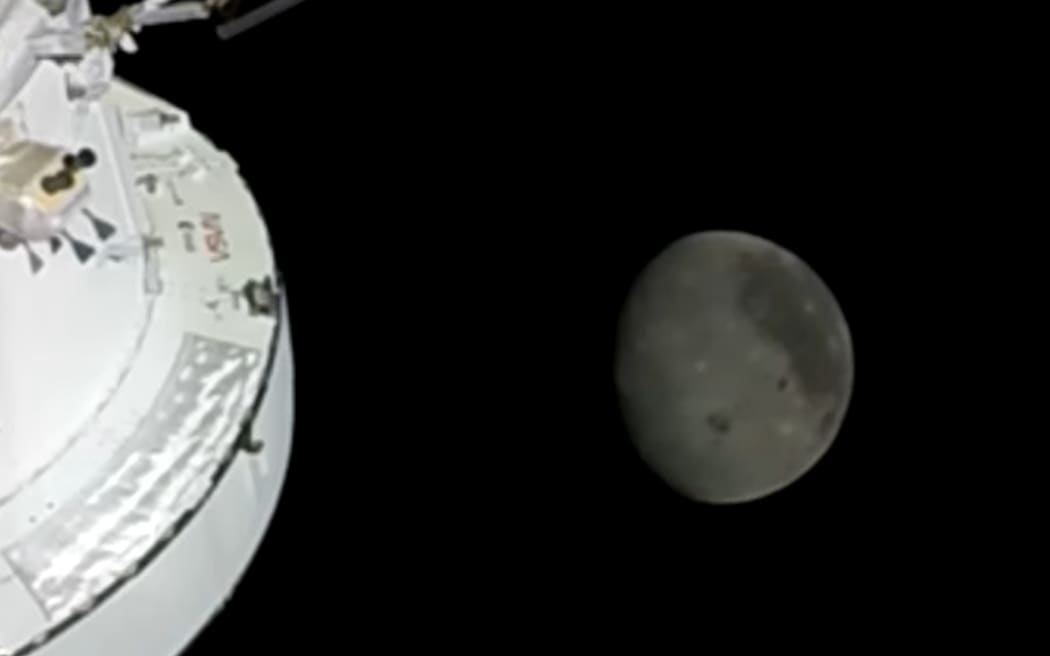
Artemis 2 approaches the moon.
Photo: NASA / SCREENSHOT
It’s these activities that need clear boundaries, Johnson says, pointing out that New Zealand has an important role to play as it is a major player already in space and is eyeing up future missions to the moon.
“People always focus on astronauts but I guess the thing that we like to draw people’s attention to is New Zealand’s impact on space overall,” he says.
“The Capstone Rocket Lab which launched from Mahia in 2022 was actually the pathfinder mission for this whole Artemis enterprise. That was the satellite launch to the moon.
“And we’ve got New Zealand experiments that have visited the International Space Station, we’ve got New Zealand technology in many satellites on orbit and we’ve got many New Zealanders working in the space sector here on Earth.”
The projects are all examples of peaceful collaboration in space, he says, but more needs to be done to ensure lasting peace.
New Zealand is signatory to the Outer Space Treaty which prohibits national appropriation of the moon, meaning no country can make a territorial claim over it.
It is also part of international discussions about transparency, co-ordination and deconfliction, including work through the UN Committee on Peaceful Uses Of Outer Space.
“But really this is a forum that dates back to the Cold War era which is a very, very different context. And the major treaties that are under that architecture were all agreed in the 1960s and didn’t really have a concept of what the activities we’re involved in today would look like.
“So while we continue to build on that multi-lateral framework, New Zealand has also been an active participant in the Artemis Accords which is an attempt to start building the ground for rules of behaviour for space exploration activity that we hope will eventually dock back in with the multi-lateral process.”
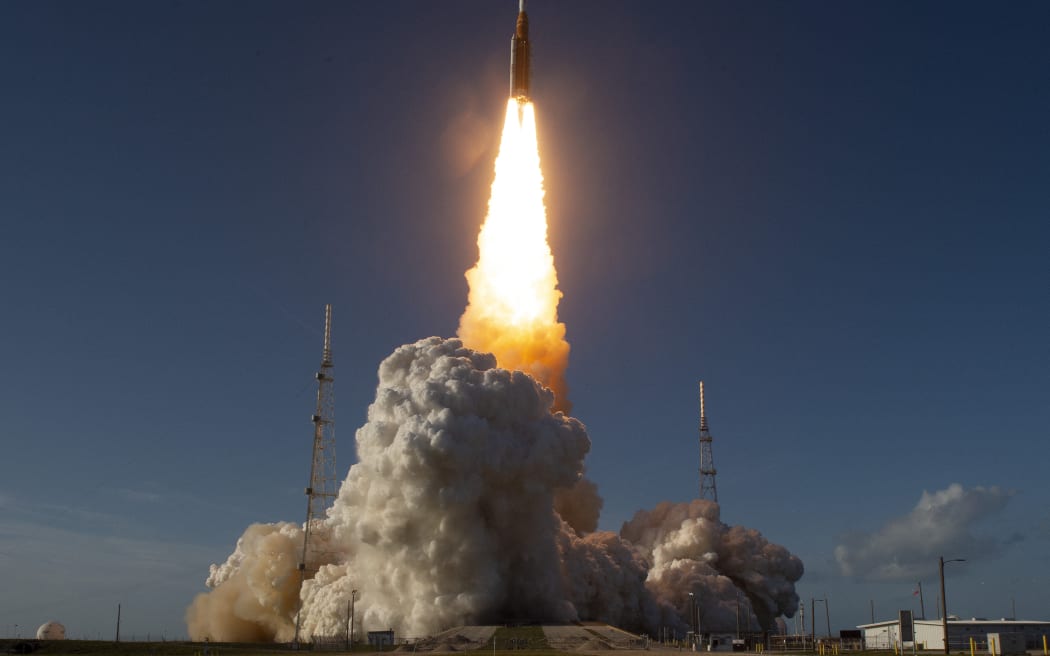
The Artemis II crewed lunar mission lifts off from Pad 39B at Kennedy Space Centre in Cape Canaveral, Florida.
Photo: JIM WATSON / AFP
Johnson stressed to The Detail that in order to maintain a peaceful environment in outer space including the moon’s surface, the ground rules need to be clear on how different countries interact with each other.
Space lawyer and teacher at Bond University Gregory Radisic agrees that legal and governance systems for space are lagging behind the technology.
“There’s a real risk that the early actors, the countries or the companies that operate in space, those first ones that land on the moon, will really shape the rules, simply because they’re first, which can obviously lead to a lot of conflict, unfair access to resources [and] environmental damage.”
Radisic says despite the conflict on Earth he remains optimistic that peace and international collaborations can be maintained in space.
He points to the crewed US and Russian space missions during the Cold War era and the famous handshake between an American astronaut and a Russian cosmonaut.
“Space has always acted as almost this very unique example of human cooperation,” Radisic says.
“Living on the moon long term will be largely associated with questions of survival and when those existential rules come in place I think what happens is people tend to put aside grievances on Earth and focus on working together to try to help each other survive and succeed,” he says.
Check out how to listen to and follow The Detail here.
You can also stay up-to-date by liking us on Facebook or following us on Twitter.
Sign up for Ngā Pitopito Kōrero, a daily newsletter curated by our editors and delivered straight to your inbox every weekday.